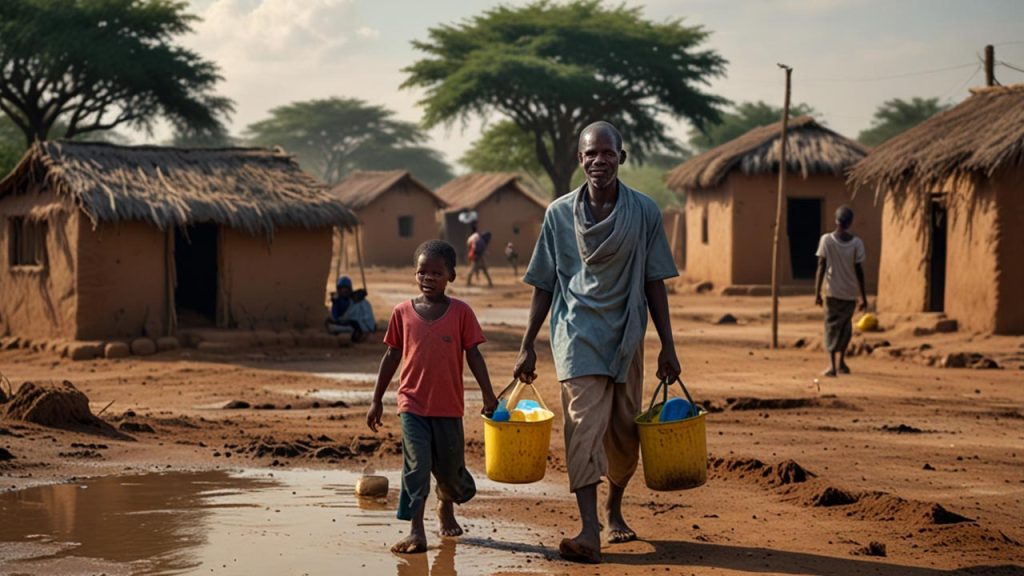
If you live in Africa and have ever tried to pay for a Netflix subscription, chances are you’ve hit a wall.
Many global platforms like Netflix, Amazon, YouTube Premium, Google Ads, to name a few simply won’t accept African-issued debit or credit cards. Whether it’s a streaming subscription, ad spend for your business, or software for freelance work, access is often cut off by payment friction. The solution? Virtual USD cards.
Many African bank cards are region-locked or come with restrictions. Some don’t support foreign currency transactions, while others are blocked by merchants using MCC (Merchant Category Code) filters such as “Digital Goods” or “Advertising Services.” If you’re based outside the US or Europe, this could mean losing access not just to entertainment, but to tools critical for earning a living online.
Enter virtual dollar cards — fintech-powered alternatives to traditional banking that let users pay in USD without needing a foreign bank account. These cards are typically issued by startups, not banks, and are designed to be instantly accessible and globally compatible.
In this guide, we explore three standout platforms Spend.net, Chipper Cash, and Geegpay, and what you need to check before signing up.
Four things to check before choosing a virtual USD card
1. Licensing and regulation
Always look for platforms that are registered in jurisdictions with robust financial oversight—think the UK, US, or Lithuania. Regulation means more transparency and accountability, reducing the risk of sudden service shutdowns or frozen funds.
2. Payment network integration
Not all “virtual” cards are created equal. Some lack proper international BINs (Bank Identification Numbers) and fail verification on platforms like Google or Amazon. Make sure the provider issues genuine Visa or Mastercard cards with full merchant compatibility.
3. Funding options
Top-up options matter. The best platforms let you fund your account in dollars via crypto (like USDT), SEPA transfers, SWIFT, or even local currency—at transparent and reasonable exchange rates.
4. Fees and limits
Some services charge 1–3% per transaction or impose hefty fees for card issuance. Others make it difficult or impossible to withdraw your funds. Always read the fine print before creating a card.
Top three platforms for virtual dollar cards
Spend.net
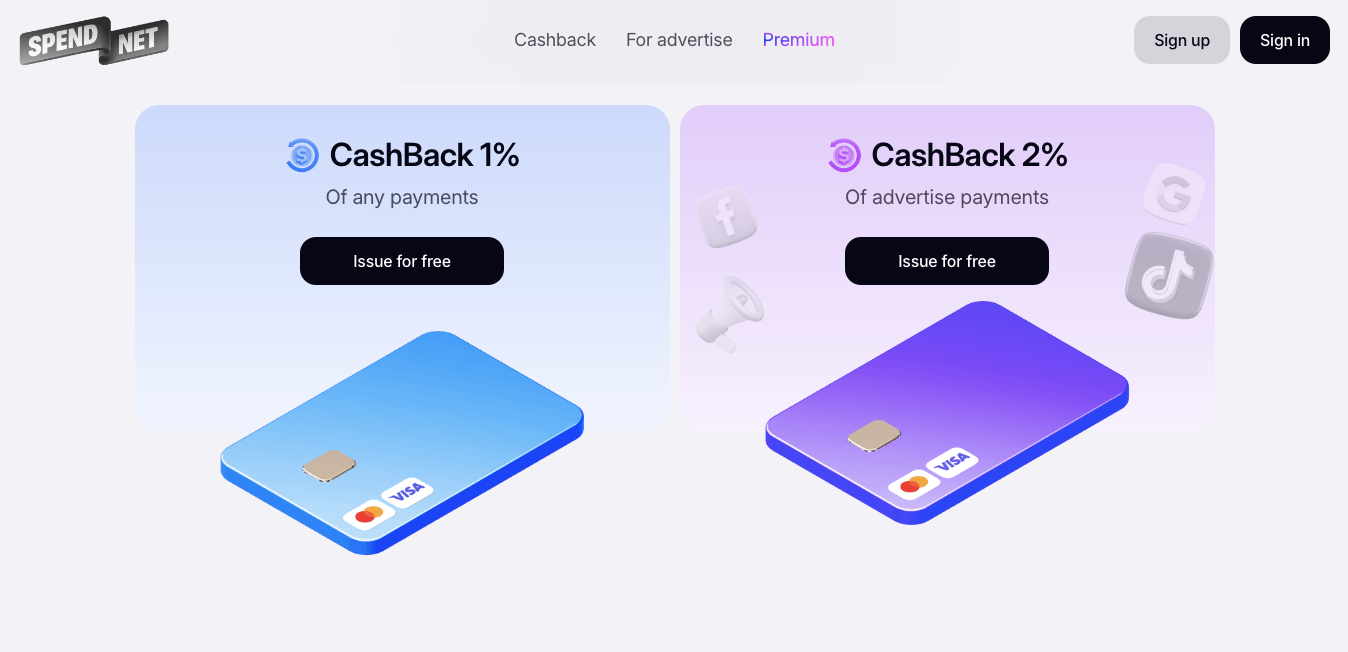
Spend.net is a global fintech platform offering virtual Visa and Mastercard cards with built-in 1% cashback on all online purchases. Whether you’re paying for Netflix, running Facebook ads, or buying SaaS tools, Spend.net is built for uninterrupted access to international digital services.
What sets it apart? Cashback is automatic – no activation, no hoops to jump through, and applies to everything from subscriptions to e-commerce purchases. Users can also tweak the top-up fee when adding funds, giving them more control over transaction costs. On average, fees sit at around 2%, but this can be adjusted based on the needs of each payment.
All cards come with 3D Secure by default, which helps prevent fraud and unauthorised charges. That’s especially important when dealing with sensitive platforms like ad networks or subscription services.
Key features:
Security: 3D Secure enabled
Funding: Supports USDT, BTC
Easy onboarding: Google sign-in or email registration
Customer support: 24/7 live chat in the user dashboard
Chipper Cash
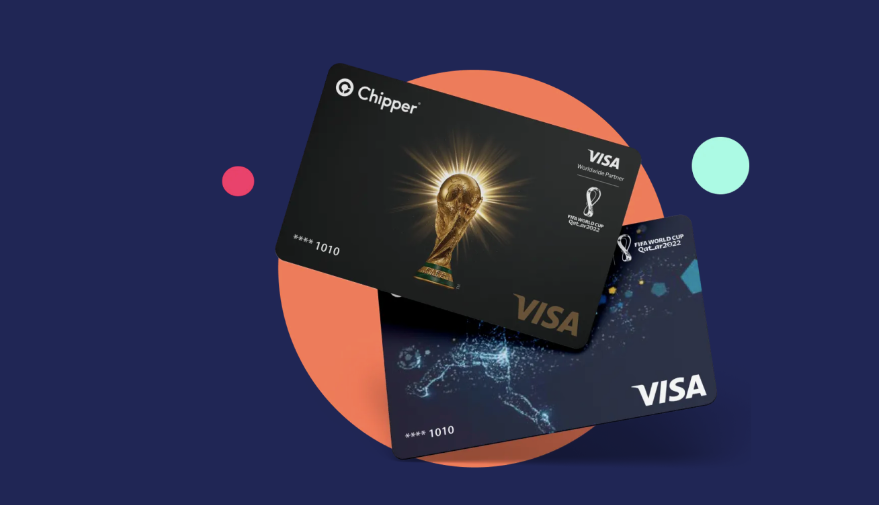
Operating across 21 African countries, Chipper Cash offers a virtual Visa card specifically tailored for the region. It’s especially popular in Nigeria, where users can hold balances in both Naira and USD.
The card enables seamless payments on global platforms—from streaming sites to cloud software. Thanks to its multi-currency wallet, users can top up in local currency and spend in dollars, avoiding unnecessary conversion fees or the need for a foreign bank account.
Top-ups are done via the internal Chipper wallet and transferred instantly to the card—no delays, no added charges. This is a huge plus when timing is critical, such as funding ad campaigns or maintaining active subscriptions.
Key features:
Security: Identity verification, 2FA
Funding: Internal wallet, instant transfer with zero fees
Registration: Via mobile app, document verification required
Support: Help centre, phone and email support
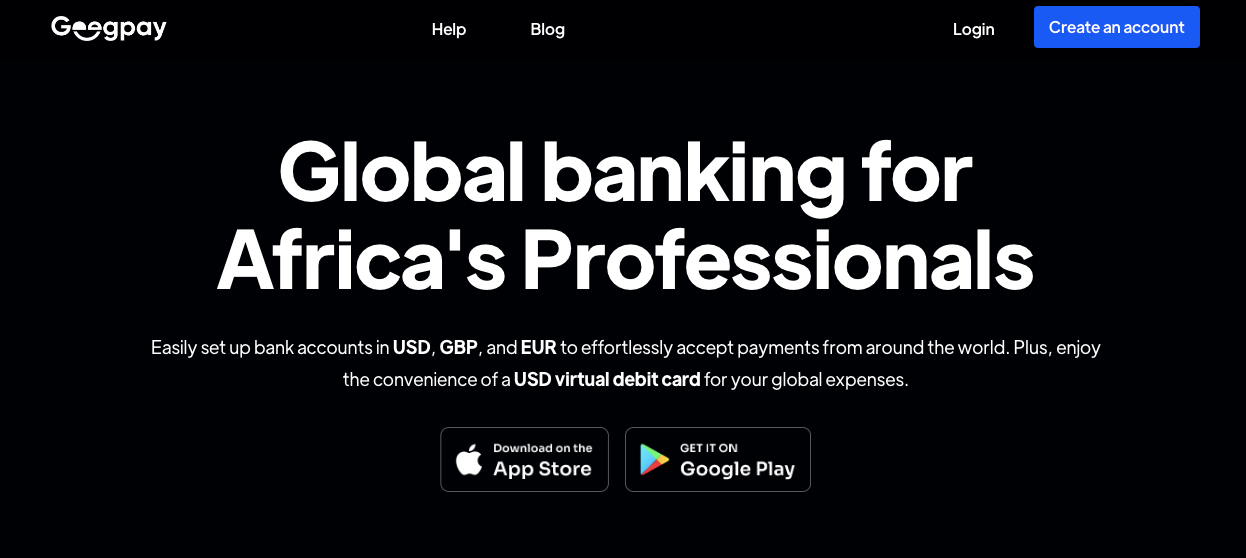
Geegpay
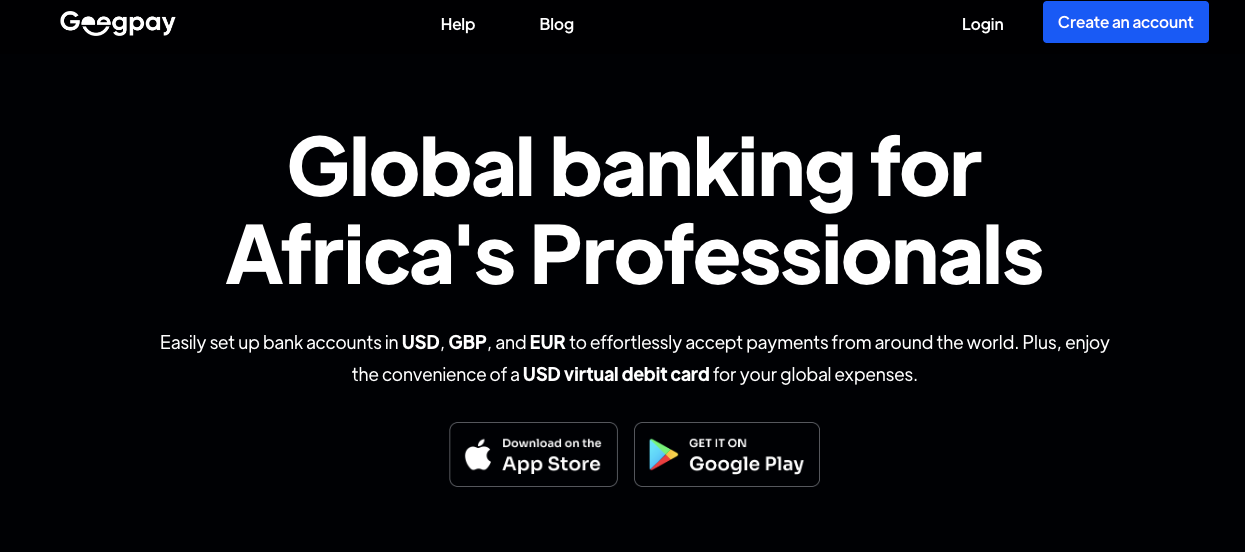
Initially built for African freelancers paid in USD, Geegpay has grown into a full-fledged virtual card provider supporting all types of digital transactions. The platform offers Visa debit cards tied to a multi-currency wallet that supports both USD and Naira.
With built-in FX tools, Geegpay allows users to manage currency conversions and transfers in real time. It’s ideal for anyone juggling USD expenses and income in local currency.
The platform also supports p2p transfers, letting users send money to each other, convert currencies, and top up cards—all from within the Geegpay ecosystem. These internal processes are fast and carry low fees, bypassing the need for third-party banks or exchanges.
Key features:
Security: ID verification with selfie confirmation
Funding: Multi-currency wallet with internal FX tools
Registration: Through mobile app, card setup under “Cards” section
Support: In-app chat (available after verification)
For many in Africa, virtual USD cards aren’t just a payment tool, they’re a digital lifeline. Whether you’re streaming your favourite show, running a small business, or freelancing for clients abroad, platforms like Spend.net, Chipper Cash, and Geegpay provide vital access to the global economy.
Each provider offers its own strengths:
Spend.net focuses on cashback and flexible fees
Chipper Cash simplifies currency management and removes friction
Geegpay supports remote work with a scalable ecosystem
What unites them is a commitment to inclusion, empowering users with tools to engage with the world, no matter where they’re based. Understanding how these cards work isn’t just about convenience. It’s about enabling digital freedom, unlocking new income streams, and building a more connected financial future.
When you send a text message to your best friend, do you ever think about how it gets from your phone to theirs? The message doesn’t magically appear—it travels through a network, following specific rules. This process is guided by network topologies, which define how devices are arranged and communicate. One of the simplest forms is the point-to-point topology, which acts like a direct bridge between two places, ensuring smooth and private communication.
What Is Point-to-Point Topology?
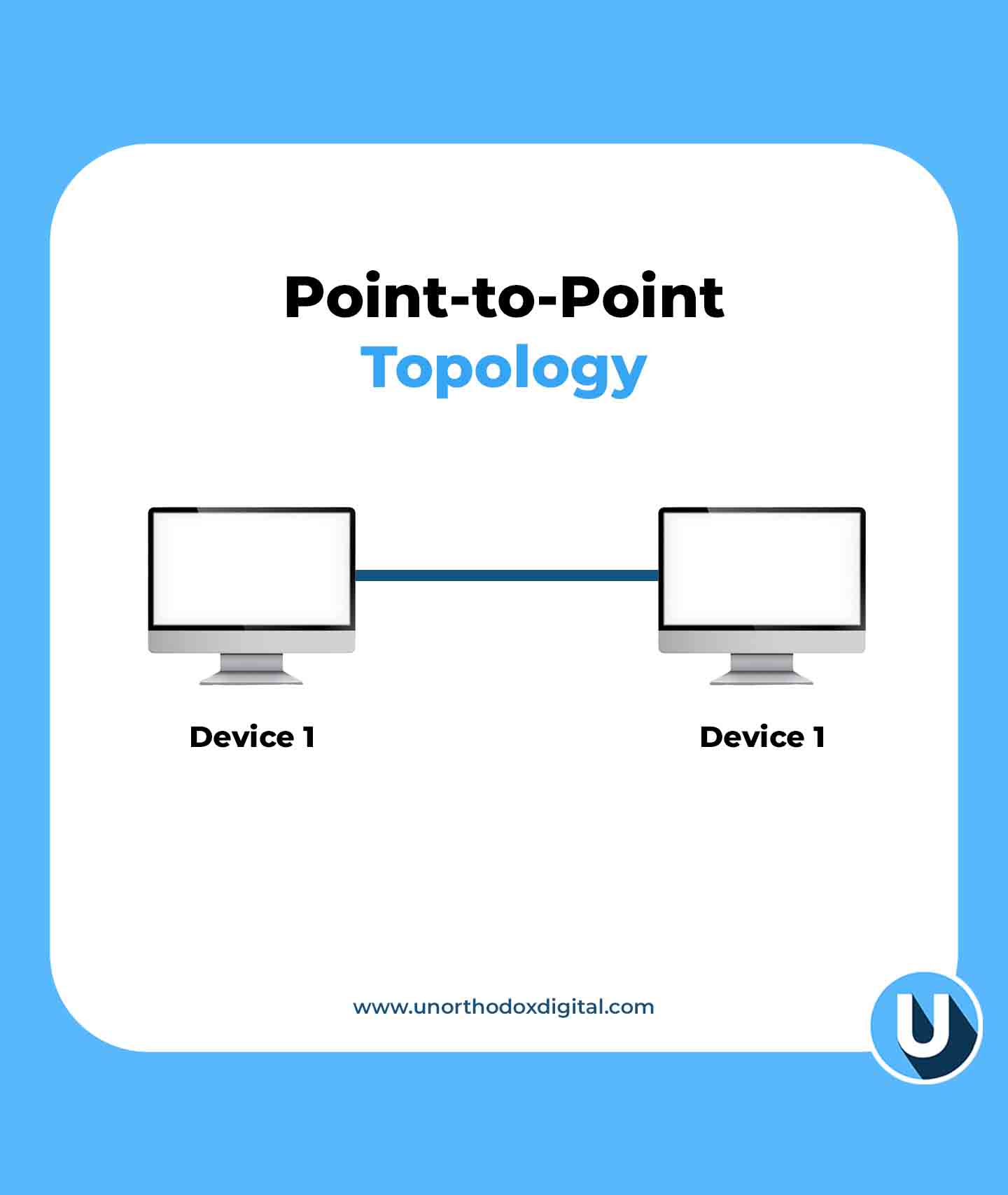
Imagine you have a can-and-string telephone connecting you and a friend. There’s one string, and only you two can talk to each other. No one else can listen in unless they tap into your string. This is a simple example of topologies in networking, where different connection structures determine how devices communicate. The point-to-point topology follows this concept—it’s a direct connection between two devices, with no interference from others.
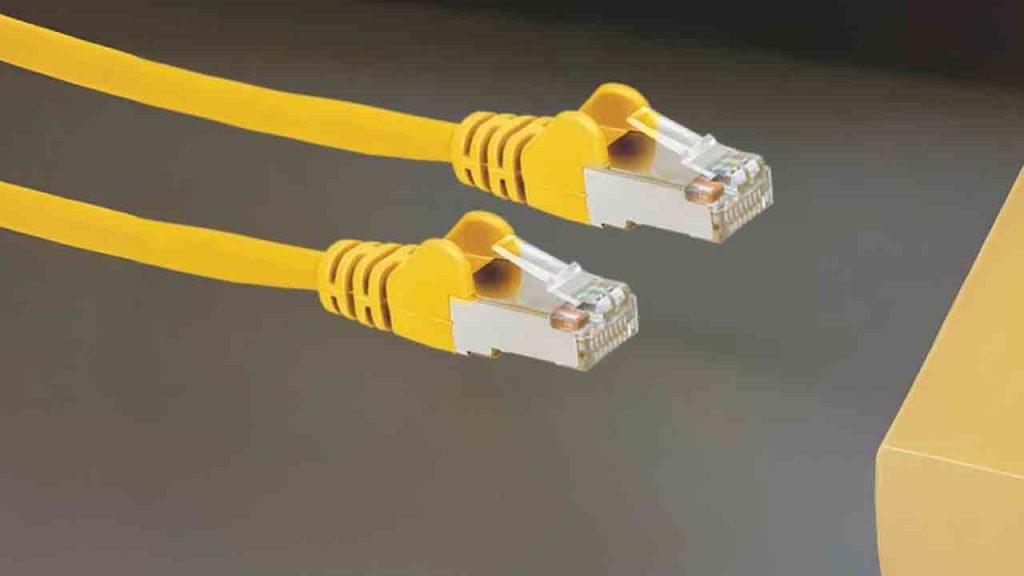
In networking, this means two devices are linked directly, either with a physical cable or through a wireless signal. Information moves back and forth in a dedicated path, making communication fast and reliable.
How Does It Work?
Let’s break it down step by step:
Two devices are connected – This could be two computers, a computer and a printer, or two routers. There’s no third party involved.
Data travels between them – Just like passing a note to a friend sitting next to you, information moves directly from one device to the other.
It’s a private line – Since no other devices share the connection, the data is secure and moves without congestion.
It can be wired or wireless – Devices can be connected using cables (like Ethernet) or wireless signals (like Bluetooth or infrared).
Real-Life Examples
To make things clearer, let’s look at some real-world examples of point-to-point connections:
Example
Description
Telephone call (landline)
When you call someone using an old-fashioned landline, the connection is direct between two phones.
Bluetooth headphone connection
Your phone connects directly to your wireless headphones without involving other devices.
Direct printer connection
Some printers connect to a single computer via USB or a dedicated wireless link.
Two computers with a crossover cable
In older network setups, two computers could be linked directly with an Ethernet crossover cable.
Point-to-Point Topology
Advantages of Point-to-Point Topology
Simple and easy to set up – With just two devices, there’s no complex setup or extra hardware needed.
Fast communication – Since no other devices share the connection, data moves quickly between the two points.
Secure connection – No other devices are involved, reducing the chances of hacking or data leaks.
No network traffic congestion – Unlike bigger networks where many devices share bandwidth, a point-to-point link stays dedicated.
Disadvantages of Point-to-Point Topology
Limited scalability – It only connects two devices. If you need more, you’ll have to create multiple links.
More cables (in wired setups) – If you connect many devices this way, you’ll end up with a lot of wires.
Can be expensive – If every device needs its own dedicated link, the cost of wiring or maintaining connections increases.
Where Is It Used?
Even though larger networks often use more complex topologies, point-to-point connections still have their place. Here are some common areas where this setup is used:
In home networks – If you connect your laptop directly to your modem via an Ethernet cable, that’s a point-to-point link.
Satellite communication – When a satellite links directly to a ground station, it uses a point-to-point connection.
Leased lines for businesses – Companies sometimes pay for dedicated point-to-point connections between offices to ensure reliable communication.
Bridges in networking – Sometimes, two distant parts of a network are linked with a dedicated wireless bridge.
Comparing Point-to-Point With Other Topologies
To see how point-to-point topology stacks up, let’s compare it to other types:
Topology Type
Connection Style
Pros
Cons
Point-to-Point
One-to-one direct
Fast, private, no congestion
Limited to two devices
Star
One central device connects all others
Easy to manage, scalable
If the central device fails, everything stops
Bus
All devices share a single cable
Simple setup, cost-effective
If the main cable fails, the whole network goes down
Mesh
Every device connects to every other device
Highly reliable, no single point of failure
Expensive and complex to set up
Point-to-point topology is one of the simplest and most efficient ways for two devices to communicate. Whether it’s a direct cable link between two computers or a Bluetooth connection between your phone and earbuds, this setup ensures fast, reliable, and private communication. While it’s not the best choice for large networks, it’s still widely used where dedicated connections are needed.
The next time you make a phone call or send a file directly to a friend, take a moment to appreciate the point-to-point connection working behind the scenes. It’s simple, effective, and still an essential part of modern networking.
Network topologies define how devices connect in a network. This guide explains different types, their structures, and how they function.
Imagine you’re setting up a town where all the houses need to be connected with roads. The way you design those roads—whether they all lead to a central square, form a circular route, or crisscross everywhere—determines how easily people can travel and communicate.
Network topology works the same way, but instead of roads and houses, we’re talking about cables and devices in a computer network.
What is Network Topology?
Network topology is how computers and devices (like routers, switches, and servers) are connected in a network. It determines how data travels between them and affects the speed, reliability, and efficiency of communication.
Physical vs. Logical Topology
Physical Topology: This is how devices are physically arranged and connected using cables or wireless signals.
Logical Topology: This describes how data actually moves through the network, regardless of the physical layout.
Now, let’s explore different types of network topology with simple explanations and relatable examples.
1. Point-to-Point Topology
The Point-to-Point Topology is the simplest form of a network—just two devices directly connected to each other.
Example: Imagine two people using walkie-talkies. One talks, the other listens, and they take turns. That’s a point-to-point connection.
Advantages
Disadvantages
Simple setup
Limited to just two devices
Fast communication
No flexibility to add more devices
Point-to-Point Topology
2. Bus Topology
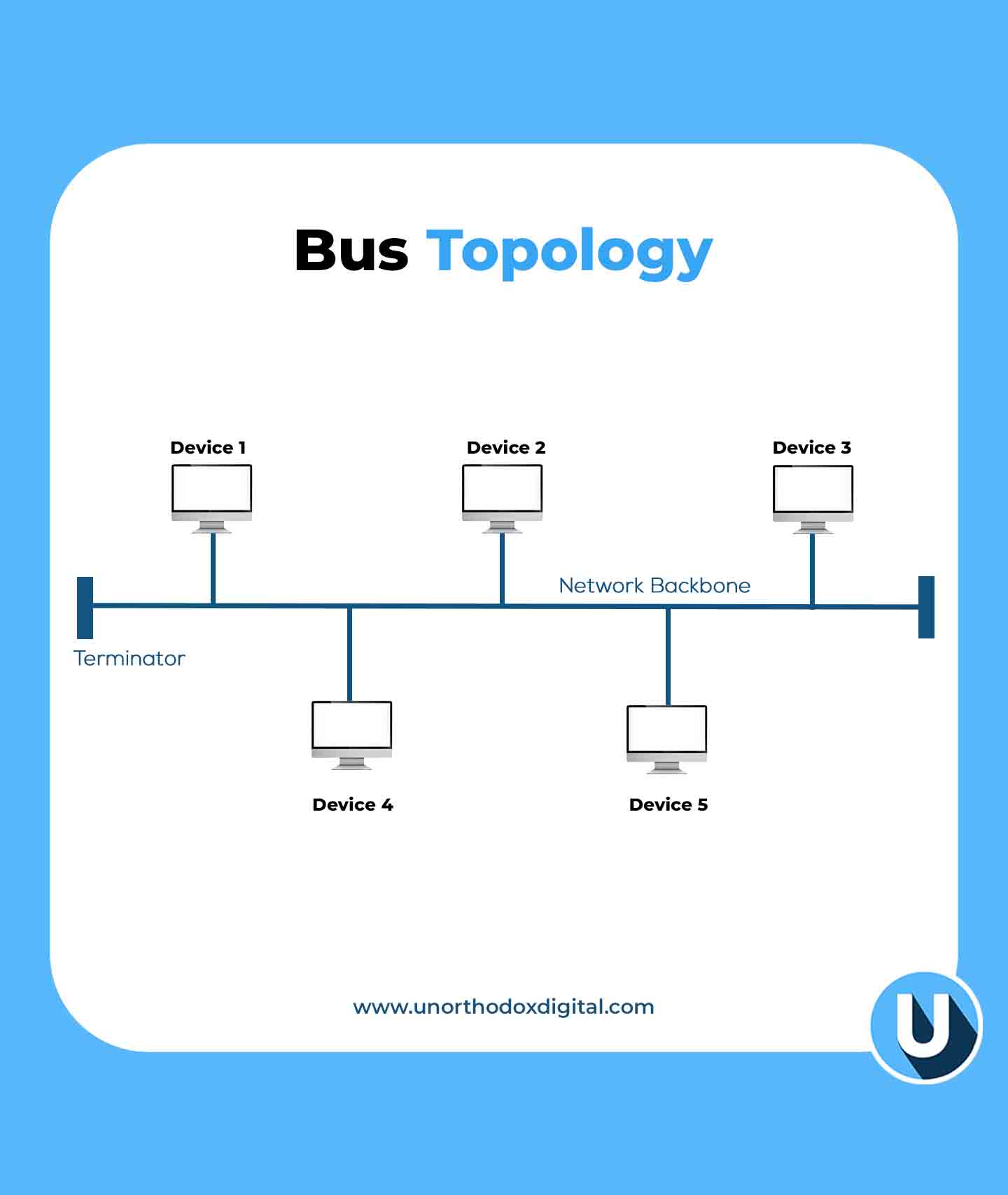
In the Bus Topology, all devices are connected to a single main cable (called a backbone), and data travels in both directions.
Example: Think of a public bus route. If one bus stop (device) has a problem, other stops might be affected.
Advantages
Disadvantages
Cost-effective (less cable needed)
If the main cable fails, the whole network goes down
Easy to expand
Performance slows down with more devices
Bus Topology
3. Star Topology
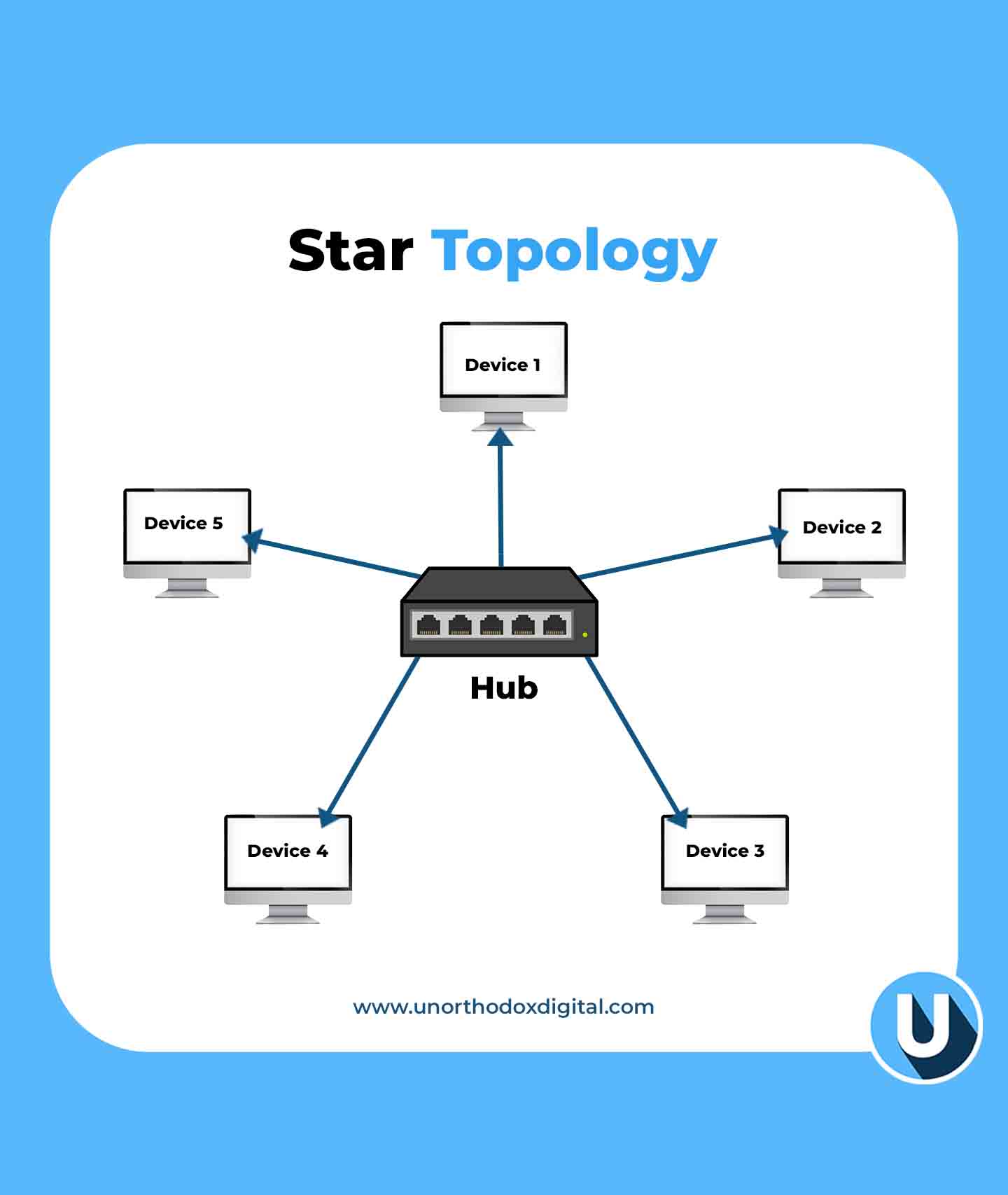
In the Star Topology, all devices connect to a central hub or switch, which acts like a traffic controller for data.
Example: Imagine an airport where all flights must go through a central control tower. If the tower is down, flights can’t take off.
Advantages
Disadvantages
Easy to manage and troubleshoot
If the central hub fails, the whole network stops working
Adding or removing devices is simple
More cabling required
Star Topology
4. Ring Topology
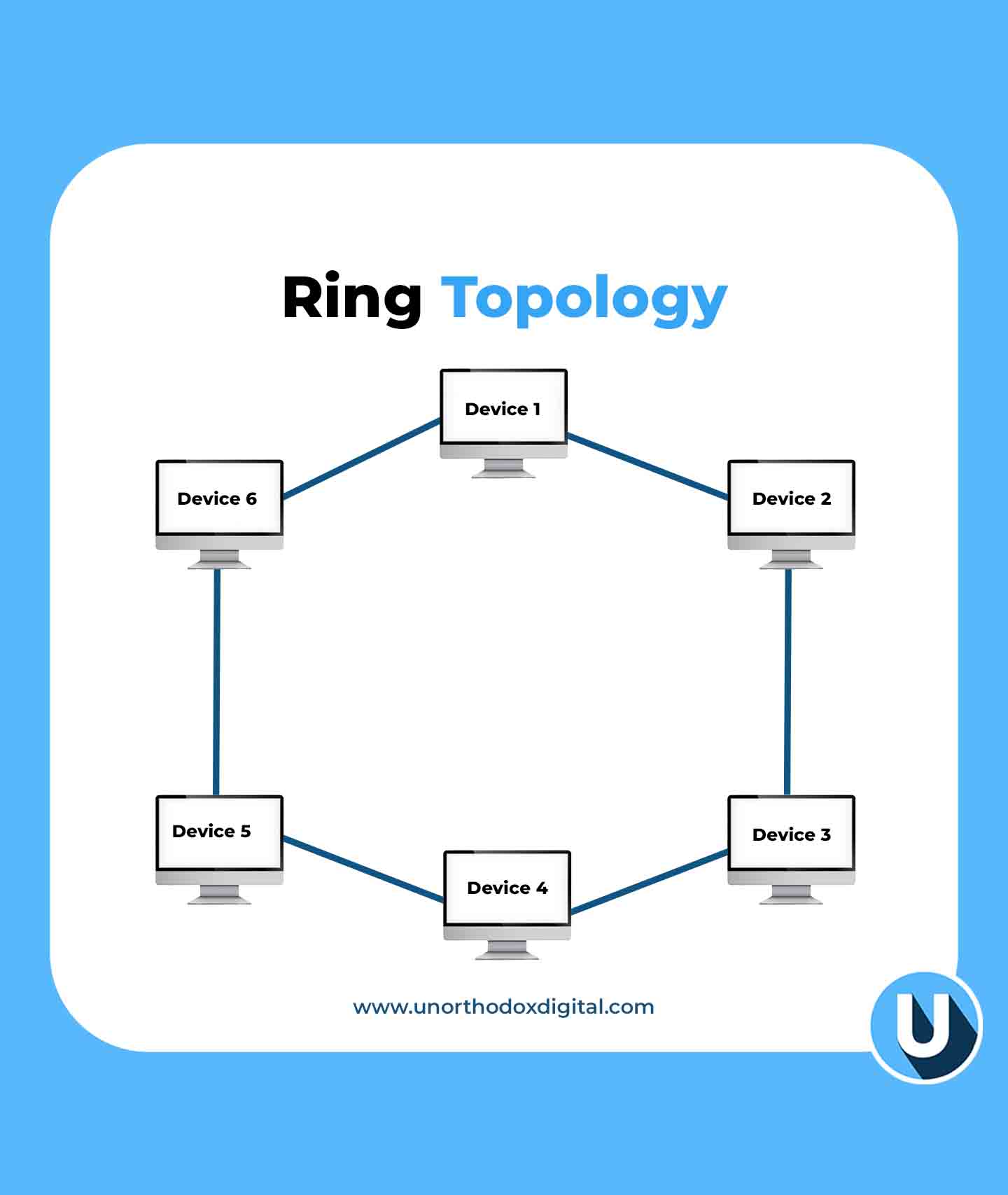
This setup, known as a Ring Topology, connects each device to two others, forming a circular data path. Data travels in one direction (or both in a dual-ring setup), ensuring a structured and efficient flow.
Example: Think of a relay race where a baton (data) is passed from runner to runner (device) until it reaches the destination.
Advantages
Disadvantages
No data collisions
If one device fails, the entire network can break
Predictable data flow
Adding new devices can disrupt the network
Ring Topology
5. Mesh Topology
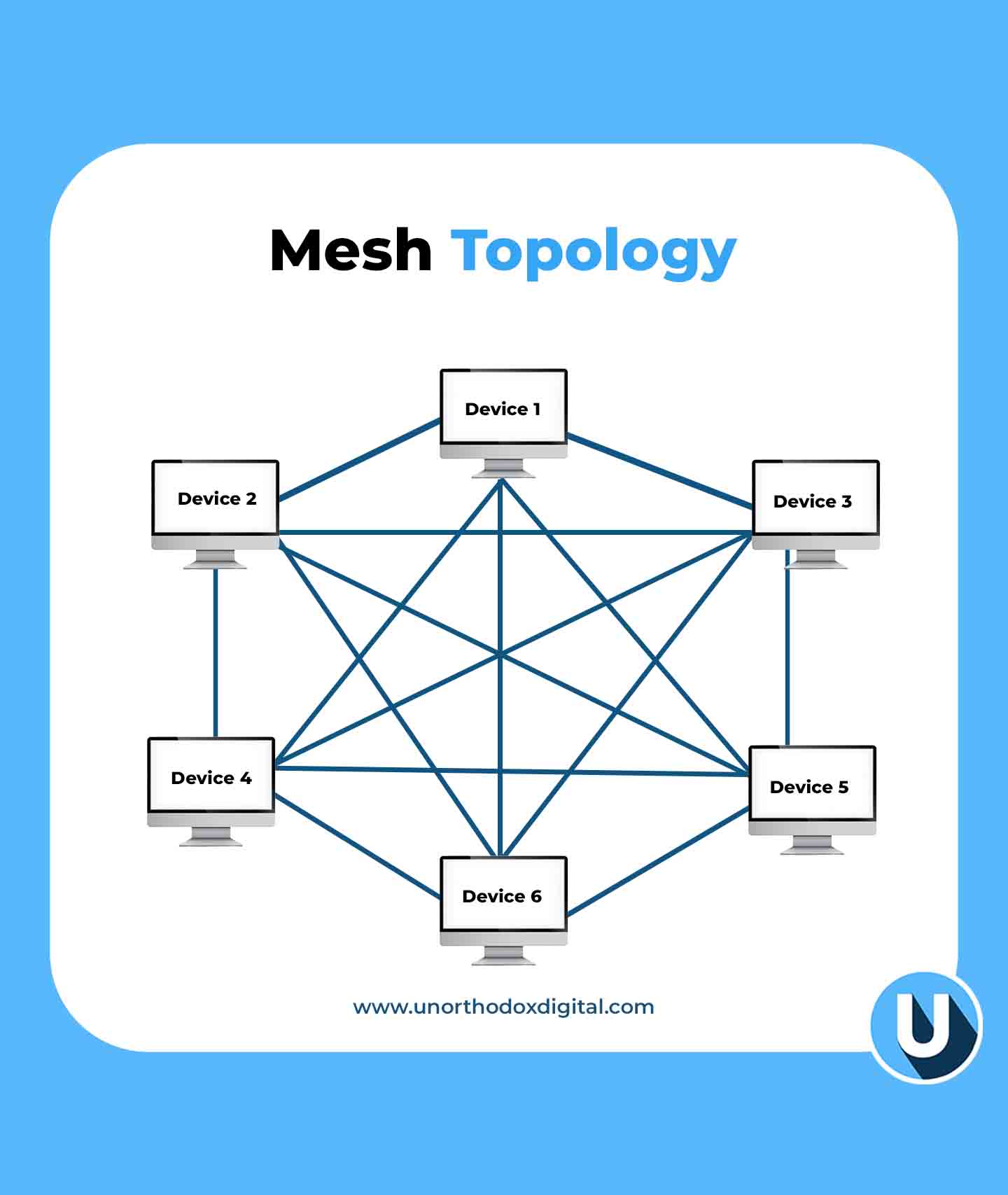
In the Mesh Topology, every device is connected to every other device, creating multiple paths for data.
Example: Think of a spider web. If one strand breaks, there are still plenty of other ways for the spider to move around.
Advantages
Disadvantages
Very reliable (data can take multiple routes)
Expensive and complex to set up
If one link fails, data can still reach its destination
Requires a lot of cabling
Mesh Topology
6. Tree Topology
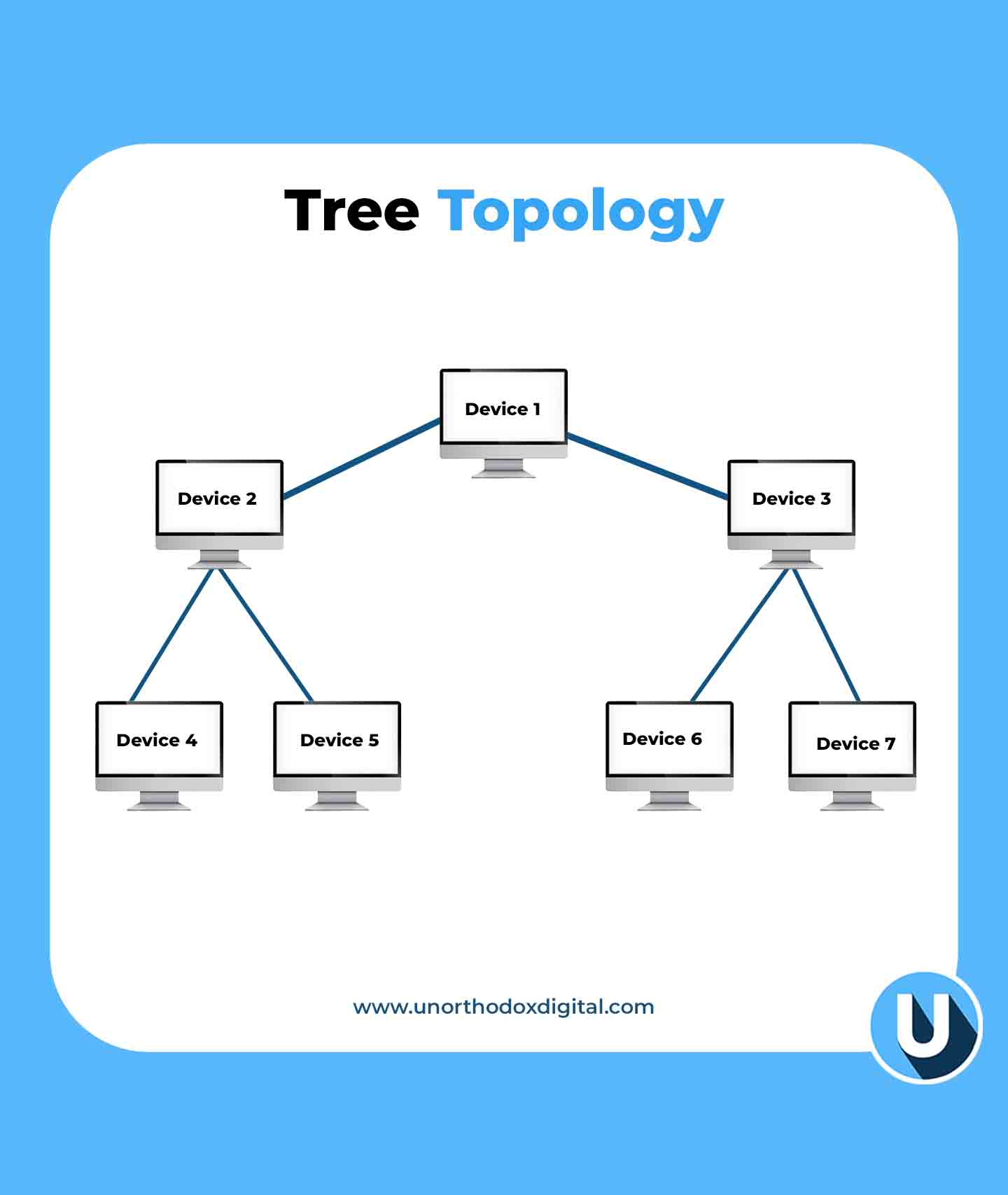
The Tree Topology is a mix of star and bus topologies, with multiple branches stemming from a central hub.
Example: Think of a big family tree. The oldest generation (main hub) connects to multiple generations (sub-hubs and devices).
Advantages
Disadvantages
Easy to expand and manage
If the main hub fails, the entire network can go down
Well-structured hierarchy
Requires more cabling and configuration
Tree Topology
7. Hybrid Topology
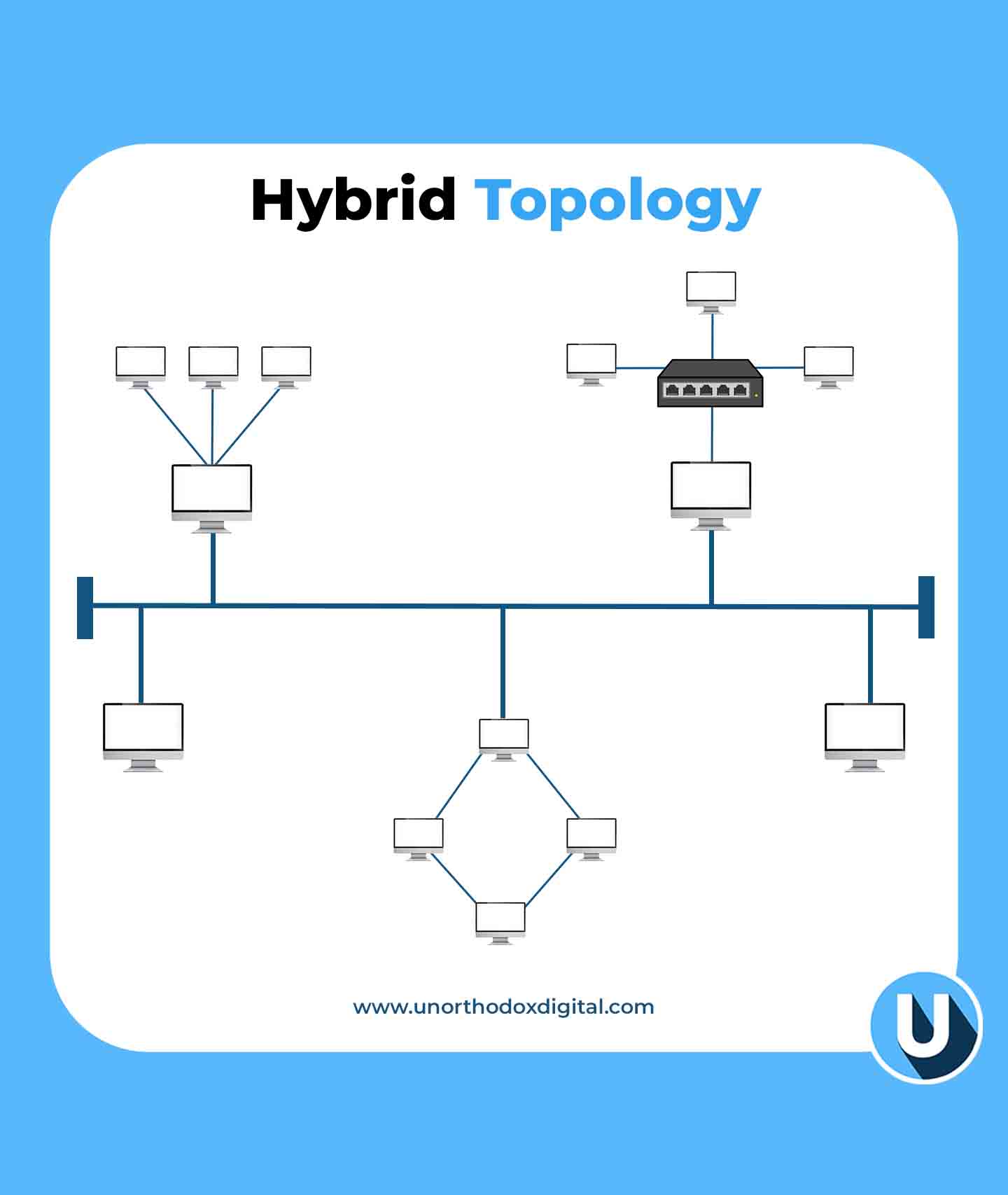
The Hybrid Topology is a combination of two or more topologies, depending on the needs of the network.
Example: A university might have a star topology in classrooms, a bus topology in dormitories, and a mesh topology for research labs.
Advantages
Disadvantages
Highly flexible and scalable
Complex to design and maintain
Best for large organizations
Expensive setup
Hybrid Topology
Why Does Network Topology Matter?
Choosing the right network topology is important because it affects:
Performance: A good layout ensures fast and efficient communication.
Reliability: Some topologies provide backup routes if a connection fails.
Cost: More complex topologies need more cables and hardware.
Scalability: Some layouts make it easier to add new devices without disrupting the network.
Network topology might sound technical, but at its core, it’s just about how devices talk to each other. Whether it’s a simple point-to-point connection or a complex hybrid setup, the right choice depends on what you need. Just like choosing the best road layout for a town, picking the right network topology ensures smooth communication and efficiency.
Frequently Asked Questions (FAQs)
Is it possible to use multiple network topologies together?
Yes, a network can combine different topologies in a hybrid setup. This approach enhances flexibility, performance, and reliability by leveraging the strengths of multiple structures.
What factors should be considered when selecting a network topology?
The choice of topology depends on factors such as network size, budget, performance requirements, scalability, and reliability. Evaluating these elements helps in selecting the most efficient structure.
Which network topology is the most cost-effective and easiest to implement?
Bus topology is the simplest and most affordable to set up, as it connects all devices using a single main cable. However, it is better suited for smaller networks due to its limitations.
Why do large networks often use hybrid topology?
Hybrid topology is widely used in large networks because it integrates multiple topologies, allowing for greater flexibility and optimization based on specific networking requirements.
What is the most suitable topology for large-scale networks?
For large-scale networks, mesh and tree topologies are commonly used. Mesh topology ensures high reliability through redundant connections, while tree topology supports scalability and efficient data management.
Glo short codes make it easy for users in Nigeria to check airtime, buy data, or borrow credit when needed.
If you use Glo in Nigeria, you probably want quick and easy ways to check your airtime, buy data, or even borrow credit when you’re low on cash.
That’s where short codes come in! Think of them as magic numbers you dial to get things done in seconds. But recently, many of Glo’s old codes changed, so if you’ve been dialing the same codes for years, it’s time for an update.
This guide will break down all the important Glo short codes you need to know—whether you want to recharge, check your balance, share data, or link your NIN. Let’s dive in!
Updated Glo Short Codes
Glo, like other mobile networks in Nigeria, has updated many of its USSD codes. Here are the most important ones you need:
Airtime Recharge (*311*Voucher PIN#): Buy a Glo recharge card, scratch it, and dial this code with the PIN to top up instantly.
Check Airtime Balance (*310#): Want to see how much credit you have left? Just dial *310# and your balance will pop up.
Borrow Airtime (*303#): Out of credit? Dial *303# and follow the instructions to borrow airtime and pay it back later.
Buy Data (*312#): Need internet? Dial *312# to see different data plans and pick the one that fits your budget.
Share Data (*321#): If you have extra data and want to send some to a friend, dial *321# and follow the prompts.
Check Data Balance (*323#): To check how much data you have left, simply dial *323#.
Value-Added Services (*305#): If you want access to Glo’s extra services like call tunes, news updates, or premium content, dial *305#.
Link Your NIN (Send SMS to 109): The Nigerian government requires all SIM cards to be linked to a National Identification Number (NIN). To do this, send UPDATENIN NIN FirstName LastName to 109.
Glo Short Codes That Haven’t Changed
Some Glo codes are still the same. If you were using these before, you don’t need to relearn them:
Service
Short Code
Verify SIM Registration/NIN Linkage
*996#
Manage Do-Not-Disturb (DND)
2442
Mobile Number Portability (Porting)
3232
When You Might Need These Codes
SIM Registration Check (*996#): If you’re unsure whether your SIM is properly registered, dial 996 to verify.
Do-Not-Disturb (2442): Tired of annoying spam messages? Dial 2442 to activate or manage DND settings.
Porting (3232): Want to switch to another network but keep your Glo number? Dial 3232 to start the porting process.
FAQs About Glo Short Codes
1. What happens if I dial an old USSD code?
If you use an outdated Glo short code, you might get an error message or be redirected to the new one. It’s best to use the updated codes to avoid confusion.
2. Can I borrow both airtime and data on Glo?
Yes! While *303# is for borrowing airtime, Glo also allows some users to borrow data. Just dial *312# to check if you’re eligible.
3. How do I know if my NIN is linked?
Simply dial *996# to check if your NIN is linked to your Glo line.
4. Can I share my data with more than one person?
Yes! With *321#, you can send data to multiple people, as long as you have enough to share.
5. What should I do if a USSD code doesn’t work?
Make sure you have network coverage and enough balance for the service. If it still doesn’t work, restart your phone or contact Glo customer support.
Knowing your Glo short codes make it easy to manage your mobile services in seconds. Whether you’re recharging, buying data, or checking your balance, these codes save you time and effort. Bookmark this guide or save the table so you always have the codes handy!
Now that you know all the important Glo short codes, which one do you think you’ll use the most?
Sending money to Nigeria should be simple, safe, and fast. Whether you’re supporting family, paying for services, or handling business transactions, choosing the right platform matters. But with so many options, how do you know which one to pick? No worries—I’ve got you covered. Let’s break it down in a way that makes sense, just like explaining a game plan to a friend.
Key Features of a Reliable Money Transfer Platform
Before diving into the list, here’s what we should look for in a good money transfer service:
Security – Your money should be safe from fraud and scams.
Speed – Some transfers are instant, while others take days.
Fees – Look for low or no fees.
Exchange Rates – Some services give better rates than others.
Ease of Use – It should be simple to send money without headaches.
Payment Methods – Options should include bank transfers, mobile wallets, and cash pickups.
Now, let’s explore 12 trusted platforms that make sending money to Nigeria easy and reliable.
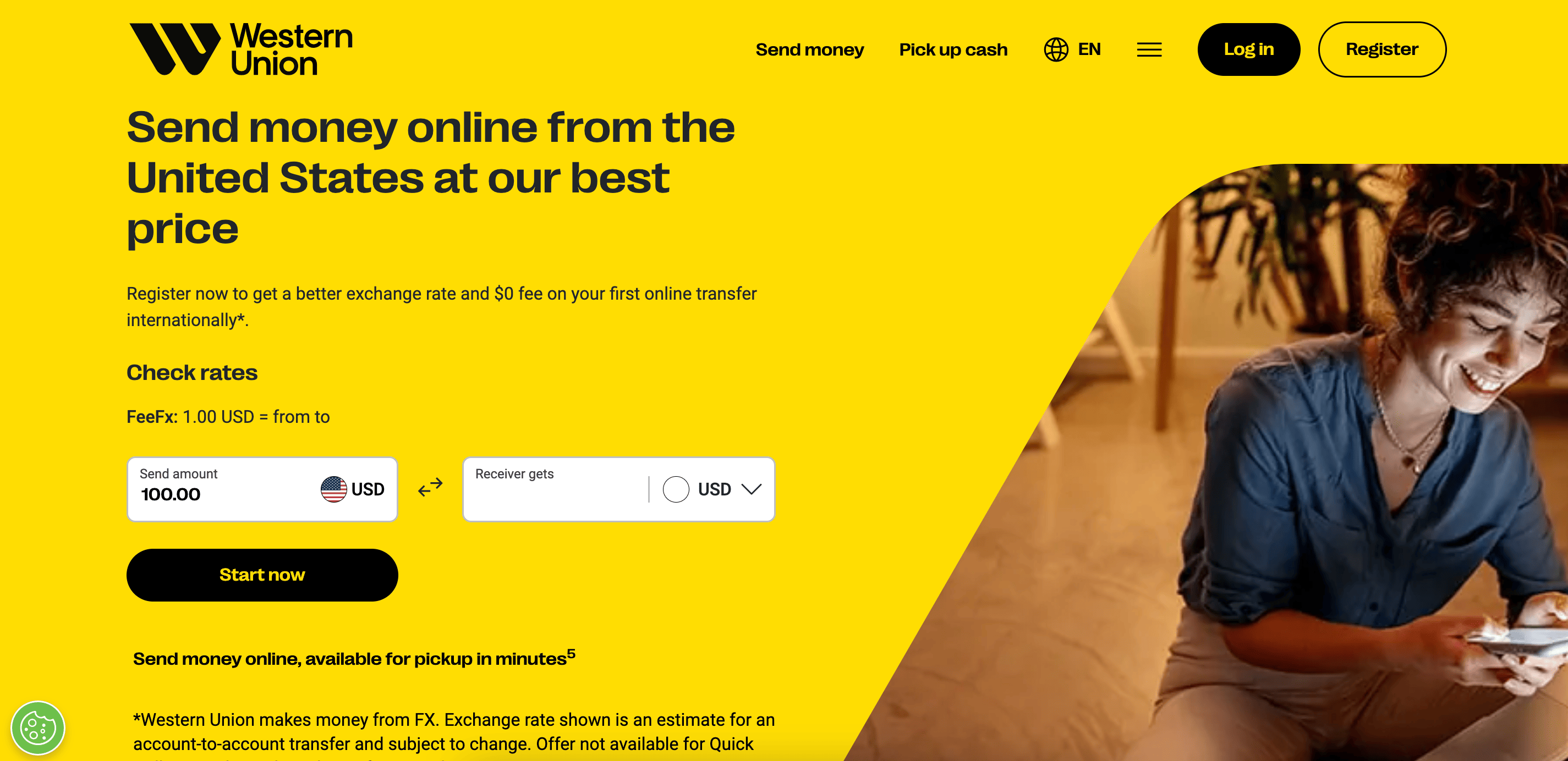
1. Western Union
Why it’s great:
Western Union has a large global network with thousands of locations.
Supports bank deposits, cash pickup, and mobile money.
Flexible payment options, including credit/debit cards and bank transfers.
Best for: Sending money to someone who prefers picking up cash in person.
2. MoneyGram
Why it’s great:
Fast and available worldwide.
Supports cash pickup, mobile money, and bank deposits.
Available in many retail locations, making it easy to send money.
Best for: Those who prefer in-person transactions or need fast cash pickups.
3. Remitly
Why it’s great:
Express (instant) and Economy (cheaper but slower) options.
Supports mobile money, bank deposits, and cash pickup.
Offers promotional exchange rates for first-time users.
Best for: First-time senders looking for a good deal and reliable delivery options.
4. WorldRemit
Why it’s great:
Supports bank deposits, mobile money, and cash pickups.
Fast delivery, often within minutes.
Reasonable fees with competitive exchange rates.
Best for: Sending money in multiple ways, especially for cash pickups and mobile wallets.
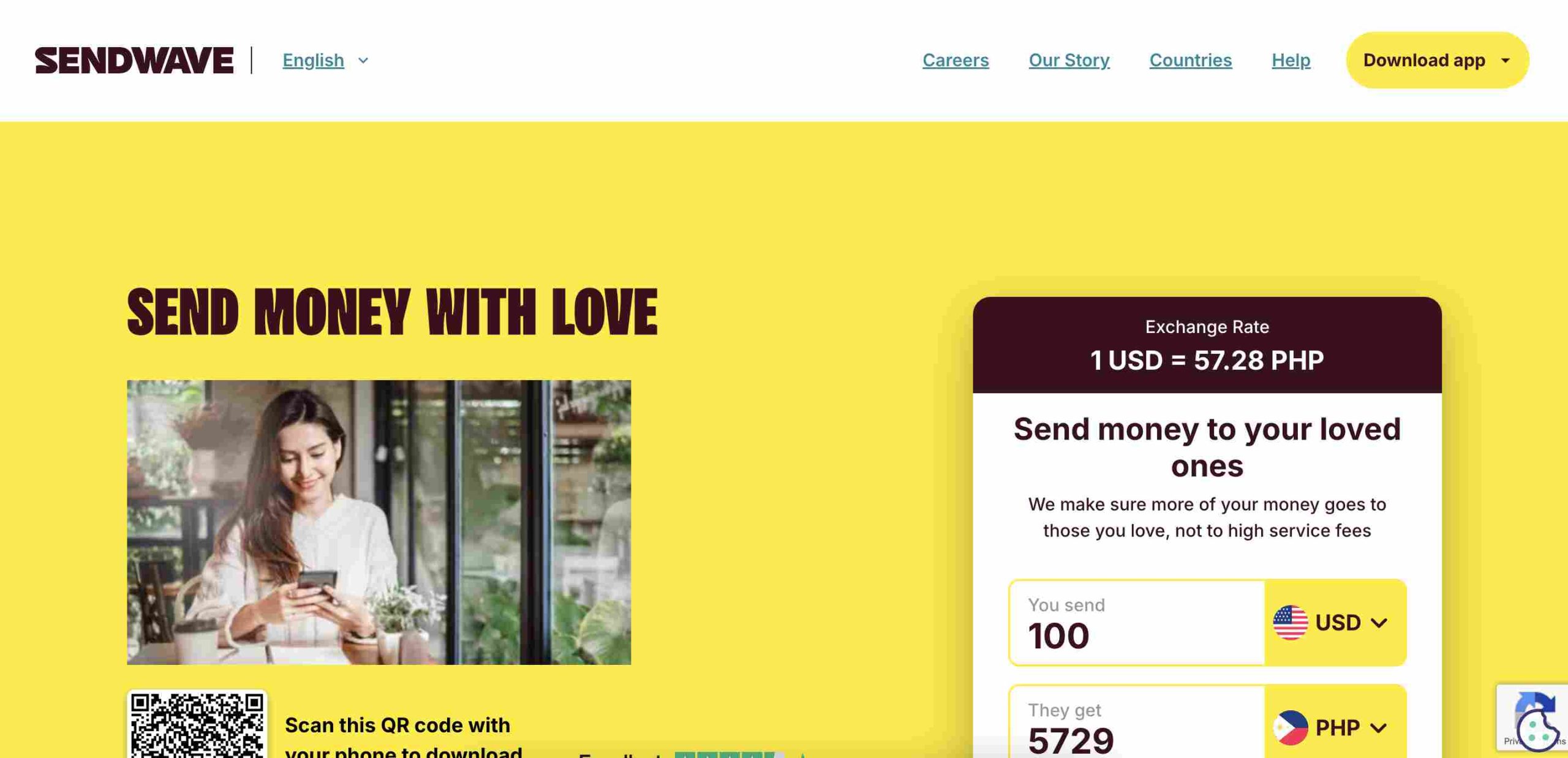
5. Sendwave
Why it’s great:
No fees for transfers.
Fast transfers, often within minutes.
Sendwave works with mobile money services like Opay and PalmPay.
Easy to use with a mobile app.
Best for: People who want quick, fee-free transfers straight to a mobile wallet.
Works well for Nigerians in the diaspora sending money home.
Best for: People looking for fee-free international transfers with multi-currency support.
9. Paysend
Why it’s great:
Flat transfer fee of about $2.
Direct transfers to bank accounts and mobile wallets.
Fast transactions, often within minutes.
Best for: Those who want low-cost international transfers with simple pricing.
10. Skrill
Why it’s great:
Allows sending money using a digital wallet.
Low-cost transactions compared to traditional banks.
Works well for online purchases and payments as well.
Best for: Digital-savvy users who want a multi-purpose wallet for sending money and online transactions.
11. TransferGo
Why it’s great:
Fast transfers, sometimes as quick as 30 minutes.
Competitive exchange rates.
Supports bank deposits.
Best for: Those who need quick transfers to a bank account with good exchange rates.
12. Remitbee
Why it’s great:
No fees for bank transfers over $500.
Good exchange rates compared to banks.
Remitbee works well for Canadians sending money abroad.
Best for: People in Canada who want affordable and reliable transfers.
Comparing the Best Options
Here’s a quick comparison to help you choose the right service:
Platform
Fees
Speed
Payment Methods
Best For
Western Union
Varies
Fast
Bank, mobile, cash
Cash pickups worldwide
MoneyGram
Varies
Fast
Bank, mobile, cash
In-person and urgent transfers
Remitly
Low
Varies
Bank, mobile, cash
First-time users & flexible options
WorldRemit
Low
Fast
Bank, mobile, cash
Multiple transfer options
Sendwave
No
Fast
Mobile money
Instant, fee-free transfers
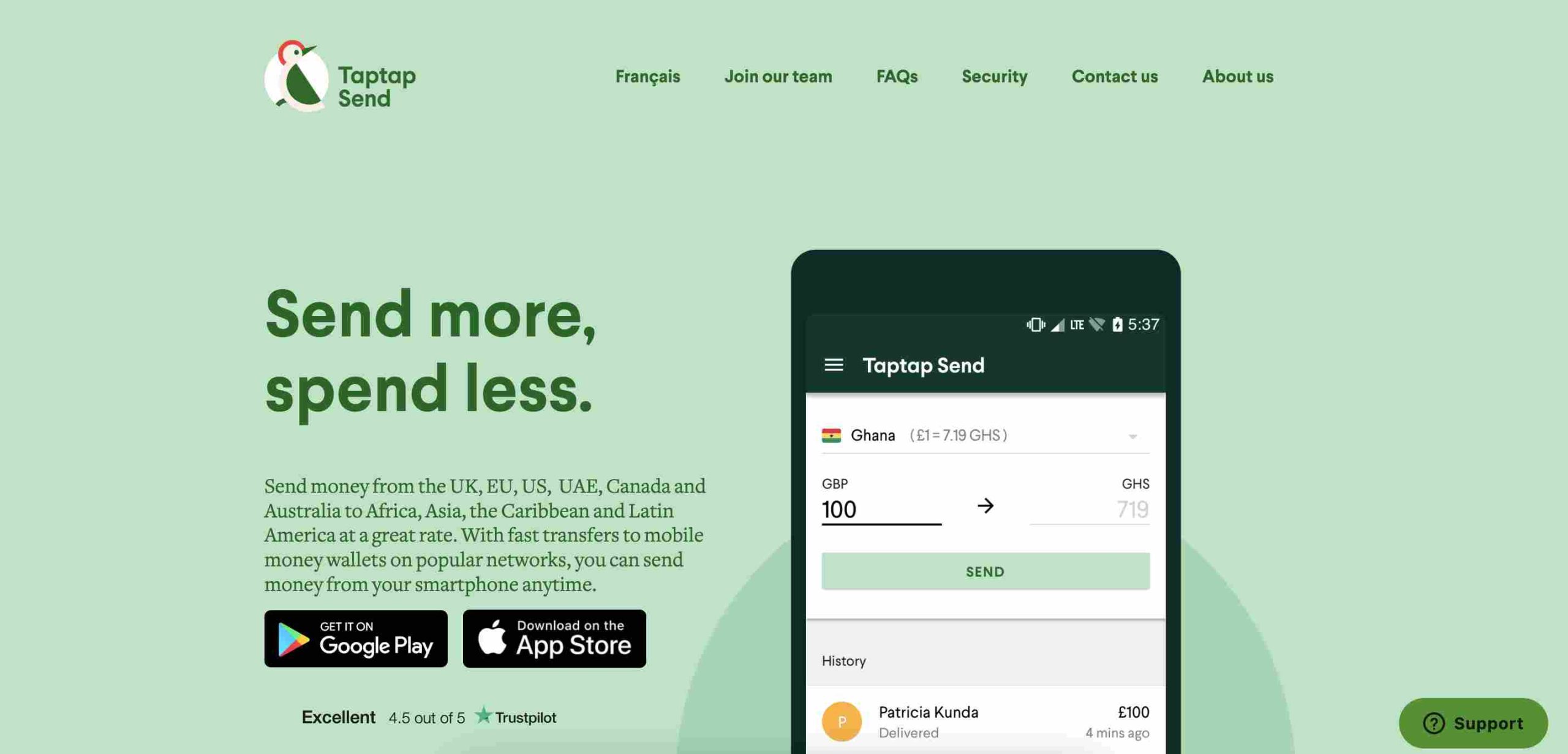
Taptap Send
No
Fast
Mobile money
Fee-free mobile money transfers
ACE Money Transfer
Low
Fast
Bank, mobile, cash
Competitive exchange rates
LemFi
No
Fast
Multi-currency
No-fee transfers
Paysend
$2
Fast
Bank, mobile
Low-cost transfers
Skrill
Low
Fast
Digital wallet
Online payments & money transfers
TransferGo
Low
Fast
Bank deposits
Quick bank transfers
Remitbee
No (over $500)
Fast
Bank deposits
Canadians sending money
Your choice of money transfer platform depends on what matters most—speed, cost, or payout methods. For no-fee mobile transfers, Sendwave and Taptap Send are excellent options. If you prioritize favorable exchange rates, TransferGo or ACE Money Transfer might be the best fit. And for those who need cash pickup, Western Union or MoneyGram could be the right solution. No matter which you choose, all these platforms are secure and trustworthy for sending money to Nigeria.
Sending money to South Africa should be easy, secure, and fast. Whether you’re supporting family, paying for services, or handling business transactions, picking the right platform is essential. With so many options, how do you choose the best one? Don’t worry—I’ve got you covered. Let’s break it down in a way that makes sense, like explaining a game plan to a friend.
How to Identify a Good Money Transfer Platform
Before we jump into the list, here’s what to look for in a reliable money transfer service:
Security – Your money should be protected from fraud and scams.
Speed – Some transfers happen instantly, while others take a few days.
Fees – Look for low or no fees to save on costs.
Exchange Rates – Some platforms offer better rates than others.
Ease of Use – The platform should be simple to navigate.
Payment Methods – Options should include bank transfers, mobile wallets, and cash pickups.
Now, let’s explore 12 trusted platforms that make sending money to South Africa seamless and secure.
1. Western Union
Why it’s great:
Large global network with thousands of locations.
Western Union supports bank deposits, cash pickup, and mobile money.
Multiple payment options, including credit/debit cards and bank transfers.
Best for: Sending money to someone who prefers picking up cash in person.
Fast and direct deposits to mobile money accounts.
Easy-to-use mobile app for seamless transfers.
Best for: Mobile money users who want quick and free transfers.
11. LemFi
Why it’s great:
Zero transaction fees.
Supports multiple currencies for international transfers.
LemFi works well for South Africans living abroad who send money home frequently.
Best for: People who want fee-free international transfers with multi-currency support.
12. Remitbee
Why it’s great:
No fees for bank transfers over $500.
Strong exchange rates compared to banks.
Remitbee is ideal for Canadians sending money abroad.
Best for: Those in Canada who need a reliable and affordable way to send money to South Africa.
Comparing the Best Options
Here’s a quick comparison to help you pick the right service:
Platform
Fees
Speed
Payment Methods
Best For
Western Union
Varies
Fast
Bank, mobile, cash
Cash pickups worldwide
MoneyGram
Varies
Fast
Bank, mobile, cash
In-person and urgent transfers
WorldRemit
Low
Fast
Bank, mobile, cash
Multiple transfer options
Remitly
Low
Varies
Bank, mobile, cash
First-time users & flexible options
Paysend
$2
Fast
Bank, mobile
Low-cost transfers
Skrill
Low
Fast
Digital wallet
Online payments & money transfers
TransferGo
Low
Fast
Bank deposits
Quick bank transfers
ACE Money Transfer
Low
Fast
Bank, mobile, cash
Competitive exchange rates
Sendwave
No
Fast
Mobile money
Instant, fee-free transfers
Taptap Send
No
Fast
Mobile money
Fee-free mobile money transfers
LemFi
No
Fast
Multi-currency
No-fee transfers
Remitbee
No (over $500)
Fast
Bank deposits
Canadians sending money
The best money transfer platform for you depends on what matters most—speed, cost, or payout methods. For fee-free mobile transfers, Sendwave and Taptap Send are solid options. If you’re after competitive exchange rates, consider TransferGo or ACE Money Transfer. Need cash pickup? Western Union or MoneyGram may be the best fit.
Whichever platform you choose, you can be confident that all of these are safe and reliable options for sending money to South Africa.
Africa is a continent full of natural beauty, cultural richness, and incredible potential. However, some countries still face significant economic struggles. One way to measure a country’s economic situation is by looking at its Gross Domestic Product (GDP) per capita, which tells us how much money a country makes in a year divided by its population. A low GDP per capita means people generally earn less and have fewer resources available.
In this article, we’ll explore the 10 poorest countries in Africa by GDP per capita and break down the reasons behind their economic challenges.
1. Burundi
GDP per capita: $231
Capital: Gitega
Population: 14.04 million
Major Exports: Coffee, tea
Burundi is a small, landlocked country in East Africa, and it has the lowest GDP per capita in Africa. Over 80% of Burundians depend on farming to survive, but many don’t produce enough to sell.
Challenges like political instability, ethnic conflicts, and limited infrastructure have held back economic growth. However, the country has potential in its coffee and tea exports—if investments in infrastructure and stability improve, Burundi could see better economic progress.
2. Central African Republic (CAR)
GDP per capita: $467
Capital: Bangui
Population: 5.4 million
Major Exports: Diamonds, timber
Despite having gold and diamonds, the Central African Republic remains one of the poorest nations due to armed conflicts and weak governance. Many regions are controlled by rebel groups, making it difficult for people to farm, trade, or even receive aid.
Economic progress depends on stabilizing the country and creating a safe environment for businesses to grow. If this happens, CAR’s mining and agricultural sectors could bring in more revenue.
3. Sierra Leone
GDP per capita: $480
Capital: Freetown
Population: 8.72 million
Major Exports: Diamonds, bauxite, cocoa
Sierra Leone has rich diamond reserves, but its people still struggle with poverty due to corruption and poor governance. A long civil war (1991–2002) destroyed much of the country’s infrastructure, and the Ebola outbreak (2014–2016) further weakened the economy.
Agriculture is a major employer, but outdated farming methods limit productivity. If Sierra Leone modernizes its agriculture and infrastructure, economic conditions could improve significantly.
4. Madagascar
GDP per capita: $491
Capital: Antananarivo
Population: 32.32 million
Major Exports: Vanilla, cloves, coffee
Madagascar is known for its unique wildlife and rainforests, but it faces economic struggles due to frequent cyclones, poor infrastructure, and reliance on agriculture.
Since it exports a lot of vanilla, the country’s economy is heavily influenced by global prices. Madagascar’s economy could grow if it invests in eco-tourism and diversifies its industries.
5. Mozambique
GDP per capita: $547
Capital: Maputo
Population: 35.1 million
Major Exports: Natural gas, coal, aluminum
Mozambique has huge natural gas reserves, yet many people still live in poverty due to political instability, natural disasters, and poor infrastructure.
The country faces frequent cyclones and floods, which damage roads and homes, slowing down development. With better disaster preparedness and responsible management of natural gas revenue, Mozambique could reduce poverty.
6. Niger
GDP per capita: $552
Capital: Niamey
Population: 27.44 million
Major Exports: Uranium, livestock, onions
Niger is mostly desert, making farming difficult. Despite being one of the world’s top uranium producers, it remains poor due to climate change, weak industry, and high population growth.
The country could benefit from investments in solar energy and improved trade agreements with neighbors.
7. Democratic Republic of the Congo (DRC)
GDP per capita: $567
Capital: Kinshasa
Population: 110.92 million
Major Exports: Cobalt, copper, diamonds
The DRC is one of the most resource-rich countries on Earth, yet corruption, ongoing conflicts, and poor infrastructure have kept most of its people in poverty.
Armed groups control much of the mining industry, preventing wealth from benefiting ordinary citizens. If corruption is reduced and resources are managed properly, the DRC could become an economic powerhouse.
8. South Sudan
GDP per capita: $581
Capital: Juba
Population: 12.06 million
Major Exports: Crude oil
South Sudan gained independence in 2011, but civil wars, food shortages, and weak infrastructure have slowed its economic growth. Despite having oil reserves, much of the revenue is lost due to instability and mismanagement.
For South Sudan to thrive, long-term peace and infrastructure investments are needed.
9. Somalia
GDP per capita: $614
Capital: Mogadishu
Population: 19.31 million
Major Exports: Livestock, bananas
Somalia has faced decades of conflict, leaving it with weak governance and limited economic opportunities. Most people rely on livestock farming, but droughts often destroy their income.
However, Somalia has one of the longest coastlines in Africa, making fishing and trade potential sources of growth if stability improves.
10. Malawi
GDP per capita: $640
Capital: Lilongwe
Population: 21.92 million
Major Exports: Tobacco, tea, sugar
Malawi is highly dependent on agriculture, but its economy struggles due to climate change, deforestation, and rapid population growth. The government is working on diversifying the economy by investing in small industries and education.
These 10 African countries face major economic struggles, but they also have immense potential. With better governance, infrastructure investments, and industry diversification, their economies could improve significantly in the future.
By understanding these challenges and opportunities, we can better appreciate the complexity of economic development in Africa.
Sending money to Ghana should be simple, safe, and fast. Whether you’re supporting family, paying for services, or handling business transactions, choosing the right platform matters. But with so many options, how do you know which one to pick? No worries—I’ve got you covered. Let’s break it down in a way that makes sense, just like explaining a game plan to a friend.
What Makes a Good Money Transfer Platform?
Before diving into the list, here’s what we should look for in a good money transfer service:
Security – Your money should be safe from fraud and scams.
Speed – Some transfers are instant, while others take days.
Fees – Look for low or no fees.
Exchange Rates – Some services give better rates than others.
Ease of Use – It should be simple to send money without headaches.
Payment Methods – Options should include bank transfers, mobile wallets, and cash pickups.
Now, let’s explore 12 secure platforms that make sending money to Ghana easy and reliable.
1. Sendwave
Why it’s great:
No fees for transfers.
Fast transfers, often within minutes.
Sendwave works with mobile money services like MTN and Vodafone Cash.
Easy to use with a mobile app.
Best for: People who want quick, fee-free transfers straight to a mobile wallet.
Choosing the right platform depends on what matters most to you—whether it’s speed, fees, or payout options. If you want no-fee mobile transfers, Sendwave or Taptap Send are great choices. Need a good exchange rate? TransferGo or ACE Money Transfer could be your best bet. And if cash pickup is important, Western Union or MoneyGram might work better.
No matter which one you choose, rest easy knowing these are all secure and trusted ways to send money to Ghana.
If you’ve ever wondered if you can mine cryptocurrency straight from your phone, the answer is yes—but with a few catches. While mobile crypto mining won’t make you rich overnight, it’s a fun and accessible way to earn small amounts of crypto without investing in expensive mining hardware. The trick is finding apps that are trustworthy, easy to use, and actually pay out. That’s exactly what this guide will help you with.
We’ll break down six of the most reliable crypto mining apps for Android and iPhone, explaining how they work, their pros and cons, and what you need to get started. Let’s dive in!
What Is Crypto Mining on Mobile?
Before we get to the apps, let’s quickly explain what mobile crypto mining is. Traditional crypto mining requires powerful computers (or ASIC miners) to solve complex math problems and validate transactions on a blockchain. This process is energy-intensive and not practical for smartphones.
Instead, mobile mining apps use cloud mining or browser-based mining. Here’s the difference:
Cloud mining: You rent mining power from a remote data center. The mining happens on powerful machines elsewhere, and you earn a share of the rewards.
Browser-based mining: Some apps let you earn crypto while browsing the internet by using your phone’s idle processing power (although earnings are usually small).
Now that we understand the basics, here are the six best crypto mining apps available for Android and iPhone.
1. Binance Pool
Binance, one of the largest cryptocurrency exchanges, offers Binance Pool, a cloud mining service that lets you mine Bitcoin without needing special hardware.
Features:
Integrated with Binance’s trading platform
Daily payouts in Bitcoin
Easy tracking through the Binance app
How It Works:
Create a Binance account (if you don’t have one).
Purchase a cloud mining contract (starting at $23.04).
Sit back and track your earnings in the Binance app.
Pros & Cons:
Pros
Cons
Trusted and reputable platform
Contracts sell out quickly
No need for hardware
No free mining options
Daily payouts
Requires an initial investment
2. CryptoTab Browser
CryptoTab is a web browser that lets you mine Bitcoin while browsing the internet. It’s available in Lite, Pro, and Max Speed versions, with paid versions offering higher mining speeds.
ECOS offers cloud mining contracts, a Bitcoin wallet, and even an option to buy and host your own Bitcoin miners at the ECOS Data Center.
Features:
Cloud mining options
Bitcoin wallet included
Option to host real mining hardware
How It Works:
Download the ECOS app and create an account.
Choose between cloud mining, building a mining farm, or buying hardware.
Start earning and tracking your progress.
Pros & Cons:
Pros
Cons
Multiple ways to earn
Requires upfront purchase
User-friendly interface
Minimal earnings from cloud mining
Reliable platform
Withdrawal limits apply
5. NiceHash
NiceHash is a cloud mining marketplace that lets you mine Bitcoin and other cryptocurrencies with both free and paid plans.
Features:
Free and paid mining contracts
Monitor mining rigs remotely
Supports over 60 cryptocurrencies
How It Works:
Sign up on NiceHash and choose a mining plan.
Use their app to track performance.
Withdraw your earnings in Bitcoin or other cryptos.
Pros & Cons:
Pros
Cons
Free plan available
Requires PC software for mining
Supports multiple cryptos
Can be overwhelming for beginners
Remote monitoring
Service fees apply
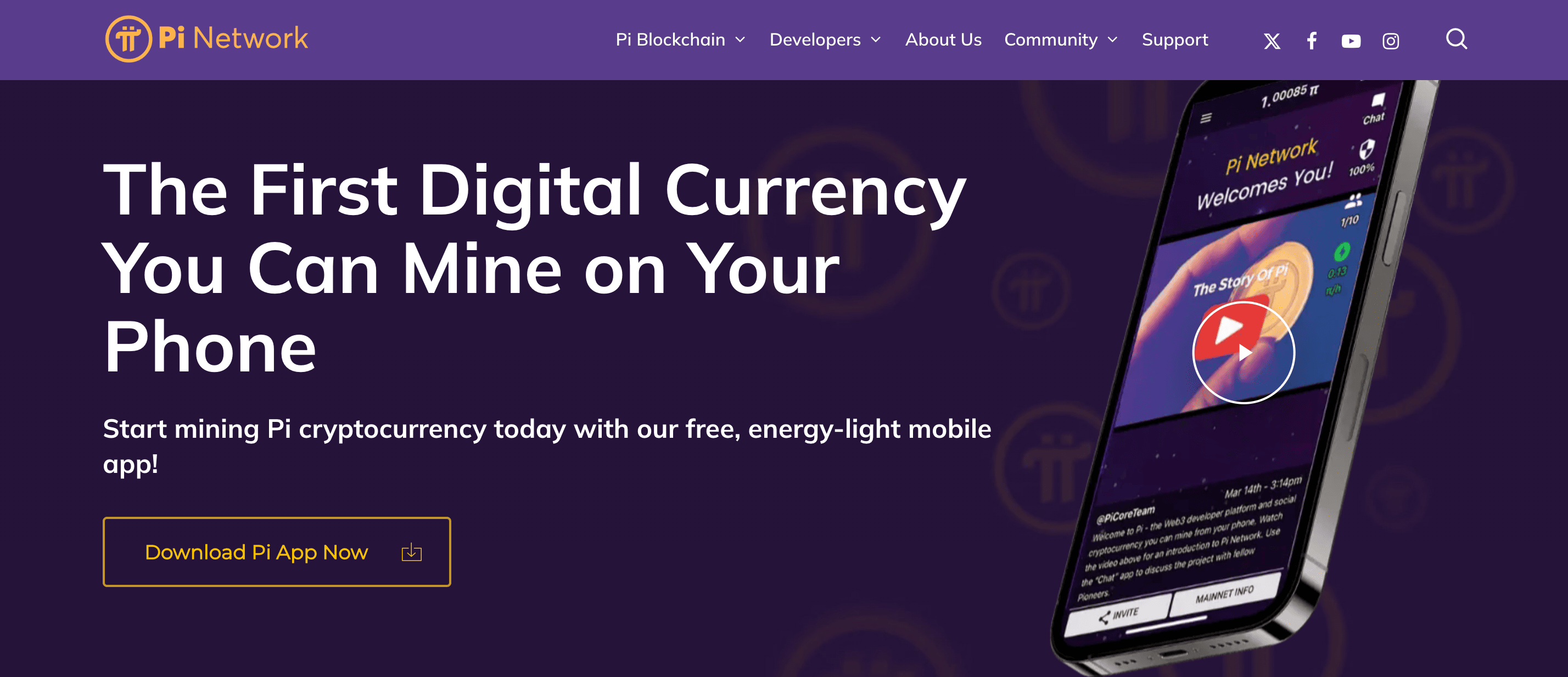
6. Pi Network
Pi Network lets you mine Pi coins directly from your phone with minimal processing power.
Features:
No battery drain or extra hardware required
Easy to use
High user engagement
How It Works:
Download Pi Network and create an account.
Click the mining button once per day.
Earn Pi coins for free!
Pros & Cons:
Pros
Cons
Completely free
Pi coins aren’t listed on exchanges yet
No hardware needed
Limited earning potential for now
Easy to use
Requires daily engagement
How to Choose a Legit Crypto Mining App
When picking a mining app, keep these factors in mind:
Factor
Why It Matters
Security
Ensure the app is from a trusted developer to avoid scams.
Ease of Use
A good mining app should have a simple interface.
Earnings Potential
Check reviews to see if the app actually pays out.
Fees
Some apps have hidden charges that reduce profits.
Customer Support
In case of issues, responsive support is a must.
Crypto mining on mobile isn’t a get-rich-quick scheme, but it can be a fun way to earn small amounts of crypto with minimal effort. If you’re serious about mining, cloud mining services like Binance Pool and Hashshiny are your best bet. If you just want to experiment, CryptoTab and Pi Network offer easy, low-effort ways to get started.
Whichever app you choose, always do your research, read user reviews, and never invest more than you can afford to lose. Happy mining!
FAQs
Can I mine crypto on my iPhone?
Direct mining on iPhones is not feasible because of hardware limitations. Nonetheless, certain apps allow users to engage in cloud mining or earn cryptocurrency through other means:
Bitdeer: This platform facilitates cloud mining by enabling users to lease mining hardware remotely, eliminating the need for personal mining equipment.
Can I mine crypto on my Android phone?
Similar to iPhones, Android devices lack the necessary power for effective cryptocurrency mining. Yet, some apps provide alternative avenues:
Pi Network: This project allows users to “mine” Pi coins through the app without intensive computational requirements. It’s important to note that Pi Network’s mining mechanism differs from traditional Proof-of-Work systems.
Are there any real crypto mining apps for Android?
While traditional mining isn’t practical on Android devices, apps like Pi Network offer participation in cryptocurrency ecosystems without heavy resource consumption.
What is the best device for mining crypto?
Effective cryptocurrency mining typically requires specialized hardware:
ASIC Miners: Application-Specific Integrated Circuit miners are tailored for specific algorithms, offering high efficiency and performance, especially for cryptocurrencies like Bitcoin.
GPU Mining Rigs: High-end Graphics Processing Units can mine various cryptocurrencies, particularly those resistant to ASIC mining.
Which crypto is fastest to mine?
The ease of mining a cryptocurrency depends on its algorithm and network difficulty:
Monero (XMR): Known for its ASIC-resistant algorithm, Monero can be mined using CPUs or GPUs, making it accessible for individual miners.
Dash: Utilizing the X11 hashing algorithm, Dash is compatible with both ASIC and GPU mining, offering flexibility in mining approaches.
Can I mine Bitcoin for free?
Mining Bitcoin without investment is challenging due to high competition and resource requirements. Some platforms claim to offer free mining, but they often come with limitations or potential risks. It’s essential to exercise caution and research thoroughly before engaging with such services.
The internet is like a giant marketplace where people buy, sell, and make money every single day. In Nigeria, many online businesses allow you to earn daily without needing a physical shop. Whether you’re a student, stay-at-home parent, or someone looking for extra cash, there’s an online business for you. Let’s explore 15 of them and how they work!
Freelancing means offering your skills online to people who need them. If you’re good at writing, designing, or coding, you can find work on platforms like Fiverr, Upwork, and PeoplePerHour. Businesses and individuals post jobs, and you get paid per task.
Example: A Nigerian writer on Fiverr can earn between ₦5,000 to ₦50,000 per article, depending on the quality and length.
2. Affiliate Marketing
Affiliate marketing is like being a middleman. You promote other people’s products using special links, and when someone buys through your link, you earn a commission. Platforms like Jumia Affiliate, Konga Affiliate, and Amazon Associates allow you to earn daily.
Example: If you promote a phone that costs ₦100,000 and the company gives you 5% commission, you earn ₦5,000 per sale.
3. Blogging with Ad Networks and Sponsored Posts
Blogging involves creating a website where you write about topics people are interested in. You make money by displaying ads from Google AdSense, Mediavine, or Adsterra, and through sponsored posts where brands pay you to write about them.
Example: A Nigerian blogger earning ₦500 per 1,000 views can make ₦5,000 daily if they get 10,000 visitors.
4. Selling Food Online
If you love cooking, why not sell homemade meals online? You can take orders through WhatsApp, Instagram, or Facebook and deliver them via dispatch riders.
Example: If you sell 10 plates of jollof rice at ₦2,000 each, that’s ₦20,000 daily!
5. Print-on-Demand Business
With print-on-demand, you design custom T-shirts, mugs, or phone cases and sell them online. Websites like Printivo and Teespring handle printing and delivery while you focus on marketing.
Example: If a T-shirt costs ₦3,000 to make and you sell it for ₦6,000, you earn ₦3,000 per sale.
6. Social Media Management
Many businesses need help managing their social media pages. If you understand how to create posts, reply to comments, and grow followers, you can offer social media management services.
Example: Some Nigerian businesses pay ₦30,000 to ₦100,000 monthly for social media managers.
7. YouTube Content Creation
YouTube pays content creators through ads, sponsorships, and product promotions. If you can create engaging videos, this is a great way to earn daily income.
Example: A YouTube channel with 10,000 views per day could earn around ₦10,000 – ₦30,000 daily from ads.
8. Forex Trading
Forex trading is buying and selling currencies to make a profit. It requires learning, patience, and the right strategy, but once mastered, it can be very profitable.
Example: A skilled trader making ₦5,000 profit per trade could do 3-5 trades daily, making ₦15,000 – ₦25,000 per day.
9. Cryptocurrency Trading
Crypto trading involves buying and selling digital currencies like Bitcoin and Ethereum. It works like forex trading, but the market runs 24/7.
Example: If you buy ₦50,000 worth of Bitcoin and sell it for ₦55,000, you just made ₦5,000 profit.
10. Virtual Assistant Services
A virtual assistant helps business owners with tasks like email management, data entry, and scheduling meetings.
Example: Many Nigerian VAs earn between ₦5,000 to ₦15,000 per day depending on the tasks.
11. Online Tutoring
If you’re good at a subject, you can teach others online via Zoom or WhatsApp and get paid.
Example: Teaching five students at ₦2,000 per class gives you ₦10,000 daily.
12. Selling Digital Products (Ebooks, Courses, Templates)
You can create ebooks, online courses, or business templates and sell them repeatedly without worrying about inventory.
Example: Selling 20 copies of a ₦2,500 ebook makes ₦50,000 daily.
13. Data Entry Jobs
Data entry involves typing information into a computer system. Many companies outsource this work, and you can do it from home.
Example: You could earn ₦3,000 – ₦10,000 per day, depending on the workload.
14. Mobile Money Agent Business
With a mobile money business, you help people withdraw, deposit, or transfer money using fintech services like Opay, Paga, or Moniepoint.
Service
Charge per Transaction
Daily Transactions
Daily Earnings
Cash Withdrawal
₦100 per ₦5,000
50 transactions
₦5,000
Cash Deposit
₦50 per ₦5,000
50 transactions
₦2,500
Bills Payment
₦100 per bill
20 transactions
₦2,000
Total Estimated Daily Earnings: ₦9,500+
15. Domain Flipping
Domain flipping is buying domain names (e.g., bestnaijadeals.com) at a low price and selling them for a profit.
Example: If you buy a domain for ₦5,000 and sell it for ₦50,000, that’s a ₦45,000 profit!
Starting an online business in Nigeria is easier than ever. Whether you love writing, teaching, or trading, there’s an option for you. The key is consistency, patience, and learning the right skills. Which of these businesses sounds most interesting to you? Start today and make money daily!
If you love shopping but prefer breaking your payments into smaller chunks, you’re probably familiar with Fingerhut. It lets you buy now and pay later, making it easier to afford big purchases without stressing your wallet. But Fingerhut isn’t the only option out there. Plenty of other websites offer flexible payment plans, whether you’re shopping for furniture, electronics, clothes, or even gifts.
Let’s dive into 15 great alternatives to Fingerhut, explaining what makes each one special and why they might be the right fit for you.
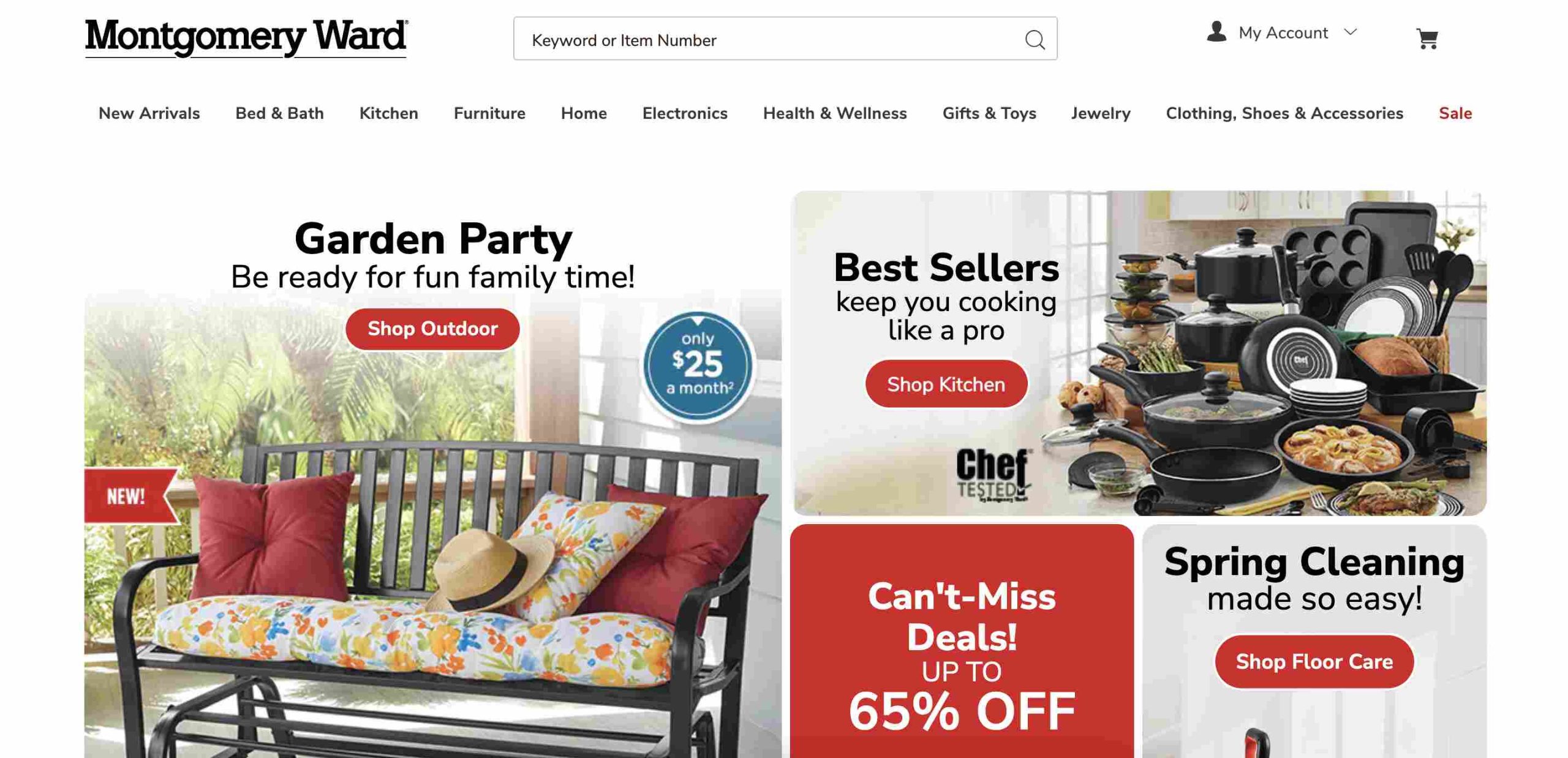
1. Montgomery Ward
Montgomery Ward has been in the buy now, pay later (BNPL) game for over a century. They offer furniture, home décor, electronics, and more, all with affordable monthly payment plans through their own credit system.
Why You’ll Like It:
Long history of reliable service
Offers a wide variety of products
Monthly payments with their store credit
2. Seventh Avenue
Seventh Avenue focuses on stylish home décor, furniture, and gifts. If you like decorating your space or finding unique home items, this is a great option.
What Makes It Stand Out:
Flexible payment plans
Great for furniture and home décor lovers
Easy credit approval process
3. Miles Kimball
If you’re into personalized gifts, kitchen gadgets, and home décor, Miles Kimball is a fun alternative. They offer BNPL options similar to Fingerhut, making it easier to grab unique finds without paying upfront.
Why You Might Like It:
Specializes in personalized gifts
Flexible payment plans
Great for home organization items
4. Walmart
Yes, Walmart! While it’s known for low prices, Walmart also offers BNPL options through services like Affirm and Klarna. Whether you’re buying electronics, groceries, or furniture, you can spread out payments.
What’s Great About Walmart BNPL:
Huge product selection
Available online and in stores
Partnered with multiple BNPL providers
5. Harriet Carter
Harriet Carter focuses on unique gifts, home solutions, and personal care products. Their flexible credit plans make it easy to shop for practical household items without immediate full payment.
Why It’s Worth Considering:
Affordable home essentials
BNPL options available
Personalized and practical gifts
6. Kohl’s
Kohl’s is a well-known department store offering everything from clothing to electronics. They have a “Buy Now, Pay Later” option through Affirm, making it easier to budget your purchases.
Why You Should Check It Out:
Frequent discounts and deals
Wide variety of products
Flexible payment plans via Affirm
7. Home Shopping Network (HSN)
HSN is great for finding daily deals on beauty, electronics, and home goods. Their Easy Pay system allows you to split payments into smaller amounts over time.
What You’ll Love:
Great for TV shoppers who love deals
Installment payments without interest
Large variety of products
8. Stoneberry
Stoneberry works just like Fingerhut, offering flexible credit terms on electronics, fashion, and more. Payments can be as low as $5.99 per month.
What Stands Out:
Low monthly payments
Easy credit approval
Wide product range
9. Bed Bath & Beyond
Though known for home goods, Bed Bath & Beyond partners with BNPL services to let you split payments on furniture, kitchen gadgets, and décor.
Why Consider It?
Frequent sales and discounts
Flexible payment options
Great for home essentials
10. ShopHQ
ShopHQ specializes in home appliances, beauty products, and jewelry. They offer BNPL plans to help customers spread out costs on bigger-ticket items.
Why Shop Here:
Niche product selection
Installment payments available
Personalized shopping experience
11. Afterpay
Afterpay isn’t a store but a BNPL service that partners with many retailers. It lets you shop and split your payment into four interest-free installments.
What’s Good About Afterpay:
No interest if paid on time
Accepted at thousands of stores
Ideal for fashion, beauty, and home goods
12. Klarna
Klarna works like Afterpay but gives you multiple payment options, such as paying within 30 days or splitting purchases into four payments.
Why It’s a Strong Alternative:
Accepted at many retailers
Different payment plan choices
Easy-to-use app for tracking payments
13. Affirm
Affirm lets you spread payments over 3 to 36 months. It’s a great alternative for big purchases like furniture and electronics.
Why People Love Affirm:
Transparent pricing with no hidden fees
Long-term financing options
Works with major retailers
14. QVC Easy Pay
QVC is famous for its home shopping channel, but its Easy Pay option lets you split payments into five equal, interest-free installments.
Why It’s a Solid Choice:
No interest on installment payments
Wide variety of products
Trusted brand with great customer service
15. Perpay
Perpay is designed for people with low credit scores. It lets you shop and pay off purchases through payroll deductions, helping you build credit.
What’s Unique About Perpay:
No credit check required
Helps improve your credit score
Easy payroll-deducted payments
Comparison Table: Best Fingerhut Alternatives
Website
Product Focus
Payment Plan Type
Montgomery Ward
Furniture, electronics
Store credit
Seventh Avenue
Home décor, gifts
Monthly payments
Miles Kimball
Personalized gifts
Flexible payments
Walmart
Everything
BNPL via Affirm, Klarna
Harriet Carter
Home & personal care
Installments
Kohl’s
Clothing, electronics
Affirm BNPL
HSN
Beauty, home goods
Easy Pay
Stoneberry
Electronics, fashion
Low monthly payments
Bed Bath & Beyond
Home goods
BNPL options
ShopHQ
Jewelry, beauty
BNPL options
Afterpay
Various retailers
4 interest-free payments
Klarna
Various retailers
Flexible BNPL options
Affirm
Electronics, furniture
3-36 month financing
QVC Easy Pay
Home shopping
5 equal installments
Perpay
General shopping
Payroll-deducted payments
FAQs
Is there another website like Fingerhut?
Yes, similar websites include Zebit, Stoneberry, and MDG, which offer buy now, pay later (BNPL) options with flexible payment plans.
Fingerhut offers a revolving credit account, which functions like a store credit card but can only be used for purchases through Fingerhut.
Why is Fingerhut so expensive?
Fingerhut’s prices tend to be higher due to financing costs, interest rates, and the convenience of its credit-based purchasing system.
What is a cheaper BNPL option compared to Fingerhut?
Afterpay and Klarna provide interest-free installment plans, making them some of the most cost-effective alternatives.
Can BNPL services be used for daily purchases?
Yes, many BNPL platforms support purchases of everyday essentials, including groceries, clothing, and household goods.
Is Afterpay a better choice than Fingerhut?
Since Afterpay offers interest-free payments, it is often a more budget-friendly alternative to Fingerhut, which typically has higher interest rates.
Finding the right Fingerhut alternative depends on what you’re looking for. If you want easy monthly payments, Montgomery Ward or Stoneberry might be best. If you prefer interest-free installments, Afterpay and QVC Easy Pay are solid choices. And if you’re looking to improve your credit, Perpay is a smart option.
No matter your shopping needs, there’s a BNPL option that fits your lifestyle. Happy shopping!
Buy Now, Pay Later (BNPL) services are transforming how Africans shop, making it easier for people to afford everyday items without paying the full price upfront.
Instead of waiting months to save up, BNPL allows customers to get what they need now and spread the payments over time. While global platforms like Fingerhut have long offered similar installment-based shopping options, Africa’s BNPL startups are now making waves in this growing industry. Let’s explore the top BNPL startups in Africa driving this change.
1. Motito
Founded in 2021, Motito is a fast-rising BNPL platform that enables shoppers to purchase a wide range of products, from fashion to electronics, and pay in installments. Customers can choose flexible repayment options that match their budget, making big purchases more manageable.
Why Motito Stands Out:
Quick approval process
Easy-to-use platform
Multiple payment plans
Partnerships with local merchants
Motito’s ability to collaborate with retailers has made it a top choice among African shoppers.
2. CDcare
CDcare was founded in 2020 by Oluwatobi Odukoya and Ayodeji Farohun to help Nigerians acquire electronics and smartphones without paying the full cost upfront. The platform requires a small deposit, after which users can pay the balance in monthly installments.
What Makes CDcare Special:
Ideal for buying smartphones and electronics
Simple tracking of installment payments
Affordable options for premium devices
Growing popularity among tech-savvy Nigerians
3. Payflex
Based in South Africa and founded in 2017, Payflex has revolutionized online shopping by allowing customers to split payments into four interest-free installments. This makes it easier for people to afford items without financial strain.
Feature
Details
Founded
2017
Location
South Africa
Installments
4 interest-free payments
Growth Rate
119% over 5 years
Payflex’s strong performance is backed by $500K in funding and a growing base of satisfied customers.
4. Mobicred
Mobicred, founded in 2013, is one of South Africa’s oldest BNPL platforms. Instead of a fixed installment plan, it offers customers a revolving credit facility, allowing them to make multiple purchases and repay at their own pace.
Key Benefits of Mobicred:
Access to thousands of retailers
Single monthly repayment option
Credit limit that resets as payments are made
This approach has made Mobicred a go-to option for South Africans looking for flexible credit solutions.
5. Carbon
Carbon started as a digital bank in Nigeria but later introduced BNPL services. Since 2016, it has helped users make purchases both online and in-store with a four-installment, zero-interest payment plan.
What Makes Carbon Unique:
Interest-free installment plans
User-friendly app
Expanding network of partner stores
Supports financial inclusion in Nigeria
6. Zilla
Launched in 2020 in Lagos, Zilla simplifies BNPL by allowing shoppers to split payments into smaller chunks, reducing financial stress. Merchants also benefit from increased sales as more customers can afford to shop.
Why People Love Zilla:
Boosts sales for merchants
Flexible installment plans
Popular among small and big retailers
Strong presence in Nigeria’s e-commerce space
7. Lipa Later
Lipa Later is a leading BNPL provider in East Africa, founded in 2018 in Nairobi, Kenya. The company operates in Kenya, Uganda, and Rwanda, offering installment payments for electronics and household goods.
Feature
Details
Founded
2018
Headquarters
Nairobi, Kenya
Countries
Kenya, Uganda, Rwanda
Focus
Electronics, household items
Lipa Later’s strategic partnerships with e-commerce platforms have made it a major player in East Africa.
8. CredPal
CredPal, founded in 2018, is one of Nigeria’s top BNPL platforms. It works by allowing customers to make purchases using credit at the point of sale, which they can pay off later in flexible installments.
What Makes CredPal a Market Leader:
Large network of merchants
Easy access to credit
Expanding services beyond Nigeria
CredPal continues to attract users looking for simple and reliable financing options.
9. EasyBuy
EasyBuy, founded in 2019, specializes in helping Nigerians afford smartphones and electronics through installment payments. It has built a strong reputation by partnering with phone retailers to offer installment plans directly in stores.
EasyBuy’s Key Features:
Focuses on smartphones and gadgets
In-store financing available
Accessible to a wide range of income levels
10. PayJustNow
PayJustNow is a major BNPL provider in South Africa, offering shoppers a way to divide their payments into three equal, interest-free installments. Since its launch in 2019, the platform has gained popularity for its ease of use and focus on responsible spending. In 2022, Weaver Fintech acquired PayJustNow, boosting its expansion and market presence. The service is available at numerous online and physical stores, giving consumers greater flexibility in managing their purchases.
Why PayJustNow Is Gaining Traction:
Seamless payment process
Attractive to younger demographics
Helps businesses increase customer spending
11. LayUp
LayUp is a South African BNPL provider that simplifies payments for consumers. Founded in 2019, the platform enables customers to pay in interest-free installments, offering better financial control. LayUp has grown by integrating its service into various industries, including healthcare, education, and retail. Unlike many BNPL services focused on everyday shopping, LayUp prioritizes essential purchases, making financial flexibility available for critical expenses beyond consumer goods.
The Future of BNPL in Africa
BNPL services in Africa are growing fast, making shopping more affordable for millions of people. With companies expanding into more regions and improving their offerings, customers can expect even more flexible and accessible payment solutions.
As financial technology (fintech) continues to evolve, BNPL is set to play a bigger role in bridging the credit gap in Africa, making essential goods and services more accessible to everyone. Whether you’re looking for a new smartphone, household appliances, or even fashion items, there’s a BNPL provider ready to help you buy now and pay later!
Choosing the right university is a big deal. Whether you’re planning for your future or just curious about Nigeria’s top schools, this guide will break things down in a way that’s easy to understand. Think of this as a friendly chat where we explore what makes these universities special. Let’s get started!
1. Covenant University (CU)
Located in Ota, Ogun State, Covenant University is often ranked as the best university in Nigeria. It’s a private Christian university known for discipline, academic excellence, and strong industry connections.
Student Population: 8,940
Male-to-Female Ratio: 63:37
Research Strength: 37% of its work involves interdisciplinary science
Student-to-Staff Ratio: 17.5 (meaning smaller class sizes)
Why It Stands Out
Covenant University focuses on entrepreneurship and leadership, ensuring that graduates are job-ready. It also has a strong tech program, which is a huge plus in today’s digital world.
2. University of Ibadan (UI)
As Nigeria’s first university, the University of Ibadan is rich in history and academic excellence. Located in Ibadan, Oyo State, it has produced many notable graduates in politics, science, and the arts.
Student Population: 41,269
Gender Ratio: 50:50
Research Strength: 19% of studies involve interdisciplinary science
Student-to-Staff Ratio: 19.7
Why It Stands Out
UI has a strong reputation for medical and agricultural sciences, making it a top choice for students in those fields.
3. University of Lagos (UNILAG)
Situated in Nigeria’s commercial capital, UNILAG is known for its vibrant student life and academic achievements.
Student Population: 41,048
Gender Ratio: 51% female, 49% male
Research Strength: 25%
Student-to-Staff Ratio: 27.5
Why It Stands Out
Being in Lagos, students get more networking and internship opportunities. It’s a great choice for those interested in business, media, and technology.
4. University of Nigeria, Nsukka (UNN)
UNN is one of Nigeria’s oldest and most respected universities. Founded in 1960, it has a strong focus on research and innovation.
Student Population: 43,108
Gender Ratio: 46% female, 54% male
Research Strength: 25%
Student-to-Staff Ratio: 11.7
Why It Stands Out
UNN is known for its high-quality engineering, medical, and law programs, attracting top students from across Nigeria.
5. University of Ilorin (UNILORIN)
This university has a reputation for being highly disciplined and maintaining an uninterrupted academic calendar.
Student Population: 52,921
Gender Ratio: 51% female, 49% male
Research Strength: 28%
Student-to-Staff Ratio: 39.2
Why It Stands Out
If you want to graduate on time without worrying about strikes, UNILORIN is a great choice. It also has strong programs in law and engineering.
6. Federal University of Technology, Akure (FUTA)
FUTA is one of Nigeria’s best universities for science and technology-related courses.
Student Population: 19,711
Gender Ratio: 26% female, 74% male
Research Strength: 35%
Student-to-Staff Ratio: 24.5
Why It Stands Out
FUTA is the go-to place for engineering and technology courses, making it a great choice for students interested in tech careers.
7. Afe Babalola University (ABUAD)
This is a fast-rising private university located in Ado-Ekiti, known for its academic excellence and top-tier facilities.
Student Population: 9,660
Gender Ratio: 57% female, 43% male
Research Strength: 30%
Student-to-Staff Ratio: 10.7
Why It Stands Out
ABUAD offers one of the best learning environments in Nigeria, with modern classrooms and a strong focus on entrepreneurship.
8. University of Benin (UNIBEN)
UNIBEN is a well-established federal university known for its research output and strong academic programs.
Student Population: 47,837
Gender Ratio: 49% female, 51% male
Research Strength: 25%
Student-to-Staff Ratio: 25.8
Why It Stands Out
It has a strong engineering faculty and a medical school that produces top doctors and researchers.
9. Federal University of Agriculture, Abeokuta (FUNAAB)
If you’re interested in agricultural sciences, FUNAAB is Nigeria’s top university in that field.
Student Population: 17,433
Gender Ratio: 52% female, 48% male
Research Strength: 30%
Student-to-Staff Ratio: 26.5
Why It Stands Out
FUNAAB focuses on agricultural research and innovations that help boost Nigeria’s farming sector.
10. Bayero University, Kano (BUK)
Located in Kano, Bayero University is a top university in Northern Nigeria with a strong emphasis on research and academic excellence.
Student Population: 43,027
Gender Ratio: 35% female, 65% male
Research Strength: 27%
Why It Stands Out
BUK has strong law and medical programs and is one of the most respected universities in Northern Nigeria.
Summary Table
University
Location
Student Population
Gender Ratio
Research Strength
Covenant University
Ota, Ogun
8,940
37% female, 63% male
37%
University of Ibadan
Ibadan, Oyo
41,269
50% female, 50% male
19%
University of Lagos
Lagos
41,048
51% female, 49% male
25%
UNN
Nsukka, Enugu
43,108
46% female, 54% male
25%
UNILORIN
Ilorin, Kwara
52,921
51% female, 49% male
28%
FUTA
Akure, Ondo
19,711
26% female, 74% male
35%
ABUAD
Ado-Ekiti
9,660
57% female, 43% male
30%
UNIBEN
Benin City, Edo
47,837
49% female, 51% male
25%
FUNAAB
Abeokuta, Ogun
17,433
52% female, 48% male
30%
BUK
Kano
43,027
35% female, 65% male
27%
Each of these universities has something unique to offer. Whether you value academic excellence, research opportunities, or a vibrant student life, there’s a perfect fit for you. Now that you know the best universities in Nigeria, which one interests you the most?
Xiaomi has become one of the most popular smartphone brands in Nigeria, offering a wide range of phones to cater to different needs and budgets. Whether you’re a student looking for an affordable option, a gamer seeking top-tier performance, or someone just looking for a reliable phone, Xiaomi has something for everyone.
In this article, we’ll explore the best Xiaomi smartphones available in Nigeria right now. We’ll go over the most important features, pros, and cons, and help you understand which phone might be perfect for you. Let’s dive into it!
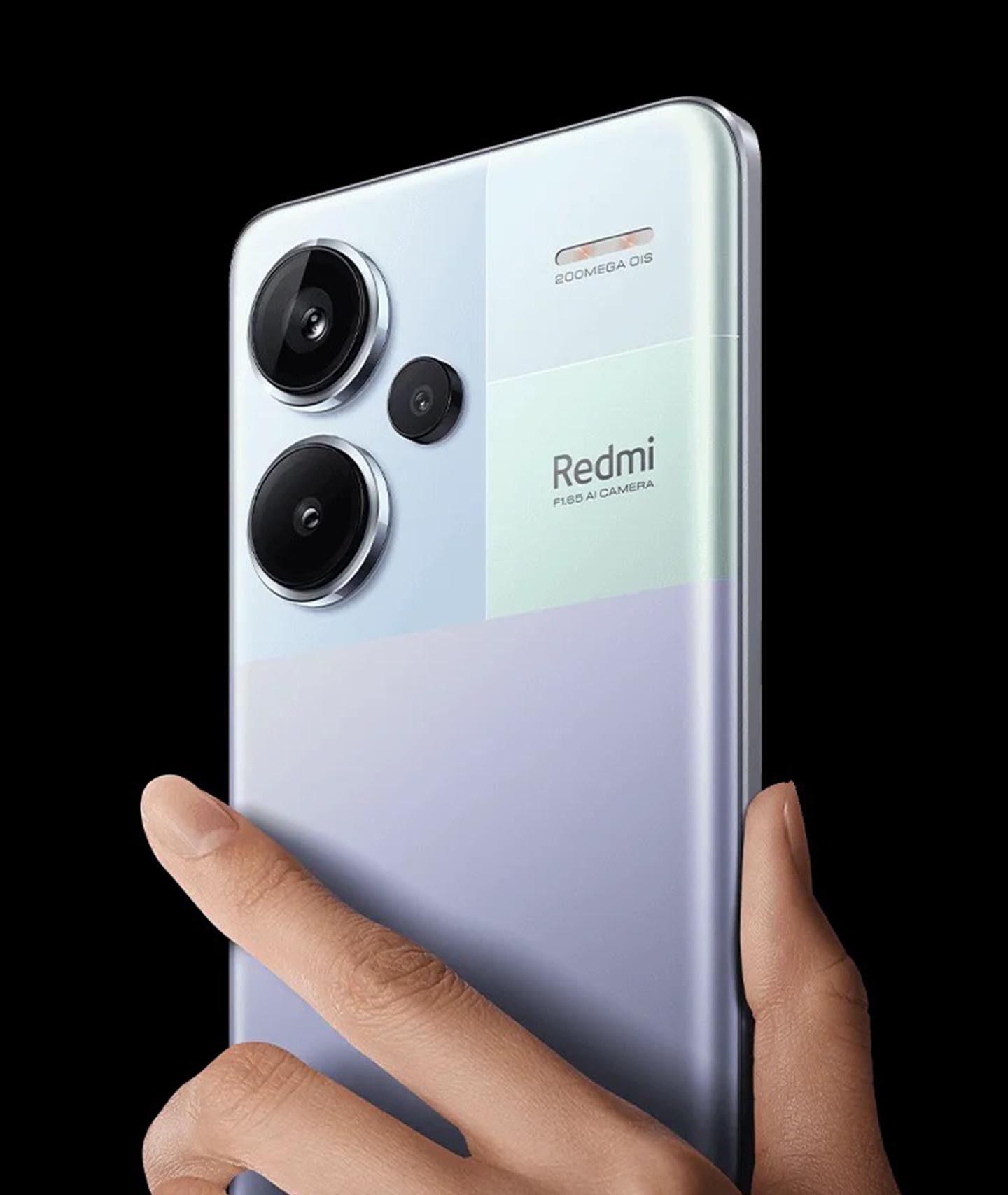
1. Xiaomi Redmi Note 13 Pro+ 5G
Price: ₦690,300
The Redmi Note 13 Pro+ is a stunning mid-range phone with excellent features. It combines a premium design, a big, curved AMOLED display, and impressive performance. This phone has a 200MP camera, which sounds amazing, right? While it can take fantastic photos in good lighting, it might struggle a bit in low-light situations. But don’t worry! For everyday photos, it works perfectly fine.
Pros:
Gorgeous curved AMOLED display
Powerful Dimensity 7200 Ultra processor
Fast 120W charging
200MP main camera for sharp daytime photos
IP68 water resistance—your phone won’t get ruined by a little splash!
Cons:
Still running Android 13, not the latest Android 14
Camera struggles in low light
Price might feel high for some users considering the camera’s limitations
2. Xiaomi Redmi Note 11 Pro+ 5G
Price: ₦370,000
The Redmi Note 11 Pro+ 5G is all about giving you a big screen and smooth performance at an affordable price. It comes with a 120Hz AMOLED display, making everything look extra smooth and vibrant. It also features 67W fast charging to get you back up to 100% in no time.
While the 108MP camera takes beautiful photos in good light, it’s not great at night. But don’t worry too much—this phone excels in everyday tasks and has a solid battery life to back it up.
Pros:
Stunning 120Hz AMOLED display
Solid 5G performance
67W fast charging—very quick charging!
Great speakers for a rich sound experience
Cons:
108MP camera isn’t great in low light
Average secondary cameras (ultrawide and macro)
MIUI (Xiaomi’s software) can be a bit messy at times
3. Xiaomi Redmi Note 12 Pro 5G
Price: ₦280,000
The Redmi Note 12 Pro 5G has a small form factor but packs powerful features. It features a 120W charging system and has a Dimensity 1080 chip, so it’s fast and reliable for gaming and other tasks. The display quality is top-notch for the price, but the camera quality, especially zooming, isn’t as good as some competitors.
Pros:
Gorgeous display—one of the best in this price range
120W fast charging—you’ll love how quickly your phone charges
Smooth performance thanks to the Dimensity 1080 chip
If you’re looking for a solid mid-range phone, the Poco X4 Pro 5G is a great choice. It’s equipped with a 120Hz AMOLED display and a powerful 5000mAh battery that lasts all day. The 67W fast charging ensures you’re up and running in no time.
Although it’s a great phone overall, the cameras could use a little improvement, especially in low light. It’s also not the best choice for hardcore gamers, but it’s more than enough for casual use.
Pros:
Bright 120Hz AMOLED display
Long-lasting 5000mAh battery
67W fast charging for super quick top-ups
Splash-resistant design for added protection
Cons:
Cameras aren’t great in low light or close-up shots
Software can feel cluttered with bloatware
Not ideal for heavy gamers
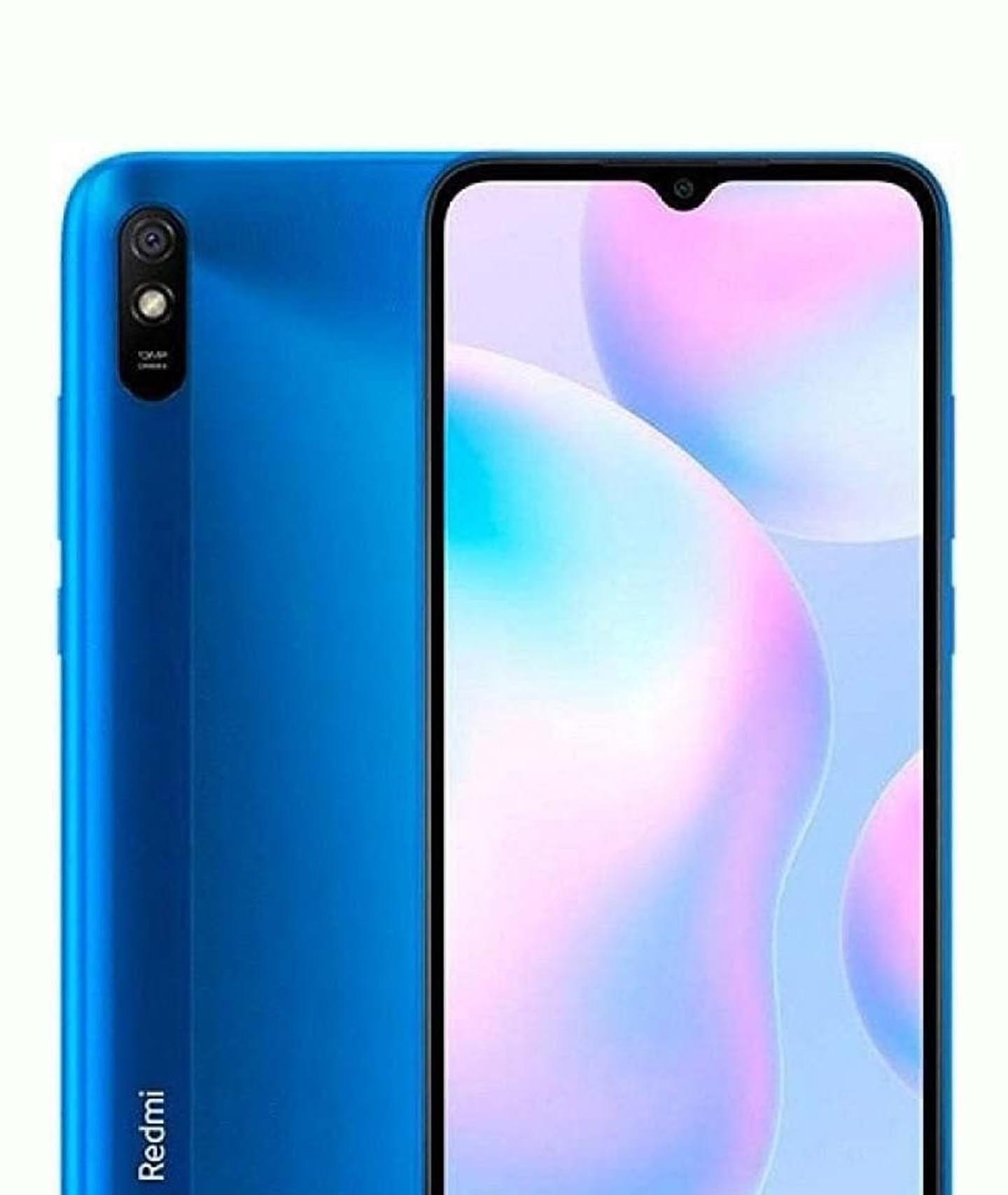
5. Xiaomi Redmi 9A
Price: ₦95,000
The Redmi 9A is one of the most affordable smartphones on the market, and it still offers a lot of value for the price. It has a 5020mAh battery that lasts all day, and the large 6.53-inch display is perfect for basic tasks like calls, browsing, and watching videos.
However, the phone doesn’t have the power for heavy multitasking, and the performance can slow down if you have too many apps open at once. Still, it’s a great budget option for users who need something simple.
Pros:
Huge 5020mAh battery for long-lasting power
Large 6.53-inch display for comfortable use
Expandable storage—add more space if you need it
Cons:
Limited 2GB RAM—multitasking can be slow
Old Android 10 version (instead of the lighter Android Go)
Slow 10W charging
Uses an older Micro-USB port instead of newer USB-C
6. Xiaomi Redmi 11 Prime 5G
Price: ₦195,800
For those who want an affordable 5G phone, the Redmi 11 Prime 5G is a solid choice. It’s powered by the Dimensity 700 chip, making it great for everyday tasks, and the 5000mAh battery will last a full day without issues.
Although it offers 5G, the 90Hz LCD display is not as vibrant as AMOLED screens, and the 50MP camera doesn’t live up to expectations for photography lovers.
Pros:
Affordable 5G phone
Decent performance for everyday use
Long-lasting 5000mAh battery
Expandable storage via microSD card
Cons:
LCD display isn’t as vibrant as AMOLED
Some bloatware in the software
The 50MP camera is decent but not impressive
7. Xiaomi Redmi 13C
Price: ₦170,000
The Redmi 13C is a budget-friendly phone with solid features. It has a 5000mAh battery and runs on the MediaTek Helio G85 chipset. With Android 13, it offers a smooth experience, and the camera setup, though basic, is good for casual photography.
It’s perfect for someone who just needs a reliable phone without breaking the bank.
Pros:
Long-lasting 5000mAh battery
Affordable 5G on a budget
Solid ergonomic build
Expandable storage (128GB option)
Cons:
Slow charging speed
Average cameras
Pre-installed apps that can clutter the interface
HD display isn’t as sharp as other phones
8. Xiaomi Black Shark 5 Pro
Price: ₦470,700
For gaming enthusiasts, the Xiaomi Black Shark 5 Pro is a beast. Powered by the Snapdragon 8 Gen 1 chip and paired with 12GB of RAM, it handles even the most demanding games with ease. Plus, it comes with pop-up physical triggers that enhance your gaming experience.
However, the phone tends to get hot during extended gaming sessions, and the battery life can be affected by the powerful components.
Pros:
Incredible gaming performance with Snapdragon 8 Gen 1
144Hz refresh rate display for smooth visuals
120W fast charging to quickly juice up the phone
Excellent stereo speakers
Cons:
Gets uncomfortably hot during gaming
Battery life could be better
Smaller 6.67-inch display may feel too small for some gamers
9. Xiaomi Mi Mix Fold 3 5G
Price: ₦1,800,610
The Mi Mix Fold 3 is Xiaomi’s third-generation foldable phone, and it’s as impressive as it sounds. The design is sleek and functional, with a 5x telephoto lens that gives you fantastic zoom shots. It also has a 67W fast charging feature, making it practical despite being a foldable.
While it has a Snapdragon 8 Gen 2 chip, it’s not perfect—it lacks waterproofing and can overheat with extended use.
Pros:
Beautiful foldable design
Snapdragon 8 Gen 2 for smooth performance
Wireless charging for convenience
Fantastic 5x telephoto zoom camera
Cons:
No waterproofing
The display can be slow to respond sometimes
No autofocus on the ultrawide camera
10. Xiaomi Mi 12 Pro 5G
Price: ₦480,000
The Mi 12 Pro 5G is a flagship phone that combines a premium design with powerful performance. It has an OLED display that’s vibrant and clear, making everything look amazing. With 120W fast charging, you can quickly charge up and keep using it for gaming, browsing, and more.
However, the camera system could be better, especially in low-light conditions.
Pros:
Beautiful OLED display
120W fast charging—you’ll love how quick it charges
Excellent 5G connectivity
Cons:
The camera system isn’t the best in low light
Speaker quality could be better
11. Xiaomi Redmi Note 14 Pro
Price: ₦480,000
The Redmi Note 14 Pro is a mid-range phone that delivers solid performance with a sleek design. It features a 6.67″ AMOLED display with a high refresh rate, making scrolling and gaming smooth. The 5,000mAh battery ensures all-day use, and with 67W fast charging, you won’t have to wait long to power up.
However, the camera struggles a bit in low-light conditions, and MIUI comes with some pre-installed bloatware.
Pros:
6.67″ AMOLED display with a high refresh rate for smooth visuals
5,000mAh battery lasts all day
45W turbo-charging gets you back up quickly
Cons:
Low-light camera performance could be better
MIUI has some bloatware
There you have it—a detailed look at the best Xiaomi phones available in Nigeria right now. Whether you’re on a tight budget or looking for something high-end, Xiaomi has options that suit every need. From the Redmi 9A for budget-conscious users to the Mi Mix Fold 3 for those who want the latest in foldable tech, there’s a phone for you.
Take your time to decide which one fits your needs, and remember: Xiaomi phones pack a lot of value for the price. Happy shopping!
FAQs
Q: Are Xiaomi phones affordable?
A: Yes, Xiaomi phones are known for their budget-friendly pricing. However, it’s worth considering how this affects long-term support and customer service availability.
Q: How do I remove bloatware from Xiaomi phones?
A: MIUI isn’t as optimized as Google’s stock Android or Samsung’s interface, but you can manage pre-installed apps in several ways:
Disabling Apps: Some pre-installed apps can be disabled to remove them from view and free up resources, though they won’t be fully deleted.
Using a Third-Party Launcher: Installing a custom launcher from the Play Store can provide a cleaner experience and hide unwanted apps.
Installing a Custom ROM: Advanced users can unlock root access and flash a new version of Android, but this is risky and may void the warranty.
To remove bloatware without rooting:
Enable developer options and USB debugging on your Xiaomi phone.
Download Xiaomi ADB/Fastboot Tools on your PC.
Connect your phone to the PC and allow USB debugging.
Use the tool to uninstall or disable unwanted apps.
Restart your phone for changes to take effect.
Note: Xiaomi doesn’t allow the Mi Browser to be uninstalled, only disabled. Some apps may also return after system updates, requiring you to disable them again.
Q: Do Xiaomi phones come with earbuds?
A: Most Xiaomi phones do not include earbuds in the box. However, Xiaomi sells separate options like the Xiaomi Buds 3 and Buds 3T Pro.
Q: Do Xiaomi phones support Google apps?
A: Yes, Xiaomi phones sold globally come with Google Mobile Services, including Google Maps, Play Store, and Google Pay. However, models imported from China may lack these services due to regional restrictions.
Investing is one of the smartest ways to grow your money, but with so many platforms available, it can be overwhelming to decide where to start. Whether you’re looking for stocks, mutual funds, real estate, or even cryptocurrency, there’s an investment platform in Nigeria for you. Let’s break it down in a simple, easy-to-follow way.
1. Bamboo
Bamboo allows Nigerians to invest in U.S. and Nigerian stocks right from their phones. You can buy shares in companies like Apple, Tesla, and Amazon with as little as $10. Bamboo also offers a “US Wallet” feature that lets you hold your funds in dollars, protecting them from naira depreciation.
Key Features:
Invest in Nigerian and U.S. stocks
Fractional shares available (own a piece of a stock)
SEC-regulated for security
Real-time market data
2. Chaka
Chaka provides access to over 4,000 stocks across Nigeria and international markets. If you want to diversify your investments, Chaka is a great choice. It allows you to open dollar and naira accounts, making it flexible for different currencies.
Key Features:
Invest in Nigerian, U.S., and global stocks
SEC-licensed for safety
Knowledge Base for beginners
3. Risevest
Risevest is a great option if you want professionals to manage your investments. They offer portfolios in U.S. stocks, real estate, and fixed-income assets. This is perfect for people who prefer a hands-off approach.
Key Features:
Professional portfolio management
Invest in U.S. stocks, real estate, and bonds
No Nigerian stock options
4. PiggyVest
PiggyVest, co-founded by Odunayo Eweniyi, one of Nigeria’s top tech women, started as a savings platform but has expanded to offer investment options. It allows users to invest in real estate, government bonds, and other assets with as little as ₦5,000.
Trove offers a mix of traditional and digital investments. With Trove, you can invest in Nigerian and global stocks, ETFs, bonds, and even cryptocurrencies.
Key Features:
Over 10,000 investment options
Start with as little as ₦1,000 or $10
Includes cryptocurrency investments
6. Cowrywise
Cowrywise is designed for those who want to automate their savings and investments. It focuses on mutual funds and does not offer stocks, making it great for long-term wealth building.
Key Features:
Invest in low, medium, and high-risk mutual funds
Automated savings feature
Investment circles for group investing
7. Quidax
If you’re interested in Bitcoin, Ethereum, and other digital currencies, Quidax is a great option. It offers a simple way to buy, sell, and store crypto assets.
Key Features:
Easy-to-use crypto trading platform
Secure wallet for storing digital assets
Approved by the Nigerian SEC
8. I-Invest
I-Invest is best for those looking for safe, low-risk investments like Treasury bills, Eurobonds, and mutual funds.
GetEquity allows you to invest in startups and high-growth companies in Africa. This is a high-risk, high-reward investment option.
Key Features:
Invest in early-stage African startups
Venture capital and equity funding
High potential returns
10. Crowdyvest
Crowdyvest focuses on funding impactful projects in sectors like agriculture, real estate, and transportation. This is perfect for those who want their investments to drive social change.
Key Features:
Invest in agriculture, real estate, and transport projects
When choosing an investment platform, consider the following:
Your Goals: Do you want short-term or long-term returns? Stocks and real estate are great for long-term growth, while Treasury bills offer stability.
Risk Tolerance: Are you comfortable with high-risk investments like crypto and startups, or do you prefer safe options like bonds?
Platform Fees: Some platforms charge transaction fees, while others take a percentage of your profits.
Ease of Use: Beginners may prefer user-friendly platforms like PiggyVest or Cowrywise.
FAQs
What is the best investment platform in Nigeria?
It depends on your goals. Bamboo and Chaka are great for stocks, while PiggyVest and Cowrywise are best for beginners. If you want cryptocurrency, Quidax is a strong option.
Can I invest in U.S. stocks from Nigeria?
Yes! Platforms like Bamboo, Chaka, and Trove allow Nigerians to invest in U.S. stocks.
Are these investment platforms safe?
Yes, most are regulated by the Securities and Exchange Commission (SEC). However, always do your research before investing.
What’s the minimum amount needed to start investing?
You can start with as little as ₦1,000 on Trove, while others require ₦5,000 or more.
There’s no one-size-fits-all investment platform. The best one for you depends on your financial goals, risk appetite, and investment interests. Whether you’re looking for stocks, bonds, real estate, or crypto, Nigeria has an investment platform for you. Start small, stay consistent, and watch your money grow!
Imagine being able to send money, buy airtime, and pay bills—all from your phone—without needing to visit a bank. That’s exactly what AirtelTigo Money (AT Money) allows you to do. If you’ve ever wondered how to register, don’t worry! This guide will walk you through the process in the simplest way possible, making sure you don’t miss a step.
What is AirtelTigo Money?
AirtelTigo Money (AT Money) is like a digital wallet sitting right in your phone. It lets you send and receive money, buy airtime and data, pay for goods and services, and even handle bill payments. Whether you’re splitting a lunch bill with a friend or paying your electricity bill, AT Money makes it easy.
It started in 2011 as Tigo Cash, but after Airtel and Tigo merged in 2017, it became AirtelTigo Money. Today, it’s one of Ghana’s most convenient mobile money services.
What You Need to Register for AirtelTigo Money
Before you jump into the registration process, make sure you meet these requirements:
You must be at least 18 years old
You need a valid national ID (Ghana Card, Passport, Voter ID, etc.)
AirtelTigo makes it easy to register in two ways: through your phone or at an AirtelTigo office. Let’s break them down step by step.
Method 1: Register Using Your Phone (USSD Code)
If you prefer handling things from the comfort of your home, this method is for you. Here’s how you do it:
Dial *110# on your AirtelTigo line.
Select Register from the options.
Choose Self AT Money Registration.
Wait for a confirmation SMS about your registration status.
Set Up Your PIN
Once you’re registered, you’ll need to set up your PIN to keep your money safe:
Dial *110# again.
Select Option 1 (Yes) to confirm registration.
Enter a 4-digit PIN (Avoid easy guesses like 1234 or 1111).
Confirm the PIN by entering it again.
Provide an alternate phone number for PIN recovery.
Enter a secret word that you can remember easily (this helps with account recovery if needed).
And that’s it! You’ll get a final SMS confirming that your AirtelTigo Money wallet is ready to use.
Pro Tip: If you face any issues during self-registration, simply call AirtelTigo customer service or visit an agent for help.
Method 2: Register at an AirtelTigo Office
Not comfortable doing it yourself? No problem! Just visit any AirtelTigo office or agent with your valid national ID. A customer care agent will assist you with the registration process.
You’ll provide your personal details, set up a 4-digit PIN, and within minutes, you’ll be good to go!
AirtelTigo Money Charges: What You Should Know
Let’s talk money! While sending money to another AirtelTigo user is free, there are charges for other transactions. Here’s what you should expect:
Amount (GHS)
Charge
0 – 50p
0.5 GHS
51 – 1000
1%
1001 – 1999
10 GHS
2000+
20 GHS
E-Levy Charges: If you send more than GHS 100 in a day, you’ll be charged 1% for e-levy, even if you’re sending money to another AirtelTigo number.
Frequently Asked Questions (FAQs)
What is the AirtelTigo Money shortcode for merchants?
If you’re a business owner, you can access your merchant account by dialing *464#.
Can I send money from AirtelTigo Money to other networks?
Yes! Thanks to Ghana’s mobile interoperability system, you can send money from AT Money to other networks like MTN MoMo and Telecel Cash.
How can I reset my AirtelTigo Money PIN if I forget it?
If you forget your PIN, don’t panic! Just dial *110#, select Reset PIN, and follow the instructions. You may need your secret word or an alternate number for verification.
AirtelTigo Money makes life easier by allowing you to handle transactions straight from your phone. Whether you’re paying for groceries, sending cash to family, or buying data, it’s a reliable and convenient service.
Dial *110# now to get started and enjoy seamless mobile money transactions! Just remember—never share your PIN with anyone to keep your account safe from fraudsters.
Now that you know how to register, go ahead and activate your AirtelTigo Money wallet today!
If you’ve got an MTN SIM card in Ghana, you need to register it—no ifs, ands, or buts. Whether you’re getting a new SIM or making sure your old one is properly registered, this guide will walk you through every step in the simplest way possible. Think of it like setting up a new phone—easy when you know what to do, but frustrating if you don’t. Let’s make sure you get it right the first time!
Why Do You Need to Register Your MTN SIM Card?
Registering your SIM card isn’t just some random rule—it’s a government requirement. The goal is to keep mobile networks secure and prevent fraud. If you don’t register, your SIM will eventually get blocked, meaning no calls, no texts, no data—nothing. That’s not a situation you want to be in!
What You Need for MTN SIM Registration
Before heading to an MTN office or agent, make sure you have:
Your Ghana Card (ECOWAS card) – No other ID will work!
Your digital address – You can find this using Ghana Post GPS
That’s it! If you have these three things, you’re good to go.
Step 1: Linking Your Ghana Card to Your MTN SIM
Before you can complete biometric verification, you need to link your SIM to your Ghana Card. You can do this in two ways: using a USSD code or through the myMTN app.
Method 1: Using the USSD Code (Easiest Method)
Dial *404# on your phone.
Follow the prompts and enter:
Your full name (as it appears on your Ghana Card)
Your Ghana Card number (skip the hyphens)
Your date of birth
You’ll get a confirmation message with a unique code.
Method 2: Using the myMTN App
If you prefer using an app, follow these steps:
Open the myMTN app (download it from Google Play Store or Apple App Store if you don’t have it).
Tap More, then My Account.
Select SIM Registration and agree to the Terms of Service.
Confirm that you are the owner of the SIM.
Enter your phone number and verify with an OTP (One-Time Password).
Enter your name and Ghana Card number.
You’ll get a notification confirming the linking process.
Note: If you’re registering a brand-new SIM, the linking process is automatic since it’s required before activation.
Step 2: Completing Biometric Verification
Linking your SIM isn’t enough—you still need to verify your identity through biometric registration. This part must be done in person at an MTN office or an authorized agent.
Here’s what to do:
Visit any MTN service center or an authorized MTN agent.
Provide your MTN SIM card, Ghana Card, and digital address.
The agent will scan your fingerprints and take other biometric details.
Once complete, they’ll confirm that your SIM is now fully registered.
You’ll receive a confirmation message, and your SIM is now good to go!
Step 3: Checking Your SIM Registration Status
Not sure if everything went through successfully? Here’s how to check:
B-Cap (Biometric Capture) status (if it says “Yes,” you’re fully registered)
If the B-Cap status is “No,” you need to visit an MTN office to complete biometric verification.
FAQs
Can I Register My MTN SIM by Myself?
No. MTN used to have a self-registration app, but it’s no longer available for customers. You must visit an authorized agent for biometric verification.
How Much Does SIM Registration Cost?
Officially, registering an MTN SIM is free when you buy a new SIM. However, some agents may charge between GHS 30 – GHS 35 for verification and Mobile Money (MoMo) registration.
What Happens if I Don’t Register My SIM?
If you don’t register your SIM, MTN will block it. You won’t be able to make calls, send texts, or use data. If you miss the final deadline set by the government, your number could be permanently deactivated.
Registering your MTN Ghana SIM card isn’t as complicated as it might seem. Just follow these steps:
Link your SIM to your Ghana Card using *404# or the myMTN app.
Visit an MTN office or agent for biometric verification.
Check your registration status by dialing *400#.
That’s it! Now, you can enjoy your MTN service without any worries. If you found this guide helpful, share it with someone who might need it!
Investing is like planting a tree. You put money in, take care of it, and over time, it grows into something valuable. But just like you wouldn’t plant a tree without checking if the soil is good, you shouldn’t invest without choosing the right platform.
Nigeria has many investment apps promising great returns, but how do you know which ones you can trust? Don’t worry—I’ve got you covered. In this guide, I’ll break down the best investment apps in Nigeria, explaining what they do, how they work, and what makes them worth your time. Let’s dive in!
1. Cribstock
Cribstock is changing the way Nigerians invest in real estate. Instead of needing millions to buy a house or apartment, you can invest in property with as little as N10,000. The platform allows users to own shares in rental properties and earn passive income from rent payments. It’s a great option for those looking to grow wealth through real estate without the hassle of buying or managing properties themselves.
2. PiggyVest
Founded by Odunayo Eweniyi, PiggyVest started as a savings platform but now offers investment opportunities through its Investify feature. With as little as N5,000, you can invest in fixed income, agriculture, and transportation sectors and earn up to 25% returns. If you’re also looking for a way to save money effectively, PiggyVest offers an automatic savings plan with interest rates between 5% and 15% per year.
3. Carbon
Formerly known as Paylater, Carbon is a digital bank that also offers great investment options. It provides three investment plans:
Cash Vault: Lock your money away and earn 11% interest.
FlexSave: A flexible plan with up to 9% interest.
Goals Plan: Set daily, weekly, or monthly targets and earn 9.5% interest. If you’re looking for a mix of digital banking and investment, Carbon is a solid choice.
4. Cowrywise
Cowrywise helps users invest in naira and dollar mutual funds. If you don’t want to put all your eggs in one basket, this app allows you to spread your investments across multiple assets. It also offers different savings plans, including emergency funds and halal savings for ethical investors. Plus, there are no minimum withdrawal restrictions.
5. Bamboo
Bamboo gives Nigerians access to over 3,500 local and international stocks. You can invest in the Nigerian Stock Exchange or major U.S. stock markets. The app’s security features ensure that your investments are safe, and you can start with as little as $20.
6. Trove
Trove is another great app for stock investing. With as little as N1,000, you can buy shares in Nigerian, American, and Chinese companies. It also supports investments in bonds, ETFs, and real estate investment trusts (REITs), making it a versatile option for those looking to diversify their portfolio.
7. Risevest
Risevest focuses on dollar-denominated investments, allowing Nigerians to invest in U.S. stocks, real estate, and Eurobonds. The app boasts an average return of 14% on stock investments, although actual returns depend on market performance. With a minimum investment of just $10, it’s a great way to protect your money from naira fluctuations.
8. Chaka
Chaka makes it easy to invest in both local and international stocks. With as little as N1,000 or $10, you can buy shares in major global markets. Whether you’re an individual or a business looking to invest, Chaka provides a secure and regulated platform.
9. I-invest
I-invest is unique because it lets you invest in Treasury bills, Eurobonds, and fixed deposits. If you prefer low-risk investment options, this app is one of the safest choices. It allows users to track their portfolios in real-time and provides a seamless way to manage investments.
10. GetEquity
GetEquity allows Nigerians to invest in early-stage startups, giving them access to potential high-growth companies before they become mainstream. If you’re interested in venture capital but don’t have millions to invest, this app provides an affordable way to get started.
11. Crowdyvest
Crowdyvest connects investors with businesses in sectors like agriculture, real estate, and transportation. It offers two main plans:
Hyperplan: Low-medium risk investment opportunities spread across different asset classes.
Projects: Project-specific investments with competitive returns. With a minimum investment of N20,000, Crowdyvest allows users to make a positive impact while earning profits.
FAQs About Investment Apps in Nigeria
Q: What’s the best investment app for beginners?
If you’re new to investing, PiggyVest and Cowrywise are great starting points because they’re simple and have low minimum investment amounts.
Q: Is it safe to invest through these apps?
Yes, but always do your research. Look for apps registered with Nigeria’s Securities and Exchange Commission (SEC) and ensure they use strong security measures.
Q: How much do I need to start investing?
It depends on the app. Some allow investments as low as N1,000 (Trove, Chaka), while others require at least N5,000 (PiggyVest) or even N20,000 (Crowdyvest).
Investing doesn’t have to be complicated or risky. The key is to start small, choose the right platform, and stay consistent. Whether you’re interested in stocks, real estate, startups, or mutual funds, there’s an app on this list that fits your needs. So, take that first step today—your future self will thank you!
Learn how to borrow airtime or data from MTN Ghana using *506# and stay connected with minimal fees.
Have you ever been in a situation where you’re trying to make an urgent call or stream your favorite music, but your airtime or data runs out? It can be super frustrating, especially when you don’t have any credit left and you need to stay connected. But don’t worry! MTN Ghana has got you covered with a service called XtraTime, which lets you borrow both airtime and data. That means, even if you’re out of credit, you can still make calls, send texts, or browse the web until you top up your balance.
Let’s walk through how you can easily borrow airtime and data from MTN. Trust me, it’s way simpler than you think!
What is MTN XtraTime?
MTN XtraTime is a super helpful service that allows you to borrow airtime or data when you’re running low. Whether you’re making an important call or need to finish that last bit of browsing, XtraTime has your back. However, there are a few things to know before you can start using this service.
Who Can Borrow Airtime or Data on MTN?
Before you start borrowing, make sure you meet the following criteria:
Registered MTN SIM: You need to be using an MTN SIM that’s properly registered.
Prepaid Customer: The service is available to prepaid or pay-as-you-go customers.
On the MTN Network for 3 Months: You should have been using MTN for at least three months.
Low Balance: If you have less than GHS 4 worth of airtime or data, you’re eligible to borrow.
No Unpaid Loans: If you have an outstanding loan from a previous XtraTime borrowing, you need to clear that first.
How to Borrow Airtime on MTN?
Imagine you’ve run out of airtime and need to make a quick call. Here’s what you need to do:
Dial the Code: On your phone, dial *506#. This is the magic number that gets you into the MTN XtraTime service.
Select Airtime Option: After dialing, you’ll see a menu with different options. Choose the one that says “Borrow Airtime” or, if you’re unsure, select Option 3 to see more choices.
Pick the Amount: You’ll be shown different amounts of airtime that you can borrow. Select the one that suits your needs. Don’t worry; there’s something for everyone!
Confirm Your Borrowing: Once you’ve selected your amount, MTN will ask you to confirm. Just press 1 to confirm your choice.
Get Your Airtime: Within a few seconds, you’ll get a message confirming the airtime has been added to your balance. You’re all set!
How to Borrow Data on MTN?
Now, let’s say you need some extra data to finish browsing or watching a video. Borrowing data from MTN is just as simple as borrowing airtime. Here’s how:
Dial the Code: Dial *506# to access the XtraTime service.
Select Data Option: Choose “Request Data Advance” from the menu.
Pick Your Data Bundle: You’ll see a list of data bundles you can borrow. Pick the one that fits your needs. Whether it’s a small amount for checking social media or a bigger bundle for streaming, MTN has you covered.
Confirm the Data Borrowing: After choosing your preferred bundle, you’ll need to confirm by pressing 1.
Receive Your Data: Just like with airtime, MTN will send you a message confirming that your data has been added to your account. Now you can browse to your heart’s content!
How Much Can You Borrow?
The amount of airtime or data you can borrow depends on a few things:
How Much You Use: If you often buy a lot of airtime or data, you’ll have a higher limit to borrow.
Your Repayment History: If you’ve been quick to repay your previous loans, MTN will trust you more and give you the option to borrow more in the future.
Your Limit: Everyone has a specific borrowing limit, which can grow over time if you’re a loyal MTN customer.
So, while you might not be able to borrow a huge amount at first, the more you use and repay XtraTime, the more you can borrow in the future.
How Much Does Borrowing Cost?
While XtraTime is super helpful, it’s not entirely free. MTN charges a small 10% service fee on everything you borrow.
For example, if you borrow GHS 1 worth of airtime, you’ll need to pay back GHS 1.10 when you recharge. If you borrow GHS 10 worth of data, the total cost will be GHS 11.
Here’s a quick tip: When you select the amount to borrow, always double-check the total cost before confirming your transaction. MTN will show you how much you’ll need to repay, so you can decide if it’s okay with you.
How Do You Pay Back the Borrowed Airtime or Data?
You don’t have to worry about remembering to repay your loan. MTN makes it easy by automatically deducting what you owe from your next airtime or data recharge. So, when you top up your balance, the borrowed amount will be deducted first. If you borrow data, the equivalent airtime will be deducted from your next recharge.
For example, if you borrow 500MB of data for GHS 3, plus a service fee of GHS 0.30, you’ll repay the total of GHS 3.30 the next time you top up.
Can You Borrow 1GB of Data?
Yes, but there’s a catch! Borrowing 1GB or more of data is usually reserved for long-time, loyal customers who frequently use the service. Your limit depends on how active you are on MTN’s network and your borrowing history. The more you use XtraTime and pay back on time, the higher your limit will get.
Borrowing airtime or data on MTN in Ghana is a quick and easy way to stay connected when you need it most. With just a few simple steps, you can borrow airtime for calls or get some extra data for browsing, all without having to wait for a top-up.
So next time you’re caught without airtime or data, just dial *506#, follow the simple prompts, and you’re good to go! Don’t forget to repay your loan the next time you recharge to keep your borrowing limit growing.
So, you’re looking to grab the AirtelTigo 30 GB data bundle, right? You’ve heard that it’s a fantastic deal, and you want to know exactly how to get it. Well, here’s the thing: the 30 GB bundle is no longer available, but don’t worry—there’s still a way to get lots of data with AirtelTigo. In this article, I’ll walk you through the details of how you can check if you’re eligible for AirtelTigo’s exclusive offers, how to buy the best available data bundles, and how to make sure you’re getting the most out of your internet.
Understanding the AirtelTigo Data Bundles
Before we dive into the steps for getting your data, let’s quickly go over the data packages AirtelTigo currently offers. That way, you’ll know exactly what’s available.
AirtelTigo Data Packages Available Right Now
15 GB for GHS 30 – Valid for 10 days
10 GB for GHS 20 – Valid for 5 days
5 GB for GHS 10 – Valid for 3 days
These options are perfect if you’re someone who loves to stream, game, or simply browse the internet. And while the 30 GB bundle isn’t available anymore, these packages still offer great value for your money.
Is the 30 GB Bundle Gone Forever?
Yep, the AirtelTigo 30 GB data offer is no longer available. But don’t panic! The good news is that you can still get a 15 GB bundle, which can be purchased twice if you want a total of 30 GB (though the 30 GB won’t be valid for 30 days like before). So, if you’re someone who loves streaming or downloading, these new packages should have you covered.
Step-by-Step: How to Check Your Eligibility for the 15 GB Data Bundle
Now, let’s talk about how to get started. The first thing you’ll need to do is check if you’re eligible for the 15 GB data bundle. AirtelTigo offers this bundle to selected customers, so it’s not available to everyone—yet! Here’s how you can check:
1. Dial *499#
This is the magic number. Dial it, and the system will tell you if you’re eligible for the bundle. Don’t worry, you won’t be charged for dialing this number.
2. Wait for a Text Message
Once you’ve dialed *499#, you’ll receive a text message. This text will confirm whether you’re eligible to get the bundle. If you’re eligible, you’ll be good to go. If not, don’t stress—it might just be a matter of time until you become eligible.
3. What if You’re Not Eligible?
If you’re not eligible for the bundle yet, don’t give up! The eligibility is decided randomly by AirtelTigo’s system. To increase your chances, just keep using your AirtelTigo number regularly, and stay connected. Over time, you may get selected for the bundle.
4. Check for Other Offers
If you’re not eligible for the 15 GB bundle, there might be other offers available to you. AirtelTigo sometimes has different promotions running, so it’s a good idea to keep an eye on their website or dial *499# from time to time to see if something new pops up.
How to Buy the AirtelTigo 15 GB Data Bundle
If you get that “You’re eligible!” message, congratulations! You can now go ahead and purchase the 15 GB bundle. Here’s how to do it:
1. Dial *499# Again
Dial *499# once more, and this time, you’ll see options on your screen. It’s as simple as following the prompts to get your data.
2. Select Option 1 for the 15 GB Data Bundle
Once you’ve dialed *499# and seen the options, choose Option 1 to select the 15 GB data bundle.
3. Choose Your Payment Method
AirtelTigo gives you a couple of ways to pay for your data bundle. You can either use your airtime balance or pay through AirtelTigo Money (if you have an account set up). Pick whichever option is easiest for you.
4. Confirm Your Purchase
Once you’ve selected your payment method, you’ll be asked to confirm your purchase. Double-check everything, and once you confirm, the data will be added to your account.
5. Start Enjoying Your Data!
That’s it! You’ll receive a confirmation SMS saying your data is ready to use. Enjoy surfing the web, streaming videos, or whatever else you do with your data.
What if You Want More Than 15 GB?
So, let’s say you’re really craving 30 GB of data. If you’re eligible for the 15 GB offer, you can actually purchase it twice! By doing so, you’ll have 30 GB of data, though the validity period won’t extend. It’s still a pretty good option if you really need a lot of data.
However, if you don’t want to deal with buying multiple bundles, there’s an alternative. AirtelTigo offers a 30 GB BigTime bundle for GHS 200. This bundle lasts for 30 days, so it might be the perfect option if you need lots of data without the worry of buying smaller bundles.
Keep an Eye on Your AirtelTigo Offers
The AirtelTigo 30 GB data bundle is no longer available, but don’t worry! There are still great options out there for getting plenty of data, like the 15 GB bundle. Whether you’re eligible or not, the most important thing is to stay connected, keep using your AirtelTigo number, and check for offers regularly.
Remember, these bundles are perfect for people who need a lot of data for things like streaming movies, playing games, or working from home. By following the steps above, you’ll be able to get the best AirtelTigo data package that suits your needs.
So, go ahead and dial *499# to see what’s available to you today. And hey, if you’re not eligible yet, don’t worry—your time will come! Keep enjoying your AirtelTigo services, and soon, you’ll be surfing the web with ease.
Are you looking to grab an hourly data bundle from MTN Ghana? If so, you might have already realized that MTN doesn’t actually offer an hourly data bundle. But don’t worry—there are still plenty of affordable data bundles MTN offers that work for all kinds of internet needs, and in this article, I’m going to tell you all about them!
In this easy-to-follow guide, I’ll explain some of the best alternatives to an hourly bundle, like the Midnight bundle, Kokrokoo, and Social Media bundles. I’ll also show you exactly how to activate these packages, step-by-step, so you can be surfing the web in no time. Let’s dive in!
Why Doesn’t MTN Ghana Have an Hourly Bundle?
You may be wondering, “Why doesn’t MTN Ghana offer an hourly data bundle?” The truth is, MTN doesn’t have a specific package that’s priced just for each hour. But here’s the cool part: They still have bundles that are really affordable and give you plenty of data for your browsing, even though they’re not structured by the hour.
Instead of an hourly bundle, MTN offers data packages that last for different periods of time, with some bundles designed for specific hours of the day. These bundles are super flexible and can be activated whenever you need them.
Let’s Explore the MTN Data Bundles You Can Activate
Since there isn’t an hourly bundle, let’s look at the great alternatives you can use throughout the day to stay connected. I’m going to break down these bundles, so you can pick the one that fits your needs best.
1. Midnight Bundle (12 AM – 5 AM)
One of the most popular bundles MTN Ghana offers is the Midnight Bundle. This special package gives you access to internet data from 12 AM to 5 AM. It’s perfect for night owls who love browsing the web late into the night or for those who want to do some serious downloading while they sleep.
Here’s how it works:
Flexi Option: You choose how much data you want! For example:
GHS 0.01 = 17.67 MB
GHS 2.99 = 5.16 GB
Standard Option: Fixed price for 7.27 MB at GHS 3.
How to Activate the Midnight Bundle:
Dial *138#
Choose the Midnight bundle option.
Pick the plan that works best for you (either the Flexi or Standard package).
You can use this bundle until 5 AM, and if you don’t use up all your data, you can save it for the next night!
This bundle is really great if you want to get things done during the quiet hours, like binge-watching your favorite shows, downloading files, or browsing social media without using up all your daytime data.
2. Kokrokoo Bundle (5 AM – 8 AM)
If you’re an early bird and need some data to kick-start your day, the Kokrokoo Bundle is for you! This package is available between 5 AM and 8 AM, so it’s perfect for checking emails, scrolling through your social media feed, or catching up on the news in the morning.
Here’s what you get with the Kokrokoo Bundle:
GHS 1.24 gets you 400 MB of data and 30 minutes of free on-net calls. How cool is that?
How to Activate the Kokrokoo Bundle:
Dial *138#
Select the Kokrokoo option.
Once activated, you’ll have 400 MB of data and 30 minutes of talk time to use between 5 AM and 8 AM.
This is a perfect choice if you don’t want to burn through your daytime data first thing in the morning. It’s also a good option if you’re someone who loves to make early morning calls or video chats with friends and family.
3. Social Media Bundles (Unlimited Social Media Browsing)
We all know how much time we spend scrolling through social media these days—whether it’s Facebook, Instagram, WhatsApp, Twitter, or TikTok. MTN Ghana has got you covered with Social Media Bundles that allow you to stay connected without worrying about your regular data usage.
Here’s what MTN offers:
Flexi option: You can choose your own data amount, and the bundle can be customized based on your needs.
Standard options: These are affordable, set-priced bundles:
GHS 1 = 70.87 MB
GHS 5 = 354.36 MB
GHS 10 = 708.72 MB
How to Activate the Social Media Bundles:
Dial *138#
Enter 99 for More options.
Select Social Media bundles from the list and choose the one that fits your social browsing habits.
Whether you want to post an update on Facebook, reply to messages on WhatsApp, or scroll through TikTok videos, these bundles give you plenty of data for just social media usage. Perfect for when you’re just interested in catching up on your feeds without burning through your main data.
How to Check Your Data Balance
It’s always good to keep an eye on how much data you have left, especially if you’re using one of these bundles. To check how much data you have remaining, you can do the following:
You’ll get a text message with the details of how much data you have left on your active bundles.
This way, you’ll always know when to top-up or when you can switch to a different bundle.
A Quick Recap: MTN’s Best Data Alternatives to the Hourly Bundle
Even though MTN Ghana doesn’t offer a specific hourly data bundle, they’ve got some awesome alternatives that will still keep you connected at all hours of the day.
Midnight Bundle: Data from 12 AM – 5 AM. Ideal for late-night browsing or downloading.
Kokrokoo Bundle: Data from 5 AM – 8 AM. Perfect for early morning browsing and calling.
Social Media Bundles: Keep your social feeds updated without using up your regular data.
Stay Connected with MTN’s Affordable Bundles
While MTN Ghana doesn’t have an hourly bundle per se, their other bundles are an excellent way to get affordable, flexible data throughout the day. Whether you’re an early riser, a night owl, or a social media enthusiast, MTN has a data package that will suit your needs.
Just follow the steps I’ve shared to activate the bundles, and you’ll be browsing, chatting, and streaming with ease. Don’t forget to check your data balance often, and you’ll always know exactly when it’s time to grab another bundle. So go ahead, pick the bundle that fits your lifestyle, and enjoy the internet with MTN Ghana!
Welcome to the Ultimate myMTN Ghana App Guide, where we’ll walk you through everything you need to know about using this handy app.
Whether you’re looking to buy data, manage your MoMo transactions, or find out how to get the best deals, this guide has got you covered. So, let’s dive in and make your mobile experience with MTN a breeze!
What is the myMTN Ghana App?
Think of the myMTN Ghana app as your personal MTN assistant right in your pocket. It’s a super helpful app for both Android and iOS devices that gives you access to all of MTN Ghana’s products and services. Whether you want to top up your airtime, check your data balance, manage your Mobile Money (MoMo), or even enjoy some cool entertainment, this app makes it all easy. Plus, it’s free to download and use!
How to Get Started: Install and Log In
Getting started with the myMTN Ghana app is quick and simple. Here’s what you need to do:
Download the App
For Android: Go to the Google Play Store and search for “myMTN Ghana.”
For iOS: Head to the Apple App Store and search for “myMTN Ghana.”
Log In
Open the app after it’s installed and tap on “Get Started”.
Enter your MTN mobile number.
You’ll receive a verification code (also known as OTP) via SMS. Enter that code into the app.
That’s it! You’re now logged in and ready to explore all the cool features.
What Can You Do with the myMTN Ghana App?
Now that you’re logged in, let’s talk about all the things you can do with the app. Whether you need more data for streaming or want to send money through MoMo, everything is at your fingertips!
1. Buy Data Bundles
If you’re always running out of data or looking for a specific package, the myMTN app makes it super easy to buy data. You can choose from:
Regular Data Bundles: For everyday internet use.
Mashup: The MTN Mashup Bundle is a flexible bundle that gives you both talk time and data.
Just4U: Just as the name implies, the Just4U bundle provides subscribers with specially customized offers just for you, based on your usage.
Social Media Data: If you love scrolling through social media apps like Instagram, Twitter, or Facebook, these bundles are perfect for you.
Call Abroad Offers: Stay connected with family and friends around the world! Whether it’s Canada, the USA, or India, there are special deals just for international calls.
Airtime Transfers: Send airtime to anyone, anytime—whether it’s another MTN number or a different network.
3. Mobile Money (MoMo) Services
Even though MTN has a dedicated MoMo app, the myMTN app lets you manage your MoMo account too. Here’s what you can do:
Check Your MoMo Balance: Keep track of how much money you have in your MoMo wallet.
Send Money: Transfer money to other MTN MoMo accounts, different mobile networks, or directly to a bank.
Withdraw Money: You can easily cash out your MoMo balance at an MTN service center.
Get Your Transaction History: Review your past transactions and even get detailed statements sent to your email.
4. Business Services
Running a business or thinking of starting one? The myMTN Ghana app also offers special services for businesses:
SME Plus: This is designed for small and medium businesses. It includes special voice, data, and SMS bundles, as well as free calls during certain hours.
Business Hub: Access useful tools for businesses, like Webwiz for website management or Business Messenger for easy communication.
5. Entertainment
The app isn’t just about work—it’s about fun too! You can enjoy entertainment services like:
Vuclip Videos: Watch movies and TV shows directly from the app.
Socca Chat: Stay updated with soccer news and chat with fellow fans.
Bookmate: Read eBooks from a huge library of titles.
6. Help and Support
Got a question or need help? The app’s Help and Support section makes it easy to reach out to MTN:
Contact Us: Get in touch with customer support via phone, email, or social media.
Find a Store: Need to visit an MTN office? The app shows you the nearest MTN stores, complete with their locations and contact details.
7. Other Cool Features
The app also offers a few more features that make it even better:
Request Broadband: Need fast internet at home? Request MTN fibre broadband and check if it’s available in your area.
Get an e-SIM: No physical SIM card needed—just request an e-SIM if your phone supports it.
Manage Subscriptions: View and manage all your subscriptions, like Caller Tunez, Data, or any MTN service.
Managing Your Account: Keeping Things in Check
One of the best things about the myMTN Ghana app is how easy it is to manage your account. You can check your data balance, voice minutes, and airtime right from the homepage. And if you ever run low on something, you can top up quickly or buy new bundles.
You can also view your usage history to see how much data you’ve used over the past week or month. This helps you stay on track and avoid surprises when it’s time to renew your bundles.
Troubleshooting: When Things Don’t Go as Planned
Sometimes, things don’t go smoothly—no app is perfect, right? If you ever run into trouble, here are a few things you can try:
Restart Your Device: A simple restart can sometimes fix minor issues.
Update the App: Check for updates in the app store. MTN often releases bug fixes or improvements.
Reinstall the App: If the app isn’t opening, try deleting it and installing it again.
Free Up Space: Make sure your phone has enough storage to run the app properly.
If these steps don’t solve the problem, you can always reach out to MTN customer support via the app.
Why You Should Use the myMTN Ghana App
The myMTN Ghana app is an easy way to stay in control of your MTN services. It helps you:
Save Time: Instead of calling customer service or going to a store, you can handle everything right from your phone.
Access Exclusive Deals: From special data bundles to business offers, there’s always something just for you.
Stay Updated: You can quickly check your balance, track your usage, and manage your services with ease.
And that’s it! With the myMTN Ghana app, you have everything you need to manage your MTN services in one place. It’s easy to use, packed with features, and designed to make your life simpler. Whether you’re a regular user, a business owner, or just someone who wants to save time, this app is your one-stop-shop for all things MTN.
So, next time you need to check your balance, buy a data bundle, or make a MoMo transfer, just pull up the myMTN Ghana app and get it done in seconds. It’s like having a mini MTN store in your pocket—how cool is that?
Learn how to activate, buy, and manage your MTN Data Zone Bundle in Ghana using the *135# shortcode with our easy guide.
Ever found yourself with no data or stuck with expensive calls when you need them most? We’ve all been there, right? Luckily, MTN Ghana has a solution that can help you save some cash and stay connected with the MTN Data Zone Bundle. Whether you’re chatting with friends, browsing the web, or checking social media, this bundle has some cool perks. Let me walk you through everything you need to know—step by step—on how to activate and use this bundle like a pro!
What Is the MTN Data Zone Bundle?
Before we dive into the “how-to,” let’s quickly go over what this bundle is all about. The MTN Data Zone Bundle is a super handy way to get discounts on calls and cheap data, which can save you a lot of money. With the Zone Bundle, you get up to 75% off on your call rates, so it’s perfect if you need to make those quick calls without burning through your airtime. Plus, it lets you grab affordable data bundles that can last you the whole day, but remember—they expire after 24 hours. So, use them wisely!
What Do You Need to Get Started?
To start using the MTN Data Zone Bundle, you need a few basic things:
A registered MTN number – This means your number should be registered under your name (simple stuff!).
A bit of airtime – You need to have enough balance on your phone to buy the bundle, so top-up your airtime first.
A little patience – Don’t worry; it’ll only take a few minutes to set up!
Got these things ready? Awesome, let’s get into the fun part: activating and using the bundle.
How to Activate the MTN Data Zone Bundle
Activating the MTN Data Zone Bundle is super simple. If you’ve ever used USSD codes before, you’ll be right at home here! Follow these steps:
Dial *135# on your phone. This is the magic code that opens up the MTN Zone menu.
Select “Activate.” Once you dial *135#, you’ll see a menu pop up on your screen. Choose the Activate option.
Wait for the confirmation message. After you activate it, you should get a message confirming that you’ve successfully joined the MTN Zone Bundle. Simple, right?
That’s it! You’re officially in the MTN Zone, and now you’re ready to buy your data bundle and enjoy those sweet savings.
How to Buy MTN Data Zone Bundles
Now that you’ve activated the MTN Zone, let’s grab some data! Here’s how you can buy data bundles through the MTN Zone:
Dial *135# again.
Yes, you’ll dial the same *135# to access the MTN Zone menu again.
Choose “Zone Bundles.” From the list, select the Zone Bundles option. This will take you to the data offers available.
Select “Data Zone Bundles.” Once you’re in the Zone Bundles section, choose Data Zone Bundles to view the different data options.
Pick the data bundle that suits you. You’ll see a list of data bundles with their prices and the amount of data you get. For example, you might see options like 281MB for GHS 2.09 or 692MB for GHS 4.19. Choose the one that fits your needs!
Confirm your purchase. After selecting your bundle, it will ask you to confirm the purchase. Select Yes to buy your data.
Once you’ve confirmed, your data bundle will be activated, and you’ll receive a text message with all the details of your new bundle. Yay, you’re all set!
How to Check Your MTN Data Zone Balance
It’s always good to know how much data you’ve used and how much is left, right? Here’s how you can check your MTN Data Zone balance:
Dial *135# again.
Choose “Zone Bundles.”
Select “Zone Balance” from the options. This will show you how much data you have left in your MTN Data Zone Bundle.
After that, you’ll get a message showing your remaining balance. If you’re running low, you can always buy more data bundles, so you’re never caught without.
MTN Data Zone Bundle Pricing
Now, let’s talk about the prices. MTN has recently updated the Zone Bundles, so the options are a little different than before. Here are the current offers:
281MB for GHS 2.09 (Good for browsing or light social media use)
425MB for GHS 3.19 (Perfect for browsing and checking emails)
692MB for GHS 4.19 (Great if you need to stream videos or download apps)
You can buy these bundles whenever you want, and they’re valid for 24 hours from the time of purchase, so use them up within a day!
Some Important Things to Know About MTN Data Zone Bundles
Before you start using the MTN Zone Bundle, here are a few quick things to keep in mind:
Expiry: Your data will expire after 24 hours. Make sure to use it up before it disappears!
Non-transferable: You can’t share your data or airtime with others. It’s all for you!
No MoMo payments: You can’t use MTN Mobile Money (MoMo) to pay for your Zone Bundles. Just make sure you’ve got enough airtime.
Unlimited? The MTN Zone Bundle isn’t unlimited, but it’s still a pretty great deal for the price.
Frequently Asked Questions (FAQs)
1. Can I share my MTN Zone Bundle with others?
Unfortunately, you can’t share your MTN Zone Bundle with other people. It’s a personal bundle just for you!
2. Is there an unlimited data option in the MTN Zone?
Nope, the MTN Zone Bundle doesn’t offer unlimited data. But it’s still a great deal for the amount of data you get!
3. What if I want 1GB of data?
Currently, there’s no 1GB data bundle in the MTN Zone. But don’t worry! You can check out other data options through the *138# or *141# codes for different bundles.
The MTN Data Zone Bundle is a great way to save money on data and calls when you’re low on airtime. It’s affordable, easy to use, and gives you great discounts on calls, plus cheap data bundles for your daily needs. Whether you’re making calls or browsing the web, this bundle helps you stay connected without the stress of running out of credit.
So, next time you find yourself needing some extra data or airtime, remember: MTN’s Zone Bundle has your back. Just dial *135#, pick your bundle, and you’re good to go!
If you’re setting up MTN internet on your phone, you need the right Access Point Name (APN) settings. Follow this guide to configure your device for seamless browsing, whether you use Android or iPhone.
MTN Ghana APN Settings Summary
Setting
Value
Name
MTN
APN
internet
MCC
620
MNC
01
APN Type
default, supl, email
APN Protocol
IPv4
APN Roaming Protocol
IPv4
Bearer
Unspecified
Setting Up MTN Internet on Android
Go to Settings > Network & Internet.
Tap Mobile Network > Advanced > Access Point Names (APN).
Tap the + sign to add a new APN.
Enter the APN settings from the table above.
Save the settings and set this APN as default.
Restart your phone if necessary.
Setting Up MTN Internet on iPhone
Go to Settings > Mobile Data > Mobile Data Network.
Under APN, enter internet.
Leave Username and Password blank.
Exit settings (changes are saved automatically).
Restart your iPhone if needed.
MTN Ghana MMS Settings
Setting
Value
Name
MTN Ghana MMS
APN
mtn mms internet
MMSC
172.17.3.7
MMS Proxy
172.17.3.5
MMS Port
8080
MCC
620
MNC
01
APN Type
mms
APN Protocol
IPv4
APN Roaming Protocol
IPv4
Setting Up MMS on Android
Go to Settings > Mobile Network > Access Point Names.
Add a new APN and enter the MMS settings above.
Save and set it as default.
Setting Up MMS on iPhone
Go to Settings > Messages.
Enable MMS Messaging.
How to Improve MTN Internet Speed in Ghana
Update your phone’s software to ensure optimal performance.
Clear cache to free up storage and improve speed.
Close background apps to reduce bandwidth usage.
Use a signal booster if you’re in a low-signal area.
Frequently Asked Questions (FAQs)
1. What’s the APN for MTN Ghana?
The APN is internet.
2. How Do I Know if My SIM Is 4G-Enabled?
Check Settings > Mobile Network > Preferred Network Type. If you see 4G or LTE, your SIM supports 4G.
If you’re an AirtelTigo user, you already know how handy it is to get things done with just a few simple taps on your phone. But did you know you can save time by using some super useful short codes? Short codes are special numbers you dial to quickly access services like checking your balance, sending money, or even buying data—all without having to dig through menus or apps. Pretty cool, right?
In this article, we’ll break down all the key AirtelTigo short codes you need to know so you can breeze through your phone tasks. Whether you’re making calls, managing data, or checking your account balance, these short codes will make life so much easier.
What Are Short Codes?
Think of short codes like secret shortcuts that let you get to what you need quickly. Imagine you’re at a restaurant, and instead of telling the waiter your order in long sentences, you just point at the menu item number. That’s what short codes do for your phone—they take you straight to the right service, saving you time and effort. They’re like your quick-pass ticket to doing stuff faster on your AirtelTigo phone.
The Most Important AirtelTigo Short Codes
Here’s a list of all the most useful short codes you’ll need. Don’t worry, we’ll explain each one in detail so you’ll know exactly what to use when you need it.
General AirtelTigo Short Codes
These codes are great for basic services like checking your balance, managing your account, and accessing customer support.
Service
Short Code
Know Your Number
*703# or 100*1*3#
AirtelTigo Premier Packs
*703# or *111*7*2#
Customer Care
100
Check Number Registration
*400#
Check SIMs Linked to Your Ghana Card
*402*1#
Access All Products
*111#
Self-Service Menu
*100#
Insurance Services
*550#
AirtelTigo Number Reservation
*100# → Option 0 → Option 6
Manage Paid Subscriptions
*100# → Option3 → Option 5
AirtelTigo Call & Voice Service Short Codes
Need to make calls or manage your voice services? These codes are here to help:
Service
Short Code
Check Balance
*124#
Recharge Airtime
*134*XXX XXX XXXX#
Unlimited On-Net Calls
*111*3*3#
Sunday Offer
*111*4*6#
Add Special Number
*450*2#
Welcome Voice Bundle
*450*1#
Fuse Voice Only
*111*2# → Option 1
International Call Bundle
*111*5#
SOS Credit
*130# or *588#
AirtelTigo Data Bundle Short Codes
Need data? These codes let you manage your data bundles with ease.
So, you might be wondering: Why should I bother remembering all these codes?
Well, using short codes is faster and more efficient. Imagine you’re in the middle of something important—maybe you’re texting a friend or watching a video—and you suddenly need to check your balance or buy data. Instead of opening an app or browsing through the menu, you just dial a quick code, and boom, you’re done!
Short codes also help you save time and avoid frustration, especially when you need to get something done quickly. Plus, they make your phone feel like a super-powered tool that’s always ready to help.
Some Handy Examples
Let’s say you’re out of credit and need to send money to a friend. Instead of going through your banking app or searching through the AirtelTigo app, all you need to do is dial *110# to access AirtelTigo Money. From there, you can easily send money to any AirtelTigo number with just a few more taps. Simple!
Or, imagine you’re enjoying a late-night Netflix binge, and suddenly your data runs out. No need to stress—just dial *111*3*2# to activate the unlimited night data plan (11 pm – 5 am), and you’re back to streaming in no time!
How to Remember These Codes
It might seem like a lot of short codes to remember, but don’t worry! Here’s how you can keep track:
Bookmark the List: You can save this article in your bookmarks so you can always come back to it when you need a quick reference.
Write It Down: Some people prefer writing down their most-used short codes on a piece of paper or in a note on their phone.
Practice: The more you use these codes, the easier it will be to remember them. Try using a new code every time you need a service!
AirtelTigo short codes are an easy, fast, and efficient way to manage your phone services. From checking your balance to sending money, all these shortcuts make it simple to do what you need in just a few seconds. Now that you know the key short codes, you can navigate your phone like a pro, saving time and making everything more convenient.
So next time you need to check your data balance or make a quick payment, just remember: there’s a short code for that! Happy dialing!
If you use MTN in Ghana, you’ve probably noticed that everything you need is just a short code away. But remembering all those codes? That’s another story. Don’t worry—this guide breaks everything down into simple categories so you’ll never be scratching your head again. Let’s dive in and make your life easier!
What Are Short Codes and Why Should You Care?
Think of short codes as tiny keys that unlock MTN’s services. Instead of heading to an MTN office or navigating a confusing app, you can dial a simple code to do things like buy airtime, check your data balance, or transfer money. It’s like having a remote control for your phone services. Pretty neat, right?
MTN Short Codes for Voice Calls and Airtime
Note that (02XXXXXXXX) represents a phone number. Some MTN Ghana phone numbers begin with 05 by the way so take note.
Think of this as your ultimate cheat sheet. Whether you’re buying data, transferring money, or just checking your balance, these codes are your shortcuts to a hassle-free experience. Bookmark this guide so you’re never stuck wondering what to do.
MTN short codes are like magic spells for your phone. The more you know, the easier life gets. Now that you’ve got this guide, you’re practically an MTN pro.
Hey there! So you’ve got an Airtel SIM, and you’re wondering, “How much data do I even have left?” Don’t worry—I’ve got you covered. Checking your Airtel data balance in Nigeria is super easy, and by the time you’re done with this guide, you’ll feel like a pro. Let’s dive in!
Why Check Your Data Balance?
Imagine you’re streaming your favorite show or chatting with friends, and suddenly, boom—your internet stops. Frustrating, right? Knowing how much data you have left helps you avoid that. Plus, it’s always good to stay on top of things so you don’t blow through your data unexpectedly.
Step-by-Step Guide: How to Check Your Airtel Data Balance
Here’s a super simple breakdown:
Step 1: Open Your Phone’s Dialer
First things first, unlock your phone and head to your dialer app. That’s the app you use to make calls. Easy peasy.
Step 2: Dial *323#
Now, type *323# into your dialer. Think of this as the secret code to unlock your data information. Once you’ve entered the code, hit the call button. Don’t worry—you won’t get charged for this.
Step 3: Check the Menu Options
After pressing call, you’ll see a pop-up menu on your screen. This menu will have options like “Check Data Balance” or something similar. It’s like a digital vending machine for your data info. Select the option for checking your balance (usually it’s labeled clearly).
Step 4: Wait for the Message
The system will process your request in a few seconds. Once it’s done, you’ll get an SMS. This message is your golden ticket to knowing how much data you’ve got left. It’ll tell you the remaining data in MB or GB and when it’s set to expire. Keep an eye out for that!
Step 5: Use the Airtel App (Optional)
If you’re more of a tech-savvy person, you can also check your balance using the Airtel app. It’s free to download from your app store. Once installed, log in with your phone number, and voila—you can view not just your data balance but also detailed usage stats. This is great if you want to know which apps are gobbling up your data.
Step 6: Troubleshooting (If Needed)
Sometimes, things don’t go as planned. If the USSD code doesn’t work or you’re having issues, don’t panic. You can call Airtel customer support by dialing 300 from your phone number. Their team will sort you out in no time.
Pro Tips for Managing Your Data
Here are a few extra tips to keep you ahead of the game:
Check Regularly: Make it a habit to check your data balance often, especially if you’re streaming or downloading large files.
Monitor Usage: Use the Airtel app or your phone’s built-in data tracker to see where your data is going. Is it social media? Streaming? Knowing this helps you manage your usage better.
Activate Data Alerts: Some phones allow you to set data usage alerts. These will notify you when you’ve used up a certain percentage of your data.
Save Data: Switch to Wi-Fi when possible, and turn off background data for apps you don’t use often.
Why Use the Airtel App?
The Airtel app isn’t just for checking data balances. It’s like your digital personal assistant for all things relating to the network provider. You can:
Recharge your account.
Buy new data bundles.
View detailed usage stats.
Access exclusive offers.
Plus, it’s user-friendly and saves you the hassle of remembering USSD codes. If you haven’t tried it yet, give it a shot—it’s worth it!
Wrapping Up
And there you have it—checking your Airtel data balance is as simple as dialing *323# or opening the Airtel app. Whether you’re a casual user or someone who’s online 24/7, keeping tabs on your data ensures you stay connected without interruptions. Got any questions or tips of your own? Feel free to share them. Happy browsing!
Frequently Asked Questions (FAQs)
1. Which other countries does Airtel operate in?
Airtel operates in over 14 African countries, serving more than 300 million users. These countries include Nigeria, Ghana, Uganda, Madagascar, Kenya, Tanzania, Malawi, Zambia, and more.
2. What types of services does Airtel offer?
Airtel provides services such as mobile voice calls, data plans, SMS, mobile money, and broadband internet, catering to various customer needs.
3. Does Airtel offer roaming services?
Yes, Airtel offers roaming services that allow you to stay connected while traveling abroad. You can activate roaming by contacting customer care or enabling it through the Airtel app.
In many African countries, there are restrictions on using international payment systems. Local bank cards sometimes don’t work on platforms like Netflix, especially when payments are required in dollars. Additionally, fees for currency conversion can be high. Virtual dollar cards solve these problems by providing access to international payments without unnecessary complications.
For example, imagine subscribing to Netflix, but your bank card fails. Or you find a great deal on AliExpress, but you face issues during payment. With a virtual dollar card, such situations can be avoided.
How to choose a virtual card
Before applying for a card, it’s important to consider:
Payment currency. Dollars allow you to pay without conversion. This is convenient if you frequently shop on international platforms.
Fees. Some cards have low maintenance costs, helping you save money.
Limits. These are crucial for those who often make large payments.
Availability. Make sure the card supports your region.
For instance, if you regularly buy clothing or electronics on AliExpress, check the card’s limits—both maximum and minimum. Keep in mind that limits are listed in dollars. Plan your expenses, including shipping and currency conversion.
If your main goal is a Netflix subscription, ensure the card is suitable for recurring monthly payments.
Top 3 virtual card services
The market offers many options, but we’ve selected three that provide reliability, ease of use, and favorable conditions. Here’s a breakdown of these services:
1. PSTNET
Ultima is a virtual dollar card from PSTNET. The service imposes no restrictions: Ultima cards let you spend as much as you want and issue an unlimited number of cards. There are no fees for payments or declined transactions. Funding costs 2% of the amount, and withdrawals in USDT are commission-free.
The cards operate on Visa and Mastercard networks, making them suitable for all kinds of online expenses. You can shop on platforms like AliExpress, Amazon, or eBay, pay for Netflix or Spotify, book hotels, buy plane tickets, and cover business expenses.
Key features:
Security: 3D Secure and two-factor authentication are used.
Flexible plans: Pay weekly or opt for an annual plan at a discounted rate of $99.
Convenient bot: Use Telegram to receive 3D Secure codes and payment status updates.
Funding options: Supports 18 cryptocurrencies, SWIFT/SEPA bank transfers, and other Visa or Mastercard cards.
Easy registration: Sign up via Google, Telegram, Apple ID, or email.
24/7 support: Contact the team through Telegram, WhatsApp, or the website chat.
2. PayDay
PayDay is a platform for issuing virtual dollar cards for users in Africa. The service allows card management through a user-friendly mobile app. These cards are suitable for subscriptions, international purchases, and other online transactions.
Key features:
Security: 3D Secure technology protects payments.
Flexible plans: Available via the mobile app.
Limits: The maximum spending limit per card is $10,000 per month.
Convenient app: Issue cards, make payments, and manage finances with ease.
Funding options: Popular cryptocurrencies and SWIFT/SEPA bank transfers are supported.
Easy registration: Sign up through the app; verification requires documents.
24/7 support: Contact the team via the app or email.
3. Geegpay
Geegpay is a financial platform designed for freelancers, remote workers, and professionals in Africa. The service offers virtual dollar cards, multi-currency accounts, and convenient payment solutions for popular shopping platforms and digital marketplaces. Fees include $0.50 per transaction, with top-up rates starting at 2%.
Key features:
Security: 3D Secure technology ensures payment safety.
Flexible plans: Manage cards and payments through the app.
Limits: Depend on the card’s plan.
Convenient app: Issue cards, make payments, and manage finances via a digital wallet.
Funding options: Includes support for some local bank cards.
Easy registration: Create and top up a digital wallet through the mobile app.
24/7 support: Reach the team through the app.
How to ensure safety
Virtual cards have built-in protection mechanisms, but users should also stay vigilant:
Never share your virtual card details with strangers
Use two-factor authentication whenever possible
Do not disclose your 3D Secure code to anyone
Verify websites before entering your card details
For safe payments on AliExpress, always check seller reviews and choose trusted stores.
Virtual dollar cards help people in Africa make payments and subscriptions where local bank cards don’t work. They enable payments for Netflix, shopping on AliExpress, booking hotels, and buying tickets. Cards should be chosen based on three factors: fees, limits, and supported regions.
For example, PSTNET offers unlimited spending, PayDay provides management through a user-friendly app, and Geegpay offers multi-currency accounts.To use cards safely, enable two-factor authentication, don’t share your card details, and verify websites before making payments. Virtual cards simplify access to international purchases and save time, making online shopping convenient and secure.
Welcome to our guide on FCCPC-approved loan apps in Nigeria, where we showcase a selection of trusted digital lending platforms authorized by the Federal Competition and Consumer Protection Commission (FCCPC) and the Central Bank of Nigeria (CBN). In addition to presenting a list of approved apps, we offer valuable insights into selecting the right loan app to suit your financial needs.
Top 10 Popular Loan Apps Approved by FCCPC
Let’s dive into the top 10 loan apps that have gained FCCPC approval, each offering unique features and benefits tailored to Nigerian consumers:
Branch: Founded in Kenya in 2015 and later introduced to Nigeria, Branch International provides accessible lending services under the leadership of Nigerian Managing Director, Dayo Odulate-Ademola. With over 10 million downloads and a rating of 4.5, Branch is a trusted choice for many.
FairMoney: Launched in 2017, FairMoney operates in Lagos, Nigeria, and Paris, France, offering financial solutions with over 10 million downloads and a rating of 4.2.
Okash: As a part of Opera, the Norway-based software company, Okash entered the Nigerian market in 2018, providing mobile-based lending services with 5 million+ downloads and a rating of 4.3.
Kuda: Established in 2019 by Babs Ogundeyi and Musty Mustapha, Kuda is a fintech company serving Nigeria and the UK, boasting 5 million+ downloads and a rating of 4.3.
Palm Credit: Owned by Newedge Finance Limited, Palm Credit offers quick loans in Nigeria since its launch in 2018, with 5 million+ downloads and a rating of 4.2.
Quickcheck: Founded in 2017 by Fabiano Di Tomaso, Quickcheck provides 24/7 loans to underserved Nigerian consumers, with 1 million+ downloads and a rating of 4.5.
Carbon: Formerly known as Paylater, Carbon has been a key player in Nigerian lending since 2012, offering fully digital consumer lending experiences with 1 million+ downloads and a rating of 4.3.
Renmoney: Operating under a microfinance banking license in Nigeria since 2012, Renmoney provides accessible financial solutions with 1 million+ downloads and a rating of 4.1.
Umba: Launched in Nigeria in 2021, Umba provides innovative lending services, emphasizing accessibility and convenience, with 1 million+ downloads and a rating of 3.6.
Aella Credit: Established in 2015, Aella Credit offers reliable lending solutions and is backed by Y Combinator, with 1 million+ downloads and a rating of 3.2.
List of Approved Loan Apps In Nigeria
For a comprehensive list of FCCPC-approved loan apps, refer to the table below:
S/N
APP NAME
OWNED BY
TYPE OF APPROVAL
1
CLAN APP
CREDITCLAN TECH LIMITED
Full Approval
2
RAPIDALART APP
ACETECH FINANCE LIMITED
Full Approval
3
KASHOUT
ACETECH FINANCE LIMITED
Full Approval
4
FLASHCREDIT
ACETECH FINANCE LIMITED
Full Approval
5
FLASHALART
ACETECH FINANCE LIMITED
Full Approval
6
SWIFTCREDIT
ACETECH FINANCE LIMITED
Full Approval
7
RAPIDLOANS
ACETECH FINANCE LIMITED
Full Approval
8
ACECREDIT
ACETECH FINANCE LIMITED
Full Approval
9
ACELOAN
ACETECH FINANCE LIMITED
Full Approval
10
LETSGO APP
LETSHEGO MICROFINANCE BANK LIMITED
Full Approval
11
NEXTPAYDAY APP
NEXTPAYDAY LIMITED
Full Approval
12
ALADDIN DIGITAL APP
ALADDIN SCHEME LIMITED
Full Approval
13
KOBOGO APP
KOBOGO NIGERIA LIMITED
Full Approval
14
OXLOAN PRO APP
SINGULARITY TECHNOLOGY NIGERIA LIMITED
Full Approval
15
LIONCASH
GROLA TECH CREDIT LIMITED
Full Approval
16
LAIRA PLUS
GROLA TECH CREDIT LIMITED
Full Approval
17
LCASH
GROLA TECH CREDIT LIMITED
Full Approval
18
CASHLOAN APP
GROLA TECH CREDIT LIMITED
Full Approval
19
TRUENAIRA APP
GROLA TECH CREDIT LIMITED
Full Approval
20
CAYCREDIT APP
GROLA TECH CREDIT LIMITED
Full Approval
21
NAIRAPLUS APP
GROLA TECH CREDIT LIMITED
Full Approval
22
CRANCASH APP
GROLA TECH CREDIT LIMITED
Full Approval
23
MYCASHIER MOBILE
FAST POINT INTEGRATED LIMITED
Full Approval
24
FAST POINT WEB APP
FAST POINT INTEGRATED LIMITED
Full Approval
25
PAYLATER APP
PAYLATER HUB LIMITED
Full Approval
26
SHOPTOPUP APP
TRADE DEPOT LIMITED
Full Approval
27
PENNEE APP
PENNEE TECHNOLOGIES LTD
Full Approval
28
9CREDIT
OTP INTERNET TECHNOLOGY
Full Approval
29
VKASH APP
ALTRACRED FINANCE INVESTMENT LIMITED
Full Approval
30
RED HARBOUR APP
RED HARBOUR FINTECH LIMITED
Full Approval
31
MENACRED APP
MENACRED COMPANY LIMITED
Full Approval
32
CREVANCE.COM
CREVANCE CREDIT LIMITED
Full Approval
33
CSENSE APP
CSENSE LIMITED
Full Approval
34
SUPREME HELP CO-OPERATIVE SOCIETY
SUPREME HELP CO-OPERATIVE SOCIETY LIMITED
Full Approval
35
CASHRUN
FLOWOOD LENDING LIMITED
Full Approval
36
MINTCREDIT
FLOWOOD LENDING LIMITED
Full Approval
37
CREDITNOW APP
FLOWOOD LENDING LIMITED
Full Approval
38
MONEYPAL APP
ZEDVANCE FINANCE
Full Approval
39
PLENTYCASH
FINTRADE SOLUTIONS LIMITED
Full Approval
40
LIFELINE
FINTRADE SOLUTIONS LIMITED
Full Approval
41
STEADYKASH APP
FINTRADE SOLUTIONS LIMITED
Full Approval
42
TRIVISTA APP
TRIVISTA CAPITAL LIMITED
Full Approval
43
AIRMONI
COMMERCEMEN TRADING CO. LIMITED
Full Approval
44
URGENT2K APP
COMMERCEMEN TRADING CO. LIMITED
Full Approval
45
VIBECREDIT APP
INSTAWAVE INTERNET TECHNOLOGY
Full Approval
46
NCREDIT
FINNEW FINTECH LIMITED
Full Approval
47
NMONEY
FINNEW FINTECH LIMITED
Full Approval
48
FITLOAN
FINNEW FINTECH LIMITED
Full Approval
49
SWIFTNAIRA
FINNEW FINTECH LIMITED
Full Approval
50
BGLOAN
FINNEW FINTECH LIMITED
Full Approval
51
WECREDIT
FINNEW FINTECH LIMITED
Full Approval
52
UMBA MOBILE APP
UMBA DIGITAL SOLUTIONS LIMITED
Full Approval
53
UMBA WEB
UMBA DIGITAL SOLUTIONS LIMITED
Full Approval
54
GOLOAN APP
ATIMI LENDING LIMITED
Full Approval
55
SYCAMORE APP
SYCAMORE INTEGRATED SOLUTIONS LIMITED
Full Approval
56
BRANCH MOBILE APP
BRANCH INTERNATIONAL FINANCIAL LIMITED
Full Approval
57
PIVO APP
PIVO TECHNOLOGY LIMITED
Full Approval
58
FLUNA APP
FLUNA CAPITAL LIMITED
Full Approval
59
PROVEST APP
PROVEST LIMITED
Full Approval
60
TOPCHANCE
MAGNET LENDING LIMITED
Full Approval
61
GOGETCREDIT
MAGNET LENDING LIMITED
Full Approval
62
LILYCASH
MAGNET LENDING LIMITED
Full Approval
63
CONSTANT CASH
MAGNET LENDING LIMITED
Full Approval
64
ALLAWEE APP
ALLAWEE TECHNOLOGIES LIMITED
Full Approval
65
DOTBANK APP
DOT MICROFINANCE BANK LIMITED
Full Approval
66
FLOATR APP
MAVEN FINANCE LIMITED
Full Approval
67
OXYMON APP
OXYMON SOLUTIONS LIMITED
Full Approval
68
CREDITVILLE APP
CREDITVILLE MICROFINANCE BANK LIMITED
Full Approval
69
NEWLENDING APP
NEO-LINK TECHNOLOGY COMPANY LIMITED
Full Approval
70
P2VEST APP
P2VEST TECHNOLOGY LIMITED
Full Approval
71
YESCREDIT APP
YESCREDIT COMPANY LIMITED
Full Approval
72
CRIMSON APP
LANTANA TECH LIMITED
Full Approval
73
TIGER CREDIT
HOLLANDALE NIGERIA LIMITED
Full Approval
74
KKCASH
HOLLANDALE NIGERIA LIMITED
Full Approval
75
ZCASH
HOLLANDALE NIGERIA LIMITED
Full Approval
76
EASYKASH
HOLLANDALE NIGERIA LIMITED
Full Approval
77
KOINS
PRIMERA MICROFINANCE BANK
Full Approval
78
GO LOAN APP
FINESET LIMITED
Full Approval
79
NAIRABOX APP
KIREDI ROCK COMPANY LTD
Full Approval
80
POCKETFUEL APP
POCKETFUEL FINANCE LIMITED
Full Approval
81
IUSTUS
BERLY SPRING GLOBAL
Full Approval
82
SNAPPY CREDIT
BERLY SPRING GLOBAL
Full Approval
83
TAP CASH
CREDITECH LENDING COMPANY
Full Approval
84
CREDIT POCKET
CREDITECH LENDING COMPANY
Full Approval
85
CASHBUS
CREDITECH LENDING COMPANY
Full Approval
86
OMAFIN APP
OMALEND SERVICE LIMITED
Full Approval
87
CREDIT WALLET APP
PRINCEPTS CREDIT SYSTEM
Full Approval
88
ICREDIT APP
BESTFIN NIGERIA LIMITED
Full Approval
89
HIFUND APP
FUBRI CENTURY COMPANY
Full Approval
90
BLACKCOPPER APP
BLACKCOPPER SERVICE LIMITED
Full Approval
91
SWIFUND APP
DOJA LIMITED GLOBAL LIMITED
Full Approval
92
MONEE APP
CITYGATE GLOBAL INVESTMENT LIMITED
Full Approval
93
PAYDAY LOAN APP
PAYDAYHUB ONLINE NIGERIA LIMITED
Full Approval
94
FLOATCASH APP
SWIPEBILL TECHNOLOGIES NIGERIA LIMITED
Full Approval
95
FAIRMONEY APP.
FAIR MONEY MICROFINANCE BANK
Full Approval
96
OKILOCASH
LIGHTING FINANCE TECHNOLOGY NIGERIA LIMITED
Full Approval
97
LUMOSLOAN
LIGHTING FINANCE TECHNOLOGY NIGERIA LIMITED
Full Approval
98
PROCASH
WINDVILLE FINANCIALS NIGERIA LIMITED
Full Approval
99
QCASH
WINDVILLE FINANCIALS NIGERIA LIMITED
Full Approval
100
MYCASH
WINDVILLE FINANCIALS NIGERIA LIMITED
Full Approval
101
ZCASH
WINDVILLE FINANCIALS NIGERIA LIMITED
Full Approval
102
LIBERTYCRED APP
LIBERTY ASSURED LIMITED
Full Approval
103
RENMONEY INSTANT CASH LOAN
RENMONEY MICROFINANCE BANK
Full Approval
104
MONEY IN MINUTES APP
MIM FINANCE COMPANY
Full Approval
105
URGENT10K APP
UGT TECHNOLOGIES LIMITED
Full Approval
106
E4MONI APP
PASSECO TECHNOLOGY NIGERIA LIMITED
Full Approval
107
ALL CREDIT APP
MOBLASPAY COMPANY LIMITED
Full Approval
108
HIKASH
APPLINK CAPITAL NIGERIA LIMITED
Full Approval
109
PAPKASH
APPLINK CAPITAL NIGERIA LIMITED
Full Approval
110
NEWCASH
APPLINK CAPITAL NIGERIA LIMITED
Full Approval
111
ALIKASH
APPLINK CAPITAL NIGERIA LIMITED
Full Approval
112
DOHCASH
APPLINK CAPITAL NIGERIA LIMITED
Full Approval
113
YOHCASH
APPLINK CAPITAL NIGERIA LIMITED
Full Approval
114
MONI/MONI AFRICA APP
RANK CAPITAL LIMITED
Full Approval
115
TOPCREDIT.COM.NG
TAJOW INVESTMENT LIMITED
Full Approval
116
NAIRABOX APP
ORCOM AND ORCOM BUSINESS SUPPORT LIMITED
Full Approval
117
IMONEY APP
AFROWIDE DEVELOPMENT LIMITED
Full Approval
118
KASH LOAN
RED PLANET NIGERIA LIMITED
Full Approval
119
CREDITLOAN
RED PLANET NIGERIA LIMITED
Full Approval
120
NAIRA LOAN
RED PLANET NIGERIA LIMITED
Full Approval
121
CREDITINN.COM.NG
IBS GOLDEN INVESTMENT COMPANY LIMITED
Full Approval
122
ADASHE APP
HOIL INVESTMENT LIMITED
Full Approval
123
HALOWALLET APP
GLOSH TECH LIMITED
Full Approval
124
WINLOAN APP
CLEM FRESH CO. LTD
Full Approval
125
CREDITWISE
FEZOTECH NIGERIA LIMITED
Full Approval
126
KASHCASH
FEZOTECH NIGERIA LIMITED
Full Approval
127
GOMONI
FEZOTECH NIGERIA LIMITED
Full Approval
128
TRUEMONEY
FEZOTECH NIGERIA LIMITED
Full Approval
129
MENOFUND APP
MENO FINANCE LIMITED
Full Approval
130
OKASH
BLUE RIDGE MICROFINANCE BANK LIMITED
Full Approval
131
RAPAID AFRICA APP
TOMX CREDIT LIMITED
Full Approval
132
CREDITGO
AFROFIRST MOBILE AND TECHNOLOGY COMPANY LIMITED
Full Approval
133
EASY MONEY LOAN
Full Approval
134
USHINE CASH APP
ELITEFIN NIGERIA LIMITED
Full Approval
135
TRACTIONAPP APP
TA PRIME LIMITED
Full Approval
136
MONEYTREE APP
NEWGRY LIMITED
Full Approval
137
CASHBUS APP
RACEOVA NIGERIA LIMITED
Full Approval
138
PAYFI APP
PAYFINANCIALS TECHNOLOGY SERVICES LIMITED
Full Approval
139
EASYFUND APP
PAPICHOU TECHNOLOGY LIMITED
Full Approval
140
PASA APP
GOHARVEST INTERNATIONAL LIMITED
Full Approval
141
TWALELOAN APP
SKITLONE NIGERIA LIMITED
Full Approval
142
SOMEMONI APP
NEW CREDAGE NIGERIA LIMITED
Full Approval
143
LOANNAIRA
RUBYSTAR GLOBAL LIMITED
Full Approval
144
AJELOAN
RUBYSTAR GLOBAL LIMITED
Full Approval
145
CASHOWOMI APP
TED ROCKET LIMITED
Full Approval
146
PENAID.NG
PENAID LIMITED
Full Approval
147
HOMETOWN APP
HOMETOWN FINTECH LIMITED
Full Approval
148
TLOAN APP
GIASUN TECHNOLOGY NIGERIA LIMITED
Full Approval
149
NICENAIRA
GIASUN TECHNOLOGY NIGERIA LIMITED
Full Approval
150
TCREDIT
GIASUN TECHNOLOGY NIGERIA LIMITED
Full Approval
151
PALMCASH
GIASUN TECHNOLOGY NIGERIA LIMITED
Full Approval
152
EASEMONEY
GIASUN TECHNOLOGY NIGERIA LIMITED
Full Approval
153
GREENCREDIT
GIASUN TECHNOLOGY NIGERIA LIMITED
Full Approval
154
LENDME APP
BE RESOURCES LIMITED
Full Approval
155
WEKASH APP
MINO SPARKS LIMITED
Full Approval
156
REGXTA APP
REGXTA GLOBAL SERVICES LIMITED
Full Approval
157
NAIRAGO APP
MUSKA TECH LIMITED
Full Approval
158
SHARA APP
SHARA TECHNOLOGY MANAGEMENT NIGERIA LIMITED
Full Approval
159
INSTANTCRED APP
DASH INNOVATION BUSINESS LINKS WEST AFRICA LIMITED
Full Approval
160
STARCREDIT APP
STELLER FINANCE COMPANY LIMITED
Full Approval
161
HCWALLET
UNI TECHNOLOGY NIGERIA LIMITED
Full Approval
162
PRIME PAY
UNI TECHNOLOGY NIGERIA LIMITED
Full Approval
163
FASTCENT
UTHINKING NIGERIA LIMITED
Full Approval
164
INTSWALLET
UTHINKING NIGERIA LIMITED
Full Approval
165
AELLA APP
AELLA FINANCIAL SOLUTIONS LIMITED
Full Approval
166
MINTBAG APP
PHOENIX PAYMENT SOLUTION LIMITED
Full Approval
167
KWIKPAY CREDIT APP
TRAFALGAR ASSOCIATION LIMITED
Full Approval
168
VALUE CREDIT APP
VALUE DRIVER TECHNOLOGY SOLUTION LTD
Full Approval
169
KIOWOPE APP
KIOWOPE CAPITAL LTD
Full Approval
170
KASHPAL
KEENEST TECH SERVICE LTD
Full Approval
171
MINICREDIT
KEENEST TECH SERVICE LTD
Full Approval
172
ROCKIT APP
ROCKIT LENDERS NIG. LTD
Full Approval
173
FLEXI CASH APP
ROCKIT LENDERS NIG. LTD
Full Approval
174
PAYHIPPO APP
PAYHIPPO LTD
Full Approval
175
GOCASH APP
PROSPERITY ARCHIPELAGO LTD
Full Approval
176
GALAXY CREDIT APP
YEGON TECH LTD
Full Approval
177
VEEND APP
VEENDHQ LIMITED
Full Approval
178
UNLOCKCASH
CROSSROAD E-PAYMENT SYSTEMS LIMITED
Full Approval
179
SUNQUOTA
CROSSROAD E-PAYMENT SYSTEMS LIMITED
Full Approval
180
MASSIVE CARD
CROSSROAD E-PAYMENT SYSTEMS LIMITED
Full Approval
181
RUSHCREDIT APP
HIGHCREDIT NIGERIA LIMITED
Full Approval
182
RUBIMONI APP
JM RUBINUS LIMITED
Full Approval
183
CREDITFAST APP
FINTCRED INNOVATIONS LIMITED
Full Approval
184
ULTRA CASH
PISKA TECHNOLOGY NIGERIA LIMITED
Full Approval
185
ULTRA NAIRA APP
PISKA TECHNOLOGY NIGERIA LIMITED
Full Approval
186
GETCREDIT APP
AFROSAY FINTECH LIMITED
Full Approval
187
BANK ONE
CORNERBLOCKS SERVICES LIMITED
Full Approval
188
CBSL CREDIT APP
Full Approval
189
POCASH APP
TRUST CEN. LIMITED
Full Approval
190
CREDPAL APP
CREDNET TECHNOLOGIES LIMITED
Full Approval
191
CASHADVANCE APP
CASH ADVANCE LIMITED
Full Approval
192
CASHPADDIE
QUARK FINANCIALS NIGERIA LIMITED
Full Approval
193
9MONEY
QUARK FINANCIALS NIGERIA LIMITED
Full Approval
194
PAYNAIRA
QUARK FINANCIALS NIGERIA LIMITED
Full Approval
195
GBOBLOAN
QUARK FINANCIALS NIGERIA LIMITED
Full Approval
196
ONEMONEY
QUARK FINANCIALS NIGERIA LIMITED
Full Approval
197
LENDQUICK APP
LENDVISERY SERVICES LIMITED
Full Approval
198
TRADE LENDA WEB APP
TRADE LENDA COM LIMITED
Full Approval
199
TOPCHANCE APP
MAYWOOD LENDING LIMITED
Full Approval
200
A1 CREDIT APP
A1 CAPITAL SOLUTION LIMITED
Full Approval
201
IRORUN MOBILE APP
IRORUN TECHNOLOGIES LIMITED
Full Approval
202
IRORUN WEB
IRORUN TECHNOLOGIES LIMITED
Full Approval
203
CARBON APP
CARBON MICROFINANCE BANK LIMITED
Full Approval
204
PAYCREDIT APP
PAYCREDIT LIMITED
Full Approval
205
SUPERMONEY APP
CWH SUCCESS NIGERIA LIMITED
Full Approval
206
MONEYHUB APP
CWH SUCCESS NIGERIA LIMITED
Full Approval
207
CASHHOP APP
CWH SUCCESS NIGERIA LIMITED
Full Approval
208
CREDITLAB APP
CWH SUCCESS NIGERIA LIMITED
Full Approval
209
MICROMONEY APP
MICRO-CASH NIG. LIMITED
Full Approval
210
1-HOUR LOAN APP
CAELUM TECHNOLOGIES LIMITED
Full Approval
211
DOCREDIT
DOVER CREDIT LIMITED
Full Approval
212
CARE FINANCE APP
DOVER CREDIT LIMITED
Full Approval
213
APEX LOAN APP
APEX LENDING LIMITED
Full Approval
214
OYESCREDIT APP
RAGEKAY GLOBAL INVESTMENT LIMITED
Full Approval
215
OK CASH APP
LINKPARK TECHNOLOGY NIGERIA LIMITED
Full Approval
216
PEARL CASH APP
LINKPARK TECHNOLOGY NIGERIA LIMITED
Full Approval
217
QUICKCHECK APP
ARVE LIMITED
Full Approval
218
WEB PORTAL.
CREDITWAVE FINANCE LIMITED
Full Approval
219
UC SALARY LOAN
UCPLUS ADVANCE LIMITED
Full Approval
220
KASHNOW APPS
UCPLUS ADVANCE LIMITED
Full Approval
221
RENNERS APP
RENNERS INVESTMENT LIMITED
Full Approval
222
ZUVY.CO
ZUVY TECHNOLOGIES LIMITED
Full Approval
223
LUCKYLOAN APP
EASYCHECK FINANCE INVESTMENT LIMITED
Full Approval
224
OKILO LOAN APP
TOPMOST FINTECH LIMITED
Full Approval
225
FLAME LOAN APP
TOPMOST FINTECH LIMITED
Full Approval
226
VYBECASH APP
REVENT GLOBAL FINANCE LIMITED
Full Approval
227
BIMZUKASH APP
BIMZU LIMITED
Full Approval
228
DYNAMIQUEIOS
DYNAMIQUE CREDIT SYSTEM LIMITED
Full Approval
229
BANKBOOK.CLOUD
DYNAMIQUE CREDIT SYSTEM LIMITED
Full Approval
230
REXAFRICA APP
REXCREDIT LIMITED
Full Approval
231
VIDUS LOAN APP
SIPAN FINANCE NIGERIA LIMITED
Full Approval
232
EARLY LOAN APP
SIPAN FINANCE NIGERIA LIMITED
Full Approval
233
HOPE LOAN APP.
SIPAN FINANCE NIGERIA LIMITED
Full Approval
234
NAIRAMAX APP
TRUSTROCK FINTECH NIG LTD
Full Approval
235
GETNAIRA APP
TRUSTROCK FINTECH NIG LTD
Full Approval
236
BALL APP
BRIDGE ADVANCE LENDING LIMITED
Full Approval
237
CREDITMONEY APP
WHITE HORSE SUCESSS NIGERIA LIMITED
Full Approval
238
LOANMATE APP
FOX LENDING LIMITED
Full Approval
239
OURPASS APP
PARKCROWDY NIGERIA LIMITED
Full Approval
240
FUTURECASH APP
NATURE LENDING NIGERIA LIMITED
Full Approval
241
EDIKA APP
COMPETENCE ASSET MANAGEMENT LIMITED
Full Approval
242
FULCRUMMONEY APP
FULCRUM SIGMA ENTERPRISE LTD
Full Approval
243
SIGMAMONEY LOAN APP
FULCRUM SIGMA ENTERPRISE LTD
Full Approval
244
TOKCASH LOAN APP
FULCRUM SIGMA ENTERPRISE LTD
Full Approval
245
MONIGO APP
NEWRGY LENDING LIMITED
Full Approval
246
EXTRA CASH APP
XTRA MFS NIGERIA LIMITED
Full Approval
247
QUICKTELLER APP
XTRA MFS NIGERIA LIMITED
Full Approval
248
SALAD AFRICA APP
SALAD TECHNOLOGIES LIMITED
Full Approval
249
EDONENTER APP
LEEBURG TECHNOLOGY LIMITED
Full Approval
250
CREDIT-MOI APP
LEEBURG TECHNOLOGY LIMITED
Full Approval
251
LENDWISE APP
SUMMIT FINANCE LIMITED
Full Approval
252
ECON MART APP
ECON CREDIT FINTECH LIMITED
Full Approval
253
HUBCASH APP
ECON CREDIT FINTECH LIMITED
Full Approval
254
NEAR MONEY APP
ECON CREDIT FINTECH LIMITED
Full Approval
255
FLICKWHEEL APP
FLICKWHEEL LIMITED
Full Approval
256
SEEDFI APP
THE DATASEED COMPANY LIMITED
Full Approval
257
KIAKIA P2P APP
KIYA BITS LIMITED
Full Approval
258
KIYA APP
KIYA BITS LIMITED
Full Approval
259
EDIKE APP
COMPETENCE ASSET MANAGEMENT LIMITED
Conditional Approval
260
LIFES TALIA APP
LIFESTALIA LIMITED)
Conditional Approval
261
KIA KIA P2P
KIAKIA BITS LTD
Conditional Approval
262
RETAIL BOOSTERS
RETAIL BOOSTERS LIMITED
Conditional Approval
263
LIDYA WEB
LIDYA GLOBAL LIMITED
Conditional Approval
264
ZIPPY APP
ZIPPY CAPITAL LIMITED
Conditional Approval
265
DOLE APP
FEDHA LIMITED
Conditional Approval
266
TASERE LOAN APP
TRIPODBASE LIMITED
Conditional Approval
267
GROWLY APP
THE PLATFORM DIGITAL NETWORK LIMITED
Conditional Approval
268
AVRO APP
OLIVERMEAD INVESTMENT LTD
Conditional Approval
269
HELPPO APP
HELPPO AFRICA LIMITED
Conditional Approval
270
NODCREDIT APP
NODENS NIGERIA LTD
Conditional Approval
271
SOKO LOAN
SOKO LOAN
Conditional Approval
272
9JA CASH
SOKO LOAN
Conditional Approval
273
GET CASH
SOKO LOAN
Conditional Approval
274
FAST MONEY
SOKO LOAN
Conditional Approval
275
GO CASH
SOKO LOAN
Conditional Approval
276
LENDING EDGE APP
LENDER EDGE LIMITED
Conditional Approval
277
ROCKSHIELD DIGITAL SAVING
ROCKSHIELD
Conditional Approval
278
LENDHA.COM
LENDHA TECHNOLOGIES LIMITED
Conditional Approval
279
OWOAFARA.COM
OWOFARA FINTECH SERVICES LIMITED
Conditional Approval
280
KWABA APP
KWABA INTERNATIONAL LIMITED
Conditional Approval
281
MYZENNAL.COM
ZENNAL INTERNATIONAL LIMITED
Conditional Approval
282
NOLT APP
NOLT FINANCE COMPANY LIMITED
Conditional Approval
283
CREDITMONEY APP
WHITE HORSE NIGERIA LIMITED
Conditional Approval
284
LOANMATEAPP
FOX LENDING
Conditional Approval
285
FEWCHORE PAY APP
FEWCHORE FINANCE COMPANY LIMITED
Conditional Approval
286
LUCRED APP
LUCRED TECHNOLOGY LIMITED
Conditional Approval
287
REXAFRICA APP
REXCREDIT LIMITED
Conditional Approval
288
LOAN247 (PAYLIST)
CREDITPRO BUSINESS SUPPORT SERVICES LIMITED
Conditional Approval
289
ALTARA APP
ALTARA CREDIT LIMITED
Conditional Approval
290
PEBBLECRED APP
PEBBLE FINANCIAL TECHNOLOGIES LIMITED
Conditional Approval
291
VENDOR CREDIT APP
EATONHILL INVESTMENT LIMITED
Conditional Approval
292
RIVERMONEY APP
RIVERBANK PARTNERS LIMITED
Conditional Approval
293
RIVERBRAND APP
RIVERBRAND TECHNOLOGY LIMITED
Conditional Approval
294
FINPADI APP
FINPADI TECHNOLOGIES LIMITED
Conditional Approval
295
YANZU KREDIT APP
ONE PAYOUT LIMITED
Conditional Approval
296
RETAIL BOOSTERS APP
RETAIL BOOSTER LIMITED
Conditional Approval
297
OKILO LOAN
TOPMOST FINTECH LIMITED
Conditional Approval
298
FLAME LOAN
TOPMOST FINTECH LIMITED
Conditional Approval
299
POPPOKKET
TOPMOST FINTECH LIMITED
Conditional Approval
300
LOAN PART APP
TOPMOST FINTECH LIMITED
Conditional Approval
301
GRIT-TECH LOAN APP
GRIT TECH LIMITED
Conditional Approval
302
LENDA APP
PRIME AVIS INVESTMENT SERVICES LIMITED
Conditional Approval
303
PRIME PAY APPS
PRIME AVIS INVESTMENT SERVICES LIMITED
Conditional Approval
304
XERO ACCOUNTING APP
X3 LEASING LIMITED
Conditional Approval
305
FINRATUS APP
X3 LEASING LIMITED
Conditional Approval
306
WWW.SLASHFINANCE.COM
SLASH FINANCE LIMITED
Conditional Approval
307
EK-PAY
EKONDO MICROFINANCE BANK LIMITED
LICENSED BY THE CBN
308
PALMPAY APP
PALMPAY LIMITED
LICENSED BY THE CBN
309
PALMPAY AGENT APP
PALMPAY LIMITED
LICENSED BY THE CBN
310
PALMPAY BUSSINESS APP
PALMPAY LIMITED
LICENSED BY THE CBN
311
PALM CREDIT APP
NEWEDGE FINANCE LIMITED
LICENSED BY THE CBN
312
NEW CREDIT APP
NEWEDGE FINANCE LIMITED
LICENSED BY THE CBN
313
EASY BUY APP
NEWEDGE FINANCE LIMITED
LICENSED BY THE CBN
314
XCROSS CASH APP
NEWEDGE FINANCE LIMITED
LICENSED BY THE CBN
315
XCASH APP
NEWEDGE FINANCE LIMITED
LICENSED BY THE CBN
316
NEO CASH APP
SHEPHERD TRUST MICROFINANCE BANK
LICENSED BY THE CBN
317
NCASH
OTP INTERNET TECHNOLOGY
Full Approval
318
EASEMONI
BLUE RIDGE MICROFINANCE BANK LIMITED
Full Approval
List Of Delisted Loan Apps In Nigeria
Unfortunately, some loan apps have been delisted by the FCCPC due to fraudulent activities. Here are the delisted apps:
FLYPAY
CASHMAMA APP
NAIRA NAIJA
NAIRALOANS-LOANS APP
EASE CASH APP
NAIRA NAIJA
IMONEYPLUS-INSTANT
CAMELLOAN APP
NIGERIA LOAN APP
NOWNOWMONEY
SWIFTCASH APP
CASH DOOR APP
JOY CASH-LOAN UP TO 1,000,000 APP
CREDITING APP
EAGLECASH APP
SECUCASH APP
MONEYTREEFINANCE MADE EASY APP
GALAXY CREDIT APP
HEN CREDIT LOAN APP
NAIRAEASY GIST LOAN APP
XCREDIT
EASELOAN APPS
LOAN 300,000 NAIRA IN CRANCASH
FIRSTNELL APP
GETLOAN APP
IMONEY
SPARK CREDIT
LUCKYLOAN PERSONAL LOAN APP
CREDITBOX APP
NAIRANAIJA-INSTANT
YOYI APP
NAIRA NAIJA
CASHPAL APP
NAIJA CASH
CASHME APP
CASHDEY APP
EASYNAIRA APP
SWIFTKASH APP
CRIMSON CREDIT APP
MAMA CREDIT LOAN APP
NAIARALAND APP
SURECREDIT-RELIABLE LOAN APP
CASHLAWN APP
SOFTNAIRA APP
ACE CASH
Tips for Choosing a Loan App
Selecting the right loan app is crucial for managing your finances effectively. Here are some tips to consider:
Purpose of the Loan: Determine the purpose of your loan and ensure it aligns with the app’s terms and conditions.
Additional Fees: Be mindful of hidden fees and charges associated with the loan, such as origination fees and late payment penalties.
Customer Support: Evaluate the app’s customer support options to ensure you have assistance when needed, especially during challenging financial situations.
By following these tips, you can make informed decisions when choosing a loan app that meets your financial needs and preferences.
Frequently Asked Questions (FAQs)
Q1: Which app gives a loan immediately in Nigeria?
Apps like Branch, FairMoney, and Quickcheck offer quick loan disbursements to eligible borrowers in Nigeria.
Q2: Which loan apps are approved by the federal government in Nigeria?
Loan apps approved by both the FCCPC and the CBN are considered authorized by the federal government in Nigeria.
Q3: Which loan apps are banned by the Nigerian government?
The Nigerian government has delisted fraudulent loan apps, such as Swiftkash, Hen Credit Loan App, and Cash Door App, due to their involvement in fraudulent activities.
Q4: Which loan app is CBN approved in Nigeria?
Loan apps approved by the Central Bank of Nigeria (CBN) adhere to regulatory standards set by the financial regulatory authority.
Q5: Which loan app is linked to Opay?
Okash is a loan app linked to Opay, both of which are owned by Opera, the Norway-based software company.
Q6: What does FCCPC mean?
FCCPC stands for the Federal Competition and Consumer Protection Commission. It’s a regulatory body in Nigeria responsible for enforcing laws aimed at promoting fair competition, protecting consumers’ rights, and ensuring businesses operate within established guidelines.
In the ever-evolving world of business, efficiency and innovation are paramount. Companies globally are turning to virtual assistants (VAs) to streamline operations, manage time-consuming tasks, and enhance productivity. While the concept of hiring virtual assistants isn’t new, the spotlight is increasingly shifting towards Africa—a continent rapidly becoming a hub for skilled virtual assistants. Here’s why hiring a virtual assistant from Africa could be one of your best business decisions.
Unmatched Cost-Effectiveness
One of the most compelling reasons to hire virtual assistants from Africa lies in the economic advantage. Due to generally lower living costs across many African countries, businesses can enjoy the benefits of skilled services at a fraction of the cost typically associated with VAs from North America or Europe. This cost reduction does not equate to lower quality; rather, it allows businesses to optimize their budgets without sacrificing the talent and quality of the services rendered.
Rich Multilingual Capabilities
Africa’s linguistic diversity is a largely untapped resource in the global VA market. With a workforce fluent in English, French, Portuguese, Arabic, and various local languages, African virtual assistants can serve a broad range of clients. This multilingual capacity makes African VAs particularly valuable for companies looking to expand internationally, offering seamless communication across different regions.
Expansive Talent Pool
The African continent is experiencing a surge in its educated populace, thanks to numerous initiatives aimed at boosting digital skills among the youth. Countries like Nigeria, Kenya, and South Africa are leading in tech education and digital literacy, producing a generation of tech-savvy virtual assistants who are proficient in modern tools and technologies. This ever-expanding talent pool is ripe for businesses seeking to outsource administrative and technical tasks.
Technological Advancements and Connectivity
Contrary to outdated stereotypes, many parts of Africa have robust internet infrastructures and are on par with global standards. Investments in ICT and mobile technology have bridged the gap, enabling seamless communication and efficient remote work. This connectivity ensures that virtual assistants in Africa can offer reliable, uninterrupted services just as their counterparts in more developed regions do.
Flexibility Across Time Zones
Africa’s geographical span across multiple time zones offers additional flexibility. Businesses in the U.S. or Europe can benefit from non-overlapping working hours, ensuring that some aspects of their operations are active outside of regular business hours. This 24-hour operational potential allows for a continuity in customer service and backend tasks, boosting productivity and client satisfaction.
The increasing integration of African VAs into global businesses has spawned numerous success stories and positive testimonials. Companies report high levels of satisfaction with their African VAs, citing their professionalism, initiative, and the high quality of work delivered.
Frequently Asked Questions (FAQs)
Q1: Are there reliable platforms to find virtual assistants from Africa?
Yes, platforms like Tunga.io, Upwork, and LinkedIn offer reliable avenues to connect with skilled virtual assistants from Africa.
Absolutely. Many African VAs are highly educated and trained in specific fields like IT support, graphic design, digital marketing, and more, capable of handling complex and specialized tasks.
Q3: What about the security concerns of working with VAs from Africa?
Security is a universal concern when hiring VAs from any region. It is advisable to use secure systems for task management and data sharing, and to establish clear contracts that address confidentiality and data protection, irrespective of the VA’s location.
Q4: How does the cost of hiring a VA from Africa compare to other regions?
Hiring a VA from Africa is generally more cost-effective. Despite the lower cost, the quality of work is consistently high, making it a value-for-money option for many businesses.
Q5: How can I ensure a smooth working relationship with an African VA?
Clear communication, regular feedback, and cultural respect are key. Set clear expectations, use collaborative tools for better task management, and invest time in understanding your VA’s work culture and ethics.
By leveraging the skills and advantages offered by African virtual assistants, businesses can enhance their operational efficiency, expand globally, and enjoy significant cost savings. As Africa continues to rise as a key player in the global digital economy, the benefits of engaging with this vibrant workforce are both vast and compelling.
Africa’s tech industry is witnessing remarkable growth, with women playing pivotal roles in driving innovation and progress. From Nigeria to South Africa, these women are breaking barriers and reshaping the continent’s digital landscape. Here, we present a consolidated list of 30 influential African women in technology, highlighting their diverse contributions and the countries they hail from.
1. Funke Opeke (Nigeria)
Funke Opeke, as the Founder and CEO of MainOne, has spearheaded a transformative venture that significantly enhanced internet connectivity across West Africa. Through MainOne’s groundbreaking submarine cable system, Opeke’s leadership has ushered in a new era of high-speed, reliable internet access, empowering communities and businesses alike. Her visionary efforts have not only bridged the digital divide but have also catalyzed innovation and economic growth throughout the region. Opeke’s unwavering commitment to excellence continues to shape the technological landscape of Africa, leaving an enduring legacy of progress and connectivity.
2. Omowale David-Ashiru (Nigeria)
Omowale David-Ashiru, in her role as Vice President of Global Operations at Andela, serves as a guiding force in nurturing African developers into future tech leaders. Through her mentorship initiatives, she empowers individuals with the skills and knowledge needed to thrive in the ever-evolving tech industry. David-Ashiru’s dedication to cultivating talent not only strengthens Andela’s global impact but also fosters innovation and excellence within Africa’s tech ecosystem. Her strategic leadership and commitment to mentorship continue to inspire a new generation of tech professionals, driving forward progress and innovation across the continent.
3. Nisha Maharaj (South Africa)
Nisha, CEO of Niche Integrated Solutions, is acclaimed internationally as a software expert and esteemed industry leader. Her illustrious career boasts accolades like the ‘Business Woman’s Association, SA’ award, ‘Africa’s Most Influential Woman,’ and finalist recognition in prestigious events including Fairlady Women of the Future South Africa and Women4Africa UK. With executive tenure at top financial institutions like Nedbank, Standard Bank, Wesbank, Investec Bank, and Altech, Nisha’s profound expertise and leadership prowess in the tech sector are undeniable.
4. Ethel Cofie (Ghana)
As the CEO of EDEL Technology Consulting, Ethel Cofie is dedicated to empowering women in the tech industry through comprehensive educational initiatives and personalized mentorship programs. Her visionary leadership not only fosters professional growth but also cultivates a supportive community where women can thrive and excel. Through her strategic guidance, Cofie is reshaping the landscape of tech entrepreneurship, paving the way for greater diversity and inclusion in the field.
5. Ifeoluwa Dare-Johnson (Nigeria)
Ifeoluwa Dare-Johnson, a tech consultant and developer, has distinguished herself by spearheading initiatives to narrow the technology gap in rural communities, thereby improving their access to digital resources. As the founder and CEO of Healthtracka, she has introduced a groundbreaking platform that enables convenient at-home health testing with secure online results, revolutionizing healthcare accessibility and empowering individuals to take control of their well-being.
6. Dr. Juliet Ehimuan (Nigeria)
Dr. Juliet Ehimuan, former Google Director, is driving African business empowerment through her initiative, Beyond Limits Africa. Leveraging her extensive experience and expertise, she equips businesses with the tools and resources needed to thrive in a dynamic digital landscape. Ehimuan’s commitment to fostering entrepreneurship and innovation is reshaping the African business ecosystem, paving the way for sustainable growth and prosperity.
7. Bilikiss Adebiyi Abiola (Nigeria)
Bilikiss Adebiyi Abiola’s groundbreaking venture, WeCyclers, is revolutionizing recycling practices in Nigeria through its innovative mobile waste collection platform. By harnessing technology, WeCyclers not only encourages recycling but also addresses environmental challenges and promotes sustainable living. Abiola’s visionary approach to waste management is paving the way for a cleaner, greener future in Nigeria, while also creating economic opportunities for local communities.
8. Adeola Shasanya (Nigeria)
Adeola Shasanya, co-founder of Afro-Tech Girls, is dedicated to inspiring and empowering young African women to embark on rewarding careers in the tech industry. Through mentorship programs and educational initiatives, Shasanya equips aspiring technologists with the skills and confidence needed to succeed in a rapidly evolving digital landscape. Her advocacy for diversity and inclusion is shaping the future of tech by fostering a vibrant and inclusive community of female innovators and leaders across Africa.
9. Karen Nadasen (South Africa)
Karen Nadasen, CEO of PayU South Africa, leads with distinction in the fintech sector, driving growth and innovation in e-commerce and digital payments. Chairing the Ecommerce Forum of South Africa (EFSA), she fosters competitiveness among online retailers and champions financial inclusion. Nadasen is a vocal advocate for diversity in tech, recognized as a Top Woman in Tech for her influential role in fintech.
10. Temi Giwa-Tubosun (Nigeria)
Temi Giwa-Tubosun’s groundbreaking initiative, LifeBank, utilizes technology to ensure timely delivery of life-saving blood supplies to hospitals across Nigeria. Through innovative solutions, LifeBank addresses critical gaps in healthcare logistics, saving countless lives and improving healthcare outcomes. Giwa-Tubosun’s visionary approach not only revolutionizes blood donation and distribution but also underscores the transformative potential of technology in healthcare delivery. Her dedication to leveraging technology for social impact has earned her widespread acclaim and recognition as a leading innovator in the healthcare sector.
11. Hawa Traore (Mali)
Hawa Traore, as CEO of Teliman, spearheads a transformative shift in Mali’s mobility sector by introducing innovative on-demand services. Through Teliman’s platform, Traore enhances accessibility and efficiency in transportation, catalyzing socio-economic development and improving the lives of Malians. Her visionary leadership and commitment to leveraging technology for social good mark her as a trailblazer in Mali’s evolving mobility landscape.
12. Yasmin Belo-Osagie (Nigeria)
As the co-founder of She Leads Africa, Yasmin Belo-Osagie empowers young African women by providing support and resources for their professional development. Through innovative programs and mentorship initiatives, Belo-Osagie fosters leadership skills and entrepreneurial spirit, enabling women to thrive in diverse industries. Her dedication to advancing women’s careers and promoting gender equality makes her a catalyst for positive change across the continent.
13. Nneile Nkholise (South Africa)
Nneile, through iMed Tech, fosters young African women’s development, envisioning them as future healthcare research leaders. Specializing in medical prosthetics and bio-implants, iMed Tech innovates in medical technology, with Nneile recognized as a top female innovator in Africa, championing women’s leadership in healthcare. Her work advances healthcare solutions and creates opportunities for women in the sector.
14. Abiola Rasaq (Nigeria)
Abiola Rasaq, as a QA Lead, cultivates a vibrant community of software testers through her platform, The Bug Detective. Her leadership and guidance empower testers to excel in their roles, fostering collaboration and continuous improvement within the software testing community. Rasaq’s dedication to quality assurance drives excellence in software development, ensuring robust and reliable digital solutions for users worldwide.
15. Ire Aderinokun (Nigeria)
Ire Aderinokun, a Google Developer Expert, advocates for web development and cryptocurrency infrastructure advancement in Africa. Her expertise and advocacy efforts drive innovation and accessibility, empowering individuals and businesses to leverage these technologies for economic growth and financial inclusion across the continent. Aderinokun’s dedication to fostering digital literacy and innovation marks her as a leader in Africa’s tech ecosystem.
16. Tara Fela-Durotoye (Nigeria)
Tara Fela-Durotoye’s e-commerce platform revolutionizes the accessibility of beauty products in Nigeria. Through her innovative approach, she democratizes the beauty industry, providing easy access to a wide range of products to consumers across the country. Fela-Durotoye’s platform empowers individuals to express themselves and enhance their well-being through quality beauty products, marking a significant shift in the Nigerian market.
17. Magatte Wade (Senegal)
Magatte Wade, through Skin Is Skin, champions economic inclusion in the beauty industry by leveraging technology. Her initiative promotes diversity and accessibility, fostering a more inclusive marketplace while celebrating the beauty of all skin types. Wade’s innovative approach to business and social impact underscores the transformative potential of technology in driving positive change.
18. Nunu Ntshingila (South Africa)
As Meta’s African Regional Director, Nunu Ntshingila spearheads initiatives to boost digital literacy and foster business growth via social media platforms. Her strategic leadership harnesses the power of social media to empower individuals and businesses across the continent, driving innovation and economic development.
19. Jihan Abass (Kenya)
Jihan Abass, the founder of Lami, revolutionizes the insurance sector in Kenya by digitizing services, thereby enhancing accessibility and efficiency. Through her innovative approach, Abass democratizes insurance products, ensuring they are more readily available to a wider audience while streamlining processes for greater convenience.
20. Lady Marieme Jamme (Senegal)
Lady Marieme Jamme, founder of iamtheCODE, empowers marginalized women by providing coding education, enabling them to thrive in the tech industry. Her initiative not only equips women with essential skills but also fosters inclusion and diversity in the digital workforce. Jamme’s dedication to bridging the gender gap in tech creates pathways for social and economic empowerment for women worldwide.
21. Odunayo Eweniyi (Nigeria)
Odunayo Eweniyi, co-founder of PiggyVest, advocates for financial empowerment among African women through fintech solutions. Her platform revolutionizes saving and investment practices, democratizing access to financial services and promoting economic independence for women across the continent.
22. Rapelang Rabana (South Africa)
Rapelang Rabana, renowned internationally for her pioneering efforts, established Rekindle Learning, a technology company providing innovative educational platforms. Her mission revolves around optimizing learning efficacy through cutting-edge mobile and web solutions.
23. Yvonne Khamati (Kenya)
Diplomat Yvonne Khamati champions fair tech policies to foster sustainable development in Africa. Through her advocacy efforts, Khamati promotes equitable access to technology and advocates for policies that prioritize environmental sustainability and social inclusion. Her diplomatic expertise and commitment to shaping ethical tech practices are instrumental in driving positive change and progress across the continent.
24. Isabel dos Santos (Angola)
Isabel dos Santos, an investor, plays a pivotal role in enhancing technology infrastructure development in Angola and beyond. Through strategic investments and initiatives, dos Santos catalyzes innovation and digital transformation, driving economic growth and connectivity across regions. Her commitment to leveraging technology for development underscores the importance of private sector involvement in shaping the future of emerging markets.
25. Charlette N’Guessan (Ghana)
Charlette N’Guessan, CEO of BACE Group, advances security in Africa through innovative facial recognition technology. Her groundbreaking solutions address pressing security challenges, safeguarding individuals and organizations across the continent. N’Guessan’s visionary leadership and technological expertise position her as a trailblazer in leveraging cutting-edge technology for societal benefit and safety.
26. Ivy Barley (Ghana)
Ivy Barley, co-founder of Developers in Vogue, empowers African women by providing training and mentorship for successful tech careers. Through her initiative, Barley champions diversity and inclusion in the tech industry, fostering a vibrant community of female technologists driving innovation across the continent. Her dedication to mentorship and skill development creates pathways for women to excel and thrive in the digital economy.
27. Regina Honu (Ghana)
Regina Honu, founder of Soronko Academy, leads the way in providing coding education for girls in West Africa. Her pioneering efforts break down barriers, empowering young women with valuable digital skills and opportunities. Honu’s visionary initiative promotes inclusivity and bridges the gender gap in tech, catalyzing positive change and innovation in the region.
28. Miishe Addy (Ghana)
Miishe Addy, co-founder of Jetstream Africa, revolutionizes logistics in Africa’s supply chain through technological optimization. Her innovative solutions streamline operations, enhancing efficiency and connectivity across the continent. Addy’s pioneering work exemplifies the transformative potential of technology in driving economic growth and development in Africa.
29. Farida Bedwei (Ghana)
Farida Bedwei, co-founder of Logiciel, defies odds by developing banking systems despite her battle with cerebral palsy. Her resilience and expertise in the field have positioned her as a trailblazer, inspiring countless individuals in the tech industry. Bedwei’s remarkable achievements underscore the power of determination and innovation in overcoming challenges.
30. Nthabiseng Mosia (South Africa)
Nthabiseng Mosia, a South African-Ghanaian entrepreneur, co-founded Easy Solar in Sierra Leone, addressing fintech and energy challenges. Under her leadership, Easy Solar has empowered nearly one million people with energy solutions in Liberia and Sierra Leone. A strong advocate for African women’s empowerment, Mosia is dedicated to community-centered solutions for Africa’s development challenges.
These women are not just leaders; they are pioneers, setting the pace for innovation and change across the continent. They exemplify how skill, passion, and determination can influence industries and inspire the next generation of tech enthusiasts in Africa.
Frequently Asked Questions (FAQs)
Q: What makes these African women influential in tech?
Their innovations, leadership, and contributions to their respective fields not only drive technological advancement but also inspire other women to pursue careers in technology.
Q: How can other women aspiring to enter the tech industry learn from these leaders?
Aspiring tech professionals can learn from these leaders by following their careers, attending talks or webinars they participate in, and reading about their approaches to solving complex problems.
Q: Why is diversity important in technology?
Diversity fosters innovation by incorporating a range of perspectives that lead to better solutions and products. It also creates a more inclusive and equitable industry.
Q: How do these women impact technology in Africa?
They provide solutions that address specific challenges, contribute to economic growth, and lead initiatives that encourage more inclusive participation in tech.
Q: What can be done to support more women in tech across Africa?
Supporting more women in tech can be achieved by creating more educational opportunities in STEM, offering mentorships, funding women-led startups, and establishing policies that encourage diversity in the workplace.
In today’s globalized economy, the demand for skilled tech professionals knows no boundaries. African tech graduates, with their diverse skills and adaptive capabilities, are becoming increasingly sought after by employers around the world. Here, we explore the top 15 countries that are keen on hiring tech talent from Africa, highlighting the unique opportunities and the reasons behind this growing trend.
1. United States
The U.S. remains a top destination for tech talent due to its massive technology sector, including Silicon Valley giants and burgeoning startups alike. African graduates are prized for their innovative thinking and robust technical skills.
2. Canada
Known for its welcoming immigration policies and high quality of life, Canada is aggressively recruiting tech talent to support its growing tech hubs in Toronto, Vancouver, and Montreal.
3. Germany
Germany’s strong engineering tradition extends into its tech industry. With a focus on precision and efficiency, Germany is a prime location for tech professionals looking to work in automotive tech and software development.
4. Australia
With a focus on expanding its technology sector, Australia is looking abroad to fill skills gaps. Cities like Sydney and Melbourne are hotspots for tech jobs in data analysis, cybersecurity, and software development.
5. United Kingdom
The UK’s tech sector is booming, with London leading as one of the world’s top tech cities. Post-Brexit, there’s an increased openness to hiring from outside the EU, benefiting African graduates.
6. Netherlands
The Netherlands boasts a vibrant tech scene, especially in Amsterdam. The country’s strategic location and English-friendly environment make it an attractive destination for software developers and IT professionals.
7. Ireland
As a European tech hub, Ireland offers numerous opportunities in tech firms and multinational corporations, particularly in Dublin. The country is known for its favorable corporate tax rates and dynamic tech ecosystem.
8. Sweden
Sweden’s innovation-led economy offers ample opportunities in tech startups as well as in established companies like Spotify and Ericsson. Its high standard of living and emphasis on work-life balance make it a great place for career growth.
9. Singapore
Singapore is Asia’s tech nexus, offering vast opportunities in fintech, biotech, and e-commerce. Its strategic location and global business environment are highly appealing to tech professionals.
10. India
With its rapidly growing tech industry and digital transformation initiatives, India is a fertile ground for ambitious tech talent, particularly in cities like Bangalore and Hyderabad.
11. United Arab Emirates
The UAE’s smart city projects and digital transformation are creating demand for tech expertise. Dubai and Abu Dhabi are becoming tech focal points in the Middle East.
12. Japan
Japan offers a unique blend of traditional values and cutting-edge technology. The country’s tech industry is well-established in robotics and electronics, providing a wide spectrum of opportunities for skilled professionals.
13. South Korea
With a high investment in R&D and a strong focus on technology, South Korea is a lucrative market for tech talent. The country is leading innovations in telecommunications and electronics.
14. France
France is rapidly growing its tech sector, highlighted by initiatives like “La French Tech,” aimed at turning France into a startup haven. Paris, in particular, is a growing hub for tech talent.
15. New Zealand
Known for its innovation and entrepreneurial spirit, New Zealand is keen on attracting skilled tech professionals to contribute to sectors like agri-tech, health tech, and digital media.
Frequently Asked Questions (FAQs)
Q1: Why are African tech graduates in high demand globally?
African tech graduates are known for their resilience, adaptability, and diverse perspectives, which are invaluable in the global tech industry.
Q2: What types of tech jobs are most available to African graduates abroad
Opportunities are particularly plentiful in software development, data science, artificial intelligence, and cybersecurity.
Q3: What should African tech graduates do to increase their chances of international employment?
They should focus on gaining certifications, building a strong online portfolio, and improving their professional networking.
Q4: Are there language requirements for African tech graduates looking to work abroad?
While English is often sufficient in many tech jobs, learning the local language of the hiring country can be a significant advantage.
Q5: What challenges might African tech graduates face when working abroad?
Potential challenges include cultural adjustments, visa issues, and navigating foreign job markets and work environments.
African tech graduates have a world of opportunities at their fingertips. The countries listed above not only offer exciting career prospects but also provide cultural experiences that can greatly enrich a professional’s life and career. As the global demand for tech talent continues to outpace supply, African tech graduates are well-positioned to take up these opportunities and make significant contributions to the global tech landscape.
In recent years, Ghana has seen a significant surge in ecommerce activities, with numerous websites emerging to cater to the growing demand for online shopping.
From electronics and fashion to groceries and household goods, these platforms offer a wide range of products, making shopping convenient for everyone. Here’s a look at the top 10 ecommerce websites in Ghana that are leading the charge in transforming the country’s digital marketplace.
1. Tonaton
Tonaton, one of Ghana’s largest marketplaces, offers a wide variety of items, including electronics, vehicles, properties, and jobs. What makes Tonaton particularly appealing is its user-friendly interface and the assurance of safety in transactions, making it one of the best online shopping sites in Ghana.
2. Jiji Ghana
As a prominent classifieds marketplace, Jiji Ghana enables users to buy and sell items from and to each other. Its straightforward interface and a vast array of listings ranging from personal belongings to business supplies make Jiji a go-to online marketplace in Ghana.
3. BestPrice Ghana
BestPrice Ghana stands out for offering competitive pricing on electronics and home appliances. This platform is perfect for shoppers looking to compare prices and secure the best deals available in the market, thereby reinforcing its position as a leading ecommerce website in Ghana.
4. Kola Market
Relatively new to the scene, Kola Market is making waves with its fresh approach to online shopping. It offers a diverse range of products including food items, which is somewhat less common in Ghanaian ecommerce. Kola Market is quickly becoming known for its convenience and quality service.
5. Jumia Ghana
Jumia Ghana is part of the larger Jumia Group, which operates across several African countries. It offers a vast product selection that ranges from electronics to beauty products, making it one of the most comprehensive online shopping sites in Ghana. Jumia’s regular promotions and discounts serve as a major attraction for consumers.
6. Electroland
Specializing in electronics and home appliances, Electroland provides an extensive catalog from popular brands. Known for reliability and quality, it is a prime destination for consumers looking to buy trusted electronics with warranty protection.
7. GHBasket.com
GHBasket.com caters to everyday needs by offering a range of products from groceries to office supplies. Its commitment to timely deliveries and customer service makes it a preferred choice among ecommerce sites in Ghana.
8. Maxmart Online
As the online arm of the popular Maxmart retail chain, Maxmart Online brings supermarket shopping to your fingertips. It’s especially valuable for those looking to do their grocery shopping online, combining the convenience of internet shopping with the reliability of a well-established retail brand.
9. Ishtari
Ishtari is a prominent player in Ghana’s e-commerce landscape, offering a diverse range of products to online shoppers. With its user-friendly interface and reliable delivery services, Ishtari has carved a niche for itself in the market. From electronics and gadgets to fashion and home essentials, Ishtari caters to the varied needs of its customers, providing them with a seamless shopping experience. With a commitment to quality and customer satisfaction, Ishtari continues to gain traction as one of the top choices for online shopping in Ghana.
10. Ubuy Ghana
Ubuy extends beyond the local Ghanaian market to offer a platform where Ghanaians can purchase products from international markets. This global approach provides access to items that are not readily available locally, making Ubuy Ghana an intriguing option for those seeking unique or specific products.
Frequently Asked Questions (FAQs)
Q1: What are the best online shopping sites in Ghana?
The best online shopping sites in Ghana include Jumia Ghana, Tonaton, and Melcom for their wide range of products and reliable customer service.
Q2: Which ecommerce website in Ghana is best for electronics?
For electronics, Electroland and BestPrice Ghana are highly recommended for their specialized focus and competitive pricing.
Q3: Where can I find the best deals for household goods online in Ghana?
Maxmart Online and GHBasket.com are excellent choices for household goods, offering a variety of products at competitive prices with convenient delivery options.
Q4: Are there any online marketplaces in Ghana that allow buying and selling between individuals?
Tonaton and Jiji Ghana are popular platforms for peer-to-peer transactions, providing a space for individuals to buy and sell items directly.
Q5: What makes an ecommerce site successful in Ghana?
A successful ecommerce site in Ghana provides a user-friendly interface, diverse product range, competitive pricing, reliable delivery, and excellent customer service.
The ecommerce landscape in Ghana is dynamic and full of potential. These top 10 ecommerce sites are not just providing services but are enhancing the shopping experience, making them integral to everyday life in Ghana. Whether you’re outfitting your home, upgrading your tech, or just in need of a few groceries, these platforms help you do it all from the comfort of your home.
Dial the USSD code *170# in Ghana to reset your MTN MoMo PIN if you forget it. Select ‘My Wallet’ → ‘Change & Reset PIN’ → ‘Reset’.
In the digital age, the convenience of mobile money services like MTN Mobile Money, commonly known as MoMo, has transformed financial transactions in numerous countries. However, like any secure service, it requires a PIN (Personal Identification Number), and forgetting this PIN can disrupt your ability to carry out transactions. Fortunately, resetting your MTN MoMo PIN is straightforward and can be done without needing to visit an agent.
This guide will walk you through the steps to reset your PIN using the MyMTN App and the USSD code, ensuring you can continue to enjoy seamless mobile money services.
Resetting Your MTN MoMo PIN Using the MyMTN App
The MyMTN App offers a user-friendly interface for managing your MoMo transactions. Here’s how you can reset your PIN through the app:
Launch the MyMTN App: Open the app on your mobile device.
Access the MoMo Feature: Select the MoMo option from the main menu to access your mobile money account.
Authentication: For security, you will be prompted to enter your current MoMo PIN. Following this, an OTP (One-Time Password) will be sent to your registered number for further validation.
Navigate to Wallet Settings: Choose ‘My Wallet’ and then select ‘Change Pin’.
Change Your PIN: You will be asked to enter your current PIN again followed by your new PIN choice. Confirm the new PIN by entering it a second time to complete the process.
How To Change MTN Mobile Money PIN in Ghana via USSD:
For those who prefer using USSD codes or do not have access to the MyMTN App, here is how you can reset your PIN:
Adding a Recovery Number:
Dial the USSD Code: Start by dialing *170# from your MTN mobile number.
Wallet Menu: Select option 6 for ‘My Wallet’, then choose option 6 again for ‘Change & Reset PIN’.
Reset PIN: Choose option 2 for ‘Reset Pin’, then option 1 for ‘Self PIN Reset’.
Add Recovery Contact: Select option 1 to add a recovery contact, enter your MoMo PIN to confirm, and complete the process with the OTP sent via SMS. A confirmation SMS will be received once the contact is added.
To Reset the PIN:
Access the Reset Menu: Dial *170#, choose option 6 for ‘My Wallet’, followed by option 6 for ‘Change & Reset PIN’, and then option 2 to reset the pin.
Self PIN Reset: Select option 1 for ‘Self PIN Reset’ and then option 4 for ‘PIN Reset’. Follow the prompts to complete the reset process.
These methods provide a secure and convenient way to regain control of your MTN MoMo account if you forget your PIN.
How To Keep Your MTN MoMo PIN Secure in Ghana
Never Share Your PIN – Keep your MoMo PIN private and do not disclose it to anyone, including MTN staff or family members.
Use a Strong, Unique PIN – Avoid using easily guessable numbers like birthdates or repetitive sequences (e.g., 1234, 0000).
Change Your PIN Regularly – Update your PIN periodically to reduce the risk of unauthorized access.
Beware of Scams and Phishing – Do not enter your PIN on suspicious links, and avoid responding to unknown callers claiming to be MTN representatives.
Keep Your Phone Secure – Lock your phone with a password or fingerprint and avoid leaving it unattended, especially in public places.
Frequently Asked Questions (FAQs)
Q1: Why is MTN Mobile Money called MoMo?
MTN Mobile Money is affectionately called MoMo, which is short for Mobile Money. This nickname reflects its role as a quick and mobile-centric money management and transaction service.
Q2: How do I recover my MTN PIN?
To recover your MTN PIN, you can use the MyMTN App or the USSD service to reset it. Follow the detailed steps provided in this guide to reset your PIN securely.
Q3: What is the code for MTN Mobile Money in Ghana?
The primary USSD code for MTN Mobile Money in Ghana is *170#. This code provides access to various MoMo services including transfers, bill payments, and PIN management.
Q4: How many digits is an MTN Mobile Money PIN?
An MTN Mobile Money PIN typically consists of 4 digits. This PIN is crucial for securing your transactions and protecting your account.
Q5: How do I reactivate my MTN MoMo account?
To reactivate your MTN MoMo account, you may need to visit an MTN service center or contact customer service for specific reactivation procedures, which might include identity verification and updating your details.
Q6: How to unlock a mobile money PIN?
If your mobile money PIN is locked, resetting your PIN via the MyMTN App or using the USSD reset option can unlock it. Ensure you have a recovery contact set up for easier resetting.
Q7: How do I reset my MoMo PIN online?
You can reset your MoMo PIN online through the MyMTN App by accessing the MoMo features within the app and following the steps to change or reset your PIN.
Q8: Can I request a new MoMo PIN with MTN’S E-Request Portal?
Yes, you can request a new MoMo PIN using the MTN E-Request Portal. Fill out the Mobile Money PIN Reset Form, verify your OTP, and submit the request. After submission, send the ticket number to MTN Ghana’s WhatsApp at +233554300000 for further assistance.
These steps and guidelines should help MTN Mobile Money (MoMo) users in Ghana and manage their accounts more effectively, ensuring they can continue enjoying the convenience of MoMo services without interruption.
In the bustling landscape of Nigeria‘s real estate market, a digital revolution is underway, opening doors for young professionals to embark on the journey of property ownership like never before. Enter Cribstock, a groundbreaking platform that is reshaping the way Nigerians invest in real estate, offering a pathway to wealth creation and societal development.
Unlocking Real Estate Ownership for the Younger Generation
The traditional narrative of real estate ownership in Africa has long been one reserved for the older demographic. However, with Cribstock, the age-old barriers are crumbling, and a new era of inclusivity is dawning. At its core, Cribstock is a community-driven platform that empowers individuals, regardless of gender or race, to become stakeholders in the real estate market.
Cribstock simplifies every step of the real estate investment journey, from learning and research to acquisition and management. Through the platform, users can access a diverse portfolio of properties and invest with confidence, knowing that their funds are safeguarded by Cardinalstone trustees, a SEC-licensed entity.
How Does Cribstock Work?
At the heart of Cribstock lies the concept of fractional ownership. Users can purchase shares of properties, becoming part-owners and reaping the benefits of rental income and property appreciation over time. The process is straightforward: invest early, earn passive income, and potentially realize capital gains when properties are sold after a predetermined period.
Earning Passive Income in Nigeria
One of the most attractive features of Cribstock is its ability to generate passive income for investors. Through fractional ownership, users receive a share of the rental income generated by properties, providing a steady stream of earnings. With returns of up to 10% per annum, investing in real estate has never been more lucrative.
At the helm of Cribstock stands Harold Nno, a visionary leader committed to democratizing real estate ownership in Nigeria. With a passion for innovation and social impact, Harold spearheads the platform’s mission to empower individuals and drive economic growth through property investment.
Navigating Risks and Rewards
While investing in real estate in Nigeria offers promising opportunities, it’s essential to acknowledge the associated risks. Property values can fluctuate, and there’s no guarantee of profits. However, by diversifying your investment portfolio and adopting a long-term perspective, you can mitigate risks and capitalize on the potential for growth.
Your Journey with Cribstock
From the moment you invest to the eventual payout, Cribstock provides a seamless experience every step of the way. Your earnings are deposited directly into your Cribstock main wallet, giving you full control over your finances. And with a low entry price starting at just NGN 50,000, real estate investment has never been more accessible.
Frequently Asked Questions (FAQs)
Q1: What is Cribstock?
Cribstock is a peer-to-peer commercial real estate and digital asset trading platform that enables individuals to invest in real estate digitally.
Q2: Can I invest or own property digitally in Nigeria?
Yes, Cribstock allows you to invest in real estate digitally, becoming a part-owner of properties and earning passive income in Nigeria.
Q3: How does Cribstock work?
Cribstock enables users to purchase shares of properties, earning rental income and potentially realizing capital gains over time.
Q4: Who is the CEO of Cribstock?
The CEO of Cribstock is Harold Nno.
Q5: Is Cribstock a risky investment?
As with any investment, there are risks involved, including fluctuations in property values. However, real estate has historically shown resilience and the potential for long-term growth.
Q6: How do I withdraw my money from Cribstock?
Your payout is sent directly to your Cribstock main wallet, from which you can withdraw funds to any bank account in your name.
Q7: Can Ghanaians invest with Cribstock?
While Cribstock primarily features properties in Nigeria, it’s inclusive, welcoming Ghanaians and individuals from diverse backgrounds to invest.
Q8: How much money do I need to start investing?
The entry price for each property investment may vary, but you can begin investing with as little as NGN 50,000.
Q9: What is “price appreciation,” and how does it benefit me?
Price appreciation refers to the increase in the value of properties over time, resulting in potential profits when you decide to sell your investment.
Q10: Can I exit my investment before 5 years if needed?
No, the investment term is generally set at 5 years to maximize potential gains from property appreciation.
Q11: Who manages the properties and takes care of maintenance?
The properties are professionally managed by experts in the field, handling maintenance, tenant management, and other operational aspects.
In Nigeria, entrepreneurship and business innovation are at an all-time high. The country’s economic landscape is vibrant with opportunities that cater to a diverse market. From tech startups to the fashion industry, the potential for substantial financial returns is vast. Here, we explore the top 15 most lucrative businesses in Nigeria, each offering unique prospects for aspiring and seasoned entrepreneurs alike.
1. Fashion Industry
Nigeria’s fashion scene is booming, driven by a rich cultural heritage and an innovative new generation of designers. The industry not only caters to local markets but also commands a growing presence on international runways. Setting up a fashion business, whether in retail or design, promises significant returns.
2. Tech Startups or Technology Sector
The technology sector in Nigeria is rapidly expanding, with Lagos often dubbed as Africa’s Silicon Valley. Tech startups focusing on fintech, agritech, and healthtech solutions are particularly profitable, given their potential to solve real-life challenges.
3. Digital Commerce
E-commerce platforms in Nigeria have been thriving, especially post-pandemic, as more consumers turn to online shopping for convenience. The sector offers vast opportunities, from running an online marketplace to offering drop-shipping services.
4. Property Development and Building Industry
With urbanization on the rise, the demand for residential and commercial properties is skyrocketing. The property development sector is a goldmine, especially in bustling urban centers like Lagos and Abuja.
5. Sustainable Energy Solutions
Nigeria’s energy sector is ripe for disruption. Investing in sustainable energy solutions, such as solar or wind power, can not only prove profitable but also help bridge the significant energy supply gap.
6. Travel and Hospitality Industry
Despite recent challenges, the travel and hospitality industry holds robust potential for growth. With its beautiful landscapes and rich cultures, Nigeria has much to offer both local and international tourists.
7. Healthcare and Medical Services
The healthcare sector in Nigeria offers enormous investment opportunities, from setting up facilities to providing health insurance and telemedicine services. The demand for improved healthcare services is a constant in this populous nation.
8. Educational Services and Professional Development
There’s a growing demand for quality education and training services in Nigeria. Starting a business in this sector can range from setting up an educational institution to offering online professional courses.
9. Foodservice and Beverage Industry
This industry is evergreen; people must eat, regardless of economic conditions. Opening a restaurant, fast food joint, or even a food processing plant can yield high returns. An example of a beverage brand doing an amazing job is Wilson’s Lemonade.
10. Agribusiness
Referencing our previous discussions on snail farming, agribusiness remains a highly profitable venture in Nigeria. From poultry farming to aquaculture and crop production, the agricultural sector is a cornerstone of the Nigerian economy.
11. Environmental Services and Recycling
With increasing awareness about environmental issues, waste management and recycling provide promising business opportunities. These businesses not only contribute to a cleaner environment but can also be quite profitable.
12. Logistics and Delivery Services
The expansion of digital commerce has increased demand for delivery and logistics services. Starting a courier service that offers timely and reliable deliveries is another lucrative business idea.
13. Real Estate Brokerage
Connecting property buyers with sellers or renters with landlords can be extremely lucrative, especially in high-demand urban areas. Real estate brokerage relies heavily on networking and market knowledge.
14. IT and Cybersecurity Consulting
As businesses move online, the need for IT and cybersecurity expertise is more pronounced than ever. Providing these specialized services can be a profitable endeavor.
15. Fitness and Wellness Centers
The growing awareness of health and fitness in Nigeria has spurred demand for gyms and wellness centers. These can become profitable ventures in affluent neighborhoods.
Frequently Asked Questions (FAQs)
Q1: What is the most profitable business in Nigeria?
Real estate and technology-related businesses are currently among the most profitable in Nigeria due to high demand and scalability.
Q2: What business can I start with 300k in Nigeria?
With 300k, you can start small-scale food processing or a mobile retail business.
Q3: What business gives daily income in Nigeria?
Fast-moving consumer goods, like food vendors or convenience stores, typically generate daily income.
Q4: What business to start with 50,000 in Nigeria?
Small-scale businesses such as selling recharge cards or starting a small street food stall can be initiated with 50,000 Naira.
Q5: What business can I start with 2.5 million in Nigeria?
With 2.5 million, you could venture into medium-scale agribusiness or establish a small private school or health clinic.
Q6: Which business can I start with 200k in Lagos?
In Lagos, 200k could start a drop-shipping business, a small fashion boutique, or a freelance digital marketing service.
These business ideas are not just lucrative; they are transforming economies and creating job opportunities across Nigeria. Each sector has its unique challenges, but with the right strategy, they all offer potential for significant returns on investment.
As the global push towards sustainability intensifies, Africa is stepping into the limelight with significant strides in renewable technology. Rich in solar, wind, hydro, and geothermal resources, the continent is uniquely positioned to pioneer innovative green solutions. This article highlights the top ten African countries leading the charge in renewable technology, showcasing their initiatives, achievements, and future potential.
1. Kenya
Kenya is a trailblazer in geothermal energy, harnessing volcanic activity along the Great Rift Valley. The Olkaria Geothermal Plant, one of the largest of its kind in the world, exemplifies Kenya’s commitment to expanding its geothermal capabilities, which supply a significant portion of the nation’s energy needs.
2. Morocco
Morocco is making remarkable headway in solar energy with the Ouarzazate Solar Power Station, also known as Noor, which is one of the largest solar farms globally. This ambitious project is part of Morocco’s plan to derive over 40% of its energy from renewable sources by 2030.
3. South Africa
South Africa’s renewable energy sector is rapidly growing, driven by the Renewable Energy Independent Power Producer Procurement Programme (REIPPPP). The country is increasingly investing in both solar and wind projects, aiming to reduce its reliance on coal and enhance energy security.
4. Egypt
With its sunny weather and high wind speeds, Egypt is ideal for both solar and wind power. The Benban Solar Park, which aims to be one of the largest solar installations worldwide, and the Zaafarana wind farm, are pivotal in Egypt’s energy transformation efforts.
5. Ethiopia
Ethiopia is investing heavily in hydropower with the Grand Ethiopian Renaissance Dam (GERD), set to be the largest hydroelectric power plant in Africa upon completion. Ethiopia’s vast hydropower initiatives are crucial for its plans to become a major electricity exporter in Africa.
6. Ghana
Ghana is emerging as a leader in solar energy within West Africa, with policies that support solar technology adoption among residential and commercial users. The country’s ambitious solar programs aim to increase energy reliability and support sustainable development.
7. Nigeria
Despite its oil-rich resources, Nigeria is advancing in renewable energy, particularly solar, to address its significant power shortages. Various initiatives, including rural solar power projects, are pivotal in increasing energy access to its large population.
8. Tanzania
Tanzania is focusing on diversifying its energy mix through renewable sources, particularly hydropower and solar energy. Projects like the Kikuletwa Hydropower Station renovation demonstrate Tanzania’s commitment to increasing its renewable energy capacity.
9. Namibia
With one of the highest rates of solar irradiance in the world, Namibia is well-positioned to become a solar energy leader. The country is working on increasing solar power installations to capitalize on this abundant natural resource, aiming for greater energy self-sufficiency.
10. Rwanda
Rwanda’s renewable energy sector is boosted by government initiatives and international partnerships. The country’s focus on small-scale solar projects and methane power plants exemplifies its innovative approaches to achieving its energy goals.
Why These Countries Stand Out
These nations are not only rich in natural resources conducive to renewable energy production but are also committed to sustainable energy policies and projects that support both local energy needs and broader environmental goals. Their efforts are supported by international investments and partnerships, enhancing their capacity to innovate and implement large-scale renewable energy solutions.
Frequently Asked Questions (FAQs)
Q1: What makes these African countries leaders in renewable tech?
These countries possess abundant natural resources, supportive government policies, active involvement in international renewable energy initiatives, and strong public-private partnerships.
Q2: How do renewable technologies impact these countries’ economies?
Renewable technologies reduce energy import costs, create jobs in new industries, and provide more stable and affordable energy supplies, which improve overall economic stability and growth.
Q3: What are the main challenges these countries face in expanding renewable tech?
Challenges include financing large-scale projects, integrating renewable systems into existing power grids, and the need for technical expertise and infrastructure development.
Q4: How significant is international cooperation in these renewable projects?
International cooperation is crucial, providing financial, technical, and logistical support that helps these countries achieve their ambitious renewable energy goals.
Q5: What future developments are expected in the renewable tech sector in these countries?
Future developments include expanding existing renewable projects, exploring new renewable resources, increasing regional power trade, and enhancing technologies to improve energy storage and efficiency.
The commitment of these ten African countries to renewable technology not only sets a precedent for the continent but also contributes significantly to global environmental sustainability efforts. As they continue to innovate and expand their renewable energy capabilities, they offer valuable insights and opportunities for the rest of the world in the transition towards a greener future.
Whether you’re dealing with unreliable internet access or simply want to save your favorite YouTube videos for offline viewing, downloading videos on your Android device is a practical solution. This article provides a comprehensive guide on three different methods to download YouTube videos directly to your Android phone, catering to various needs and preferences.
Method 1: Using Official YouTube Apps
The most straightforward method to download YouTube videos for offline viewing is by using the official YouTube app or YouTube Go. Here’s how you can do it:
Open the YouTube or YouTube Go app on your Android device.
Find the video you want to download.
Tap on the download button below the video player (look for the download icon).
Select the desired video quality. Options typically include Low (144p), Medium (360p), and High (720p).
Confirm the download.
This feature is available for YouTube Premium subscribers in most regions, allowing downloads for offline playback directly within the app. Additionally, YouTube allows you to manage download settings, such as requiring Wi-Fi to save on data.
Method 2: Using Third-Party Apps
For users without a YouTube Premium subscription, or if you need to share the downloaded files, third-party applications like TubeMate, Ymusic, or VideoMate are beneficial. These apps enable you to download videos in various formats directly to your device’s storage.
Using Ymusic as an example, follow these steps:
Download and install Ymusic from their official website (Ymusic.io).
Open the YouTube app and find the video you wish to download.
Tap the share button and select Ymusic from the sharing options.
Choose the video quality and start the download.
Ymusic not only allows you to download videos but also lets you play YouTube videos in the background.
Method 3: Downloading Via Web Browser
Downloading YouTube videos directly through a web browser is another viable option, especially if you prefer not to install additional apps:
In the address bar, add ‘ss’ before ‘youtube.com…’ (e.g., https://ssyoutube.com/watch?v=xxxx).
Press Enter, and you’ll be redirected to the Savefromnet website.
On Savefromnet, select your preferred video format and quality.
Click the download button. The video will be saved to your device, accessible through your video player or file manager.
This method works across all devices, including Android phones, iPhones, and computers, making it universally applicable.
Frequently Asked Questions (FAQs)
Q1: Can I legally download YouTube videos?
Downloading YouTube videos is legally gray and is officially allowed only via YouTube’s own apps and features, such as YouTube Premium. Be cautious with third-party apps, as downloading videos without permission may violate YouTube’s terms of service.
Q2: Are third-party YouTube video downloader apps safe?
While many third-party apps are safe, there is always a risk of security issues. Always download apps from reputable sources and read user reviews beforehand. Be wary of apps requiring unnecessary permissions.
Q3: How can I ensure high-quality downloads?
Most apps and services allow you to choose the quality of the video before downloading. Higher resolutions will provide better quality but will take up more storage space.
Q4: What happens if the video doesn’t download?
Ensure you have a stable internet connection and sufficient storage on your device. If problems persist, try restarting the app or using a different method.
By understanding these various methods to download YouTube videos on Android, you can easily save your favorite content for offline viewing or personal use. Whether you opt for the convenience of official apps, the flexibility of third-party applications, or the simplicity of browser downloads, you have multiple strategies to suit your needs.
In today’s digital era, the versatility of smartphones extends beyond their compact screens. Whether you’re looking to enhance your video streaming experience, share content with friends and family, or leverage bigger displays for online courses, connecting your smartphone to your TV wirelessly is an invaluable capability. This guide explores three effective methods to connect your phone to a TV, allowing you to enjoy a bigger display from the comfort of your couch.
How to Connect a Phone to a TV Wirelessly
Connecting your phone to your TV can be achieved either with wires or wirelessly. Opting for a wireless connection offers the convenience of not having to keep your phone tethered to your TV. You might wonder, “How can I connect my phone to my TV without a USB cord?” This section will address that question by detailing several wireless methods to connect your phone to your TV, keeping in mind that compatibility depends on both your phone and TV models.
Method 1: Using Google Chromecast
Chromecast is a compact device that plugs into the HDMI port of your TV and allows you to stream content directly from your phone. Here’s how to set it up:
Connect Chromecast: Plug the Chromecast device into your TV’s HDMI port.
Wi-Fi Connection: Ensure that both your TV and your phone are connected to the same Wi-Fi network.
Open a Supported App: On your phone, open any app that supports casting (like YouTube).
Initiate Casting: Look for the Cast icon, which appears as a rectangle with a Wi-Fi symbol at the corner. Tap on this icon.
Select Your Device: Choose your Chromecast from the list of available devices.
Start Streaming: Your TV will now display the content from your phone.
Method 2: Screen Mirroring with Android
Screen mirroring is available on most Android phones, although the specific terms and settings can vary by manufacturer.
Access Quick Settings: Swipe down twice from the top of your screen to open the Quick Settings panel.
Find Screen Cast Option: If the Cast option isn’t visible, tap on the Edit button and add the Screen Cast toggle to your Quick Settings.
Enable Screen Casting: Tap the Screen Cast button and select your smart TV from the list of available devices.
AirPlay is a feature integrated into Apple devices that allows wireless streaming to your TV.
Connect to the Same Wi-Fi: Ensure your Apple device and Apple TV are connected to the same Wi-Fi network.
Open a Compatible App: Open an app that supports AirPlay (like Apple TV or YouTube).
Select AirPlay: Tap the AirPlay icon (a rectangle with a triangle at the bottom).
Choose Your TV: Select your Apple TV from the list.
Start Viewing: Your selected content should now play on your TV.
Connecting your phone to your TV wirelessly is simpler than ever with these methods. Whether you use Chromecast, Android’s screen mirroring, or Apple’s AirPlay, each provides a seamless way to enjoy your phone’s content on a bigger screen. No longer bound by cables, you can effortlessly stream videos, share presentations, or enhance your learning experience on your TV.
This guide has answered how to pair your phone with your TV, broken down into straightforward steps. By leveraging these wireless methods, you can maximize the utility of your mobile devices and enhance your viewing experience.
Frequently Asked Questions (FAQs) About Connecting Your Phone to a TV
Q1: How to connect phone to TV wirelessly?
To connect your phone to a TV wirelessly, you can use a streaming device like Google Chromecast, Apple TV, or Roku. These devices allow you to cast or mirror content from your phone to the TV over a Wi-Fi network. Simply plug the device into your TV’s HDMI port, set up the device on your Wi-Fi network, and use the casting feature on your phone to begin streaming your content to the TV.
Q2: Can I connect my phone directly to the TV?
Yes, you can connect your phone directly to your TV using wireless methods such as Chromecast, Apple AirPlay, or screen mirroring features on Android. These require your TV to either have built-in smart capabilities or be connected to a smart device that supports these functions.
Q3: How do I connect my phone to my TV without a cord?
Connecting your phone to a TV without a cord can be done using wireless casting or mirroring technologies. Use Chromecast (with Google Home app), Apple TV (using AirPlay for iPhones), or Miracast (for Android phones) to connect without needing any physical cables.
Q4: How do I connect my phone to my TV without WiFi?
To connect your phone to your TV without Wi-Fi, you can use technologies like Miracast that create a direct wireless connection between your phone and the TV—this doesn’t require an internet connection. Ensure both your phone and TV support Miracast or similar direct connection technologies. Samsung phones and TVs often support a feature called Smart View or Samsung Connect.
Q5: How can I connect my phone to my TV without HDMI or Wi-Fi?
If you need to connect your phone to your TV without HDMI or Wi-Fi, you can use older technologies such as AV cables with adapters. For instance, if your phone has a USB-C port, you can use a USB-C to AV adapter to connect to your TV’s composite (AV) input ports. Keep in mind that this will not support HD video and audio quality.
Q6: How to connect non-smart TV to Wi-Fi wirelessly?
To connect a non-smart TV to Wi-Fi wirelessly, you’ll need an external device that turns your TV into a smart TV. Devices such as Google Chromecast, Amazon Fire Stick, or Roku can be plugged into your TV’s HDMI port. These devices connect to Wi-Fi and allow you to stream content from the internet directly to your TV.
These solutions cover a range of scenarios for connecting your phone to a TV, with or without wires, HDMI, or Wi-Fi. Choose the method that best suits your device capabilities and your specific needs.
Check call forwarding on MTN Ghana by dialing *#62# for unreachable calls and *#67# for busy lines. Learn deactivation steps.
Ever had someone call you, only for them to say, “Your line was forwarding to another number”—and you had no idea? That’s call forwarding at work! But don’t worry, if you’re an MTN user in Ghana and want to check if it’s active or turn it off, you’re in the right place. This guide will walk you through it step by step in a simple, no-confusion way.
What is Call Forwarding on MTN?
Call forwarding (or call divert) is a feature that sends your incoming calls to another number or voicemail when you’re unavailable. It’s useful when:
Your phone is off or has no signal.
You’re busy on another call.
You don’t pick up after a few rings.
You want all calls immediately redirected.
But if it’s on without you knowing, it could mean missing important calls. Let’s find out how to check if it’s active.
How to Check if Call Forwarding is Active on MTN
MTN makes it super easy to check if call forwarding is on. Just dial these codes:
Dial *#21# – Checks if all calls are being forwarded.
Dial *#61# – Checks if unanswered calls are being forwarded.
Dial *#62# – Checks if calls are forwarded when your phone is off or unreachable.
Dial *#67# – Checks if calls are forwarded when your line is busy.
Once you dial, you’ll see a message on your screen showing if call forwarding is enabled.
If everything says “Not Forwarded,” you’re good to go! If you see a number there, that means your calls are being redirected.
How to Deactivate Call Forwarding on MTN
So, you’ve checked and found out your calls are forwarding, but you don’t want them to? Here’s how to turn it off.
Method 1: Using USSD Codes
USSD codes are the fastest way to stop call forwarding. Just dial the right code and press call:
##21# – Cancels all call forwarding.
##61# – Cancels forwarding for unanswered calls.
##62# – Cancels forwarding when the phone is off or unreachable.
##67# – Cancels forwarding when your line is busy.
Once you dial the code, you’ll get a message confirming that call forwarding is turned off.
Method 2: Using Phone Settings
If you prefer not to use codes, you can also turn off call forwarding in your phone settings.
For iPhone:
Open Settings.
Scroll down and tap Phone.
Tap Call Forwarding.
If it’s on, toggle it off.
For Android (Samsung, Tecno, Infinix, etc.):
Open the Phone app.
Tap the three-dot menu (top-right corner) and select Settings.
Find Call Forwarding under “Supplementary Services” or “Call Settings”.
Select each forwarding type and tap Disable.
That’s it! Your calls should now come straight to you without any redirection.
Call Forwarding vs. Call Barring – What’s the Difference?
It’s easy to mix these up, but they’re not the same:
Call Forwarding sends your incoming calls to another number.
Call Barring blocks incoming or outgoing calls completely.
If you were looking to stop unwanted calls instead, you may need to check call barring settings instead of call forwarding.
FAQs
1. Does call forwarding cost money on MTN?
No, activating call forwarding itself is free. But if your calls are forwarded to another number, you’ll be charged as if you made the call.
2. Can I forward calls to an international number?
Yes, but keep in mind that international forwarding may come with higher charges.
3. What if I have issues deactivating call forwarding?
If the codes don’t work, try restarting your phone. If it’s still active, call MTN Customer Care by dialing 100 for assistance.
Call forwarding is useful when you need it, but it can be annoying when it’s on without your knowledge. Now you know how to check and disable it in just a few seconds. Whether you use the quick USSD codes or your phone’s settings, you’re in full control of your incoming calls. No more surprises!
Need more tips? Keep this guide handy or share it with someone who might need it!
Multi TV, a free-to-air satellite service available in Ghana, offers a variety of channels across genres such as news, entertainment, and sports without a subscription fee. This guide provides step-by-step instructions on how to install your Multi TV setup, configure the decoder, and scan for channels.
What You Need for Multi TV Installation
Before you start the installation, ensure you have the following items:
A Multi TV approved decoder
A satellite dish with an LNB (A low-noise block downconverter)
Coaxial cables
A satellite finder (optional, for precision)
Step-by-Step Multi TV Decoder Installation and Setup
Assemble the Satellite Dish: Follow the manufacturer’s instructions to assemble your satellite dish. If you are replacing a dish, ensure the new dish is aimed at the same angle and direction as the old one for optimal signal strength.
Install the Dish: Mount the dish on your roof or on a sturdy pole. Use a satellite finder to locate the optimal signal from the Astra 2B satellite at 28.2 degrees East. Ensure the dish is securely attached and stable.
Connect the Decoder:
Attach the coaxial cable to the LNB on your satellite dish.
Run the other end of the coaxial cable into your house and connect it to the ‘LNB IN’ port on your Multi TV decoder.
Power and Scan:
Connect your Multi TV decoder to the power supply and turn it on.
Attach the decoder to your television using an HDMI or RCA cable.
Follow the on-screen setup instructions. When prompted, select ‘Auto Scan’ to allow the decoder to search for all available channels. This process may take a few minutes.
Channel and Frequency Adjustment: If you’re missing channels or experience poor quality, re-adjust the satellite dish slightly or manually enter the following frequencies to re-scan:
Frequency: 12525
Polarization: Vertical
Symbol Rate: 27000
FEC: 3/4
Tips for Optimal Setup
Clear Line of Sight: Ensure there are no obstructions such as trees or buildings in the direction your dish faces.
Stable Mounting: Check that the dish is firmly secured to withstand weather conditions such as strong winds.
Regular Maintenance: Periodically check your setup to ensure the dish is correctly aligned and the cables are not worn out.
Troubleshooting Common Issues
No Signal: This often results from a poorly aligned dish or bad weather. Re-align your dish if necessary.
Channel Loss: Perform a channel rescan if you suddenly lose channels. Ensure your decoder software is up-to-date.
Enjoy Your Multi TV Experience
Once the installation is complete, you can enjoy various channels offered by Multi TV. Regularly update your decoder settings as needed to receive all available channels and service upgrades.
Frequently Asked Questions (FAQs)
Q1: How much is Multi TV in Ghana?
Multi TV itself, being a free-to-air service, does not cost anything monthly. However, you will need to purchase the necessary equipment such as a decoder and a satellite dish. The cost for the equipment and installation can vary depending on the vendor, typically ranging from GHC 150 to GHC 300.
Q2: Is Multi TV free in Ghana?
Yes, Multi TV is a free-to-air satellite service in Ghana, which means there are no monthly subscription fees. Once you have the necessary equipment installed, you can access all the available channels without any ongoing costs.
Q3: What are the channels on Multi TV HD+?
Multi TV HD+ offers a variety of channels, including but not limited to Joy Prime, Adom TV, Joy News, Fire TV, Cine Plus, and more. The platform also hosts several international channels across genres like news, sports, entertainment, and kids’ programming.
Q4: Which satellite is Multi TV on?
Multi TV broadcasts from the Astra 2B satellite at 28.2 degrees East, sharing the space with other broadcasters that target the African region.
Q5: What is the code for MultiTV?
There isn’t a specific “code” for MultiTV like a pin, but setting up the decoder involves entering certain parameters such as the frequency, symbol rate, and FEC. Commonly used parameters include a frequency of 12525 MHz, a symbol rate of 27000, and FEC of 3/4.
Q6: Which TV satellite is available in Ghana?
In Ghana, apart from the Astra 2B satellite used by Multi TV, other available satellites include SES, Eutelsat, and Intelsat, which offer various services ranging from free-to-air to premium content.
Q7: How to install satellite TV channels?
To install satellite TV channels:
Install your satellite dish and align it with the correct satellite (e.g., Astra 2B for Multi TV).
Connect the dish to the decoder using a coaxial cable.
Connect the decoder to your TV.
Scan for channels using the decoder’s installation menu, typically found under settings where you can select ‘Auto Scan’ or ‘Blind Scan’ to search and save available channels.
Q8: How do you set up multiple TVs?
To set up multiple TVs on one satellite dish:
Use a multi-output LNB on your satellite dish.
Run separate coaxial cables from each output of the LNB to different decoders connected to each TV.
Configure each decoder independently to receive and display channels.
Q9: What is the frequency of the LNB?
The frequency of an LNB (Low Noise Block) typically refers to the local oscillator frequency needed to down-convert the signal from the satellite. Common LNB frequencies are 9.75 GHz for Low Band and 10.6 GHz for High Band in a Universal LNB, which is widely used across many satellite services.
By following these detailed steps, you can ensure a successful setup of your Multi TV system, offering you access to a wide range of programming without a monthly fee.
Have you ever wondered which countries in Africa have the strongest economies? Africa is an amazing continent with 54 countries, each with its own unique story of economic development. Some African nations have grown their wealth through natural resources like oil and diamonds, while others have built strong tourism industries or developed manufacturing and technology sectors.
In this article, we’ll explore the 10 wealthiest African countries based on their Gross Domestic Product (GDP) per capita. But wait—what exactly is GDP per capita? Imagine if we took all the money a country makes in a year and divided it equally among every person living there. That amount would be the GDP per capita! It helps us understand how wealthy the average person in a country might be.
Let’s journey across Africa to discover these economic powerhouses and what makes each one special!
1. Seychelles
If you were to fly over Seychelles, you’d see a breathtaking collection of 115 islands scattered like jewels across the Indian Ocean. This tropical paradise isn’t just beautiful—it’s also Africa’s wealthiest country in terms of GDP per capita!
Seychelles might be tiny (about twice the size of Washington, DC), but its economic strength is mighty. With a population of just over 130,000 people, this nation has managed to build an economy that gives each citizen an average of $21,875 per year (as of 2024).
How did Seychelles become so wealthy?
Imagine you owned a beautiful beach house that people would pay a lot of money to visit. That’s essentially what Seychelles has done with its stunning islands! Tourism is the main economic engine here, with visitors from around the world coming to enjoy its pristine beaches, crystal-clear waters, and unique wildlife. These tourists stay in luxury resorts, eat at restaurants, and buy souvenirs, bringing money into the country.
The second pillar of Seychelles’ economy is fishing. The country is surrounded by rich fishing grounds, and seafood—especially tuna—is a major export. In fact, when you eat canned tuna in many parts of the world, there’s a chance it came from Seychelles!
In recent years, Seychelles has also developed a strong financial services industry, particularly offshore banking. Think of offshore banking as a special bank account type that people or companies from other countries can use, often because it offers some advantages like privacy or tax benefits.
Seychelles at a Glance
Statistic
Capital
Victoria
Population
~130,418 (2024)
GDP (Total)
$2.2 billion
GDP per Capita
$21,875
Main Industries
Tourism, fishing, financial services
Fun Fact
Seychelles has the highest Human Development Index in Africa at 0.802!
Seychelles’ success story isn’t just about natural beauty—it’s also about smart planning. The government has worked hard to create a stable political environment and implement economic policies that attract investments. Since gaining independence from Britain in 1976, the country has transformed from a plantation economy to a diverse, service-based one.
An interesting recent development is that Seychelles offers “digital nomad” visas, allowing remote workers from around the world to live and work from these beautiful islands. Imagine doing your homework with a view of the ocean!
2. Mauritius
Not far from Seychelles in the Indian Ocean lies another island nation that has achieved remarkable economic success. Mauritius, with its population of about 1.3 million people, has earned a reputation as “Africa’s economic miracle.”
When Mauritius gained independence in 1968, many experts thought it would struggle economically. It had few natural resources, a rapidly growing population, and depended almost entirely on sugar production. Fast forward to today, and Mauritius has a diverse economy with a GDP per capita of over $10,000!
The Secret to Mauritius’ Success
Mauritius is like a student who realized they couldn’t rely on just one subject to succeed, so they developed skills in many areas. While sugar was once the main export, Mauritius now has four strong economic pillars:
Tourism: Like Seychelles, Mauritius attracts visitors with its beautiful beaches and luxury resorts. Tourism now accounts for over 70% of the country’s GDP!
Manufacturing: Mauritius built a strong textile industry that produces clothing for major brands around the world.
Financial Services: The country has become a hub for banking and investment in the region.
Information Technology: In recent years, Mauritius has invested heavily in becoming a tech center, building cybercities and attracting IT companies.
Mauritius at a Glance
Statistic
Capital
Port Louis
Population
~1.26 million (2022)
GDP (Total)
$12.95 billion
GDP per Capita
$10,256
Main Industries
Tourism, textiles, sugar, financial services, IT
Fun Fact
Mauritius was once home to the dodo bird before it became extinct!
What makes Mauritius special is its commitment to education and good governance. The government has invested heavily in schools and universities, creating a well-educated workforce. It has also maintained political stability and low corruption, making it attractive for international businesses and investors.
The story of Mauritius teaches us an important lesson: even without abundant natural resources, countries can thrive by investing in their people and creating a business-friendly environment.
3. Gabon
Let’s travel to mainland Africa, specifically to the west-central coast, where we find Gabon. If Seychelles and Mauritius are like jewelry boxes—small but precious—then Gabon is like a treasure chest hidden in a lush forest.
Gabon is covered by nearly 85% rainforest and has a relatively small population of about 2.5 million people. With a GDP per capita of $8,831 (2023), it ranks as the third wealthiest country in Africa.
What Makes Gabon Rich?
Imagine having a backyard where you could find valuable treasures just by digging! Gabon’s wealth primarily comes from what’s under its soil: oil. In fact, oil accounts for about 80% of its exports and 70% of its government revenue. It’s like having a giant oil piggy bank!
Besides oil, Gabon has:
Some of the world’s richest manganese deposits (manganese is used to make steel stronger)
Gold mines
Beautiful timber from its vast forests
Gabon at a Glance
Statistic
Capital
Libreville
Population
~2.46 million (2024)
GDP (Total)
$19.32 billion
GDP per Capita
$8,831
Main Industries
Oil, manganese mining, timber
Fun Fact
Gabon is one of the most urbanized countries in Africa, with over 80% of people living in cities!
Despite its natural wealth, Gabon faces a significant challenge: about one in three citizens lives in poverty. This highlights an important economic concept called “wealth distribution”—just because a country has a high GDP per capita doesn’t mean everyone shares equally in that wealth.
The Gabonese government has been working to diversify its economy beyond oil and manage its forests sustainably. In fact, Gabon has set aside about 10% of its land as national parks to protect its incredible biodiversity, showing a commitment to preserving its natural treasures for future generations.
4. Equatorial Guinea
Continuing our journey along Africa’s western coast, we come to Equatorial Guinea, a small country that experienced one of the most dramatic economic transformations on the continent.
Before the 1990s, Equatorial Guinea was among the poorest countries in Africa. Then something happened that changed everything: they discovered oil! It was like finding a winning lottery ticket buried in your backyard.
The Overnight Wealth
Virtually overnight, Equatorial Guinea transformed into one of Africa’s richest countries per capita. With a GDP per capita of about $7,067 (2023) and a small population of around 1.7 million, it ranks fourth on our list.
The country’s economy is extremely dependent on its oil sector, which accounts for nearly all of its exports and government revenue. It’s also a significant producer of natural gas, which is used for cooking, heating, and generating electricity in many countries.
Equatorial Guinea at a Glance
Statistic
Capital
Malabo
Population
~1.71 million (2023)
GDP (Total)
$12.12 billion
GDP per Capita
$7,067
Main Industries
Oil, natural gas, timber
Fun Fact
Equatorial Guinea is the only Spanish-speaking country in Africa!
However, Equatorial Guinea provides an important lesson about economic development: having natural resources doesn’t automatically mean prosperity for everyone. Despite its oil wealth, approximately 70% of the population lives below the poverty line. From 2015 through 2022, the country experienced seven consecutive years of economic recession.
This situation highlights the concept of the “resource curse,” where countries rich in natural resources sometimes struggle to translate that wealth into broad-based development and improved living standards for their citizens.
5. Egypt
Let’s travel to North Africa, where the mighty Nile River flows through Egypt, one of Africa’s most populous countries and a cradle of ancient civilization. With its rich history spanning thousands of years, Egypt has built the continent’s largest economy in terms of total GDP, though it ranks fifth in GDP per capita at approximately $3,800 (2023).
The Economic Pyramids of Egypt
Egypt’s economy is as diverse as its history, built on several strong pillars:
Oil and Natural Gas: Egypt has significant petroleum and natural gas reserves, particularly in the Western Desert and Gulf of Suez.
Tourism: The Pyramids of Giza, the Sphinx, and countless other historical treasures attract millions of visitors each year. Think about it—people have been traveling to see Egypt’s wonders for thousands of years!
Agriculture: The fertile Nile Valley has been cultivated since ancient times, producing cotton (some of the world’s finest), rice, wheat, and many other crops.
Manufacturing: Egypt has a growing industrial sector, producing textiles, food products, chemicals, and pharmaceuticals.
Suez Canal: This crucial waterway connecting the Mediterranean Sea to the Red Sea generates billions in revenue from ships passing through it.
Egypt at a Glance
Statistic
Capital
Cairo
Population
~106 million (2024)
GDP (Total)
$404 billion
GDP per Capita
$3,800
Main Industries
Oil, tourism, agriculture, manufacturing
Fun Fact
The Egyptian economy is the largest in North Africa and the Arab world!
Despite its economic strength, Egypt faces significant challenges. High inflation (35.7% as of February 2024!) has made everyday items much more expensive for ordinary Egyptians. Foreign exchange shortages have also complicated international trade.
With its large, young population, Egypt’s greatest challenge—and opportunity—lies in creating enough jobs and economic opportunities to improve living standards for all its citizens. The government has been implementing economic reforms aimed at stabilizing the economy and attracting more investment.
6. Botswana
In southern Africa, landlocked Botswana shines as one of the continent’s most remarkable economic success stories. When it gained independence from Britain in 1966, Botswana was among the poorest countries in the world. Today, it ranks as the sixth wealthiest African country with a GDP per capita of $7,859 (2024).
How Diamonds Transformed a Nation
Imagine if you discovered that your backyard was full of diamonds! Something similar happened to Botswana in the years following independence when massive diamond deposits were discovered. Unlike many resource-rich countries that failed to manage their wealth effectively, Botswana did something extraordinary: it used its diamond revenue wisely.
The government partnered with De Beers (a major diamond company) to ensure that most of the profits from diamonds stayed in the country. These revenues were then invested in:
Building schools and hospitals
Developing infrastructure like roads and water systems
Creating a savings fund for future generations
Botswana at a Glance
Statistic
Capital
Gaborone
Population
~2.36 million (2022)
GDP (Total)
$21.90 billion
GDP per Capita
$7,859
Main Industries
Diamond mining, tourism, cattle farming
Fun Fact
Botswana has one of the world’s fastest growing economies over the past 50 years!
Botswana’s success isn’t just about diamonds—it’s about good governance. The country has maintained a stable democracy with low levels of corruption, allowing it to use its natural resources for the benefit of its citizens. This approach has helped Botswana achieve one of the fastest economic growth rates in the world over several decades.
However, Botswana faces two significant challenges. First, its heavy reliance on diamonds makes it vulnerable to changes in the global diamond market. Second, the country has one of the world’s highest HIV/AIDS rates, which affects many families and puts pressure on healthcare systems.
Despite these challenges, Botswana’s transformation from one of the world’s poorest countries to an upper-middle-income nation demonstrates how good leadership and smart resource management can change a nation’s destiny.
7. Algeria
Traveling to North Africa, we arrive in Algeria, the largest country on the continent by land area—most of it covered by the magnificent Sahara Desert. With its vast natural resources and strategic location, Algeria has built the seventh highest GDP per capita in Africa at approximately $4,100 (2023).
The Energy Powerhouse
Algeria’s economic strength comes primarily from beneath its sandy surface: oil and natural gas. These energy resources account for about 25% of the country’s GDP and an even larger share of its export earnings and government revenue.
Imagine having an underground lake of oil and natural gas that you could sell to other countries! That’s essentially what Algeria has, making it one of Africa’s most important energy suppliers, especially to Europe. The country has the 16th largest oil reserves in the world and is the 10th largest natural gas producer.
Algeria at a Glance
Statistic
Capital
Algiers
Population
~47 million (2024)
GDP (Total)
$193.6 billion
GDP per Capita
$4,100
Main Industries
Oil, natural gas, mining, agriculture
Fun Fact
Algeria is the largest country in Africa and the 10th largest in the world!
Beyond energy, Algeria has a diverse economic base:
Mining: The country has significant deposits of phosphates, iron, gold, and other minerals.
Agriculture: Despite the desert climate, Algeria produces cereals, dates, and other crops in its fertile northern regions.
Manufacturing: Industries include steel production, cement, and food processing.
In recent years, the Algerian government has recognized the dangers of relying too heavily on oil and gas. What happens when these resources eventually run out, or if the world moves away from fossil fuels to combat climate change? To address this concern, Algeria has been working to diversify its economy by developing other sectors and creating a more business-friendly environment.
8. South Africa
At the southern tip of the African continent lies South Africa, a nation of remarkable diversity and economic complexity. While it ranks eighth in GDP per capita at approximately $6,950 (2023), South Africa is the largest economy in Africa, with a GDP of over $373 billion in 2024.
A Treasure Chest of Resources
South Africa’s wealth begins with what’s underground. The country is:
The world’s largest producer of platinum
A leading producer of gold, diamonds, and chromium
Rich in coal, iron ore, and many other minerals
But unlike many resource-dependent economies, South Africa has built a diverse economic structure that’s more like what you’d find in developed countries:
Manufacturing: South Africa has a substantial industrial sector, including automobile assembly, machinery production, and metal processing.
Agriculture: The country produces a wide variety of crops and is especially known for its excellent wines. If your parents enjoy South African wine, that’s part of the country’s economy at work!
Financial Services: Johannesburg is home to Africa’s largest stock exchange, and South African banks operate throughout the continent.
Tourism: From safari adventures to stunning coastal drives, South Africa attracts visitors from around the world.
South Africa at a Glance
Statistic
Capital
Pretoria (administrative), Cape Town (legislative), Bloemfontein (judicial)
Despite its economic sophistication, South Africa faces significant challenges, particularly inequality. The country has one of the world’s highest gaps between rich and poor, a legacy partly stemming from its apartheid past. Another major challenge has been electricity supply—since 2007, power outages (called “load shedding” in South Africa) have constrained economic growth.
Nevertheless, South Africa remains the continent’s most industrialized economy and an important gateway for investment in Africa.
9. Libya
In North Africa along the Mediterranean coast, Libya controls the largest proven oil reserves on the African continent. This oil wealth has helped Libya achieve the ninth-highest GDP per capita in Africa at approximately $17,700 (2023).
An Economy Built on Black Gold
Libya’s economic story is predominantly about oil, which forms the backbone of its economy. Before oil was discovered in 1959, Libya was one of the poorest countries in the world. The subsequent oil boom transformed it into one of Africa’s wealthiest nations per capita.
Oil and natural gas account for almost all of Libya’s export earnings and the vast majority of government revenue. It’s like having a giant underground savings account that keeps producing money!
Libya at a Glance
Statistic
Capital
Tripoli
Population
~7.36 million (2024)
GDP (Total)
$121.95 billion
GDP per Capita
$17,700
Main Industries
Oil, natural gas, petrochemicals
Fun Fact
Libya has the largest proven oil reserves in Africa!
Beyond oil, Libya has tried to develop:
Agriculture: In the coastal regions, farmers grow olives, dates, wheat, and other crops.
Industry: The country has facilities for producing petrochemicals, cement, and some light manufacturing.
Libya’s recent economic history provides an important lesson about how political stability affects prosperity. Two civil wars in the past two decades have severely disrupted oil production and other economic activities. Even though Libya has enormous resources, conflict has prevented the country from reaching its full economic potential and improving living standards for all its citizens.
10. Tunisia
Completing our journey across Africa’s wealthiest countries, we arrive in Tunisia, the northernmost country on the African continent. Though it ranks tenth on our list with a GDP per capita of approximately $3,800 (2022), Tunisia stands out for having one of North Africa’s most diverse economies.
A Little Bit of Everything
Unlike some of its neighbors that rely heavily on oil and gas, Tunisia has built an economy with multiple strengths:
Agriculture: Tunisia produces wheat, citrus fruits, olives (it’s one of the world’s largest olive oil producers!), dates, and many other crops.
Tourism: With beautiful Mediterranean beaches, ancient Roman ruins, and unique desert landscapes, Tunisia attracts millions of visitors annually.
Manufacturing: The country has developed industries producing textiles, food products, mechanical and electrical equipment, and chemicals.
Mining: Tunisia has significant phosphate deposits, which are used to make fertilizers.
Tunisia at a Glance
Statistic
Capital
Tunis
Population
~12.1 million (2024)
GDP (Total)
$45.6 billion
GDP per Capita
$3,800
Main Industries
Agriculture, tourism, manufacturing, mining
Fun Fact
Parts of Star Wars were filmed in Tunisia’s desert landscapes!
Tunisia’s journey hasn’t been without challenges. The country was the birthplace of the “Arab Spring” uprisings in 2011, when a revolution overthrew the government. This political upheaval, while ultimately leading to democratic reforms, disrupted economic growth for several years.
More recently, the COVID-19 pandemic dealt a severe blow to Tunisia’s tourism industry, which accounts for about 14% of the country’s GDP. However, tourism has rebounded strongly since the pandemic, helping to drive economic recovery.
What Makes a Country Wealthy?
As we’ve journeyed across Africa’s wealthiest nations, you might have noticed some patterns about what contributes to a country’s prosperity:
Natural Resources: Many countries on our list have valuable natural resources like oil (Libya, Algeria, Gabon, Equatorial Guinea), diamonds (Botswana), or other minerals (South Africa).
Tourism: Countries with beautiful landscapes or cultural attractions (Seychelles, Mauritius, Tunisia) have leveraged tourism to build wealth.
Diversification: The most resilient economies tend to have multiple economic sectors rather than relying on just one industry.
Good Governance: Countries that manage their resources wisely and maintain political stability generally perform better economically over time.
Human Capital: Investing in education and healthcare helps build a skilled workforce that can drive economic growth.
It’s important to remember that GDP per capita doesn’t tell the whole story about a country’s development or the well-being of its people. Some countries with high GDP per capita still struggle with inequality, where wealth is concentrated among a small portion of the population.
Africa’s economic landscape is rich and diverse, with countries finding different paths to prosperity based on their unique resources, geography, and historical circumstances. From the tourism-driven island economies of Seychelles and Mauritius to the resource-rich nations of Libya and Gabon, each country offers valuable lessons about economic development.
As Africa continues to grow and develop in the coming decades, these ten nations will likely remain important economic players on the continent. However, the rankings may shift as countries work to diversify their economies, manage their resources more effectively, and navigate the challenges of a changing global economy.
By understanding how these nations built their wealth, we gain insights not just into Africa’s economic present, but also its promising future. Who knows? Perhaps in a few decades, we’ll see entirely different countries on this list as Africa’s economic story continues to unfold!
Snail farming, or heliciculture, is an agricultural venture that, although niche, offers significant returns and sustainability due to the increasing demand for snail meat both domestically and internationally.
In Nigeria, this sector has garnered attention due to its low startup costs, minimal space requirements, and the high profitability of mature snails. This comprehensive guide explores the intricacies of starting and scaling a snail farm in Nigeria, leveraging technology for efficient operations and robust sales.
The Essentials of Snail Farming in Nigeria
Understanding Snail Breeding in Nigeria: Snail farming begins with selecting the right breed. The most common and commercially viable snail species in Nigeria is the Giant African Land Snail (Achatina achatina). This species is favored due to its size, growth rate, and adaptability to the Nigerian climate.
Setting Up Your Snail Farm: To start a snail farm, you’ll need a controlled environment that mimics the snail’s natural habitat. This can be a simple structure like a hutch, a plastic tunnel, or a greenhouse set up to protect snails from harsh weather conditions and predators. The enclosure should be moist and dark, with soil rich in calcium and other minerals to promote shell development.
Feeding and Care: Snails are vegetarians and thrive on a diet rich in fruits, vegetables, and calcium supplements. Proper nutrition is crucial for their growth and reproduction. Regular feeding, clean water provision, and proper handling will ensure your snails grow healthy and fast.
Harvesting and Market Readiness: Snails typically reach maturity within a year to 18 months. Mature snails are harvested, processed, and then prepared for sale. The market for snail meat is vast, not only within local Nigerian markets but also internationally, particularly in the culinary industry.
Leveraging Technology in Snail Farming
Automated Environmental Controls: Advanced farming can utilize technology to regulate environmental conditions, ensuring optimal humidity and temperature are maintained, which are critical for snail survival and growth.
Digital Record Keeping: Implementing software solutions for record-keeping helps in monitoring the growth patterns, health, and productivity of the snails. Efficient data management aids in making informed decisions about scaling operations and managing inventory.
Online Marketing and Sales: Technology serves as a catalyst for business growth through digital marketing. Creating an online presence for your snail farm can attract a broader audience. Platforms like social media, company websites, and online marketplaces are excellent channels for marketing and selling snail products.
E-commerce Integration: Setting up an online store for direct sales can significantly expand your market. Utilize e-commerce tools that allow customers to place orders directly. This system reduces the middle-man and can increase profitability.
Overcoming Challenges in Snail Farming
While snail farming can be highly profitable, it also comes with its set of challenges. Predation, diseases, and climatic vulnerabilities are some issues farmers face. Employing proper farm management practices, regular health checks, and controlled breeding environments can mitigate these risks. Understanding market demands and fluctuating prices also play crucial roles in the business’s success.
Economic Impact and Profitability
Snail farming in Nigeria not only contributes to the local economy by creating jobs but also provides a sustainable source of protein. The profitability of snail farming hinges on the operational efficiency and the effective marketing of the snails. Snails fetch a high price in the market, particularly mature ones, which are in high demand in the restaurant industry and among health-conscious consumers.
Frequently Asked Questions (FAQs)
Q1: What is the best breed of snail in Nigeria?
The Giant African Land Snail (Achatina achatina) is considered the best breed for commercial snail farming in Nigeria due to its size and growth rate.
Q2: How long does it take a snail to mature in Nigeria?
It typically takes about 12 to 18 months for a snail to mature in Nigeria, depending on the breed and environmental conditions.
Q3: Is snail farming profitable in Nigeria?
Yes, snail farming is quite profitable in Nigeria, thanks to low overhead costs, high demand for snail meat, and the premium price of mature snails.
Q4: What are the problems with snail farming in Nigeria?
Challenges include vulnerability to diseases, predation, and the necessity for controlled environments. Market fluctuations and initial setup costs can also pose challenges.
Q5: How much is a matured snail in Nigeria?
The price of a mature snail can range from 250 to 600 Naira, depending on the market and the size of the snail.
Q6: How can I feed my snail to grow faster in Nigeria?
To accelerate growth, provide a balanced diet rich in calcium, vegetables, and fruits. Ensure consistent feeding and optimal living conditions to promote faster growth.
Snail farming in Nigeria offers a viable option for entrepreneurs looking to enter a lucrative and growing field. With strategic planning, proper management, and the use of technology, it presents an opportunity to tap into a market that appreciates sustainable and healthy food choices.
In the bustling tech landscape of South Africa, women are increasingly making their mark.
From spearheading innovative startups to leading major tech initiatives, South African women are reshaping the technology sector. This article celebrates the achievements of 15 influential South African women whose contributions are not only driving technological innovation but are also inspiring a new generation of tech enthusiasts.
1. Rapelang Rabana
Recognized globally for her groundbreaking work, Rapelang Rabana founded Rekindle Learning, a technology company that offers innovative educational platforms. Her work focuses on enhancing learning efficiency through mobile and web solutions.
2. Barbara Mallinson
Barbara Mallinson is the visionary founder of Obami, a groundbreaking social learning platform that has significantly impacted educational methods across Africa. Recognized by prestigious outlets such as Forbes and CNN, Obami has become a vital tool in transforming how educational content is delivered and interacted with in schools throughout the continent. The platform integrates social networking elements with educational resources, making learning more engaging and accessible for students and educators alike. By harnessing the power of technology, Obami not only facilitates enhanced communication and collaboration within educational communities but also provides tailored learning experiences that meet the diverse needs of its users. Under Mallinson’s leadership, Obami continues to expand its reach, shaping the future of education in Africa through innovative tech solutions.
3. Nthabiseng Mosia
Nthabiseng Mosia, a South African-Ghanaian entrepreneur, co-founded Easy Solar, a company based in Sierra Leone that focuses on addressing fintech and energy challenges. Through her leadership, Easy Solar has successfully delivered energy solutions to nearly one million people across Liberia and Sierra Leone. A fervent advocate for empowering African women, Mosia is committed to broadening their opportunities and enhancing their influence. She is also dedicated to developing community-centered solutions to tackle some of Africa’s most pressing development issues.
Annette Muller is the founder of DOTNXT, one of the first innovation consultancies in South Africa, which helps companies integrate new technologies. Her expertise in digital strategy and tech innovation has made her a leading figure in the industry.
5. Adriana Marais
Adriana Marais is a South African theoretical physicist, technologist, and proponent of space exploration. She serves as a director of the Foundation for Space Development Africa, which is dedicated to launching Africa’s first lunar mission, known as the Africa2Moon Project.
6. Dr. Aisha Pandor
Co-founder of SweepSouth, an online platform for booking home cleaning services, Dr. Aisha Pandor has revolutionized the domestic services industry in South Africa through technology, providing employment opportunities and streamlining services.
7. Nneile Nkholise
Nneile is deeply committed to fostering the development of young African women through her biotech company, iMed Tech. She envisions these young women as future leaders in healthcare research both continentally and worldwide. iMed Tech specializes in the technological creation of medical prosthetics, breast prostheses, and bio-implants, paving the way in medical technology. Recognized as one of the top female innovators in Africa, Nneile exemplifies the potential of women to lead and innovate in the specialized field of medical technology. Her work not only advances healthcare solutions but also opens up significant opportunities for women in the sector.
8. Baratang Miya
Baratang is the founder and chief executive of GirlHype, an academy dedicated to teaching coding to women and girls from disadvantaged communities in South Africa. Established in 2003, her academy focuses on education and development in the fields of Science, Technology, Engineering, and Mathematics (STEM). Over the years, Baratang has empowered thousands of girls to learn coding and web development, significantly enhancing their career prospects. Through GirlHype, numerous women have gained valuable tech skills and found employment opportunities in the tech industry.
9. Zandile Mkwanazi
Zandile is the CEO and co-founder of GirlCode, an organization dedicated to empowering young girls by offering free coding sessions, teaching basic programming skills, and enhancing digital literacy. Passionate about creating an equal and safe environment in the tech world for young girls globally, she provides transformative opportunities. Through GirlCode, she connects these young learners with top female professionals in the ICT industry, equipping them with vital skills and opening doors to potential recruitment by leading companies. Her work is pivotal in shaping a more inclusive future in technology.
10. Karen Nadasen
Karen Nadasen is a distinguished figure in South Africa’s tech industry, currently serving as the CEO of PayU South Africa, a leading financial services provider in the payment and fintech sector. Under her leadership, PayU has seen significant growth and innovation, particularly in enhancing e-commerce and digital payment systems within the region. Karen is recognized for her strategic acumen and her efforts to drive financial inclusion. She also chairs the Ecommerce Forum of South Africa (EFSA), promoting the development and competitiveness of online retailers. A staunch advocate for diversity and women in technology, Karen has been involved in various initiatives aimed at empowering women in the digital economy. Her contributions to the industry have earned her recognition as one of the Top Women in Tech by CIO Views and as a powerful influencer in fintech.
11. Nisha Maharaj
As the CEO of Niche Integrated Solutions, Nisha has established herself as an international software expert and a respected leader in her field. Her impressive career is highlighted by numerous awards, including ‘Winner of Business Woman’s Association, SA,’ ‘Winner of Africa’s Most Influential Woman,’ and being a finalist in events like Fairlady Women of the Future South Africa and Women4Africa UK. Nisha’s extensive experience also includes executive roles at major financial institutions such as Nedbank, Standard Bank, Wesbank, Investec Bank, and Altech, underscoring her wide-ranging expertise and leadership capabilities in the tech industry.
12. Tanya Knowles
Tanya Knowles is a prominent figure in South Africa’s tech sector, currently serving as the Business Manager of Adhara, a leader in liquidity management and international payment solutions for decentralized financial networks. Her career includes significant roles such as Country Manager of Binance and Managing Executive of Fractal Solutions at Strate (Pty) Ltd, where she focused on blockchain and digital asset technologies. Tanya holds an MBA from the University of the Witwatersrand, along with certifications in blockchain from MIT. Additionally, she is dedicated to supporting professional businesswomen through various leadership and mentoring initiatives.
13. Magda Wierzycka
CEO of Sygnia, Magda Wierzycka is a fierce advocate for technology’s role in finance. Under her leadership, Sygnia has embraced innovative technologies to enhance financial services and investment strategies.
14. Lindiwe Matlali
Founder and CEO of Africa Teen Geeks, Lindiwe Matlali runs one of Africa’s largest computer science non-profit organizations, dedicated to educating young Africans in digital technology and coding.
Michelle Atagana is a prominent figure in the South African tech industry, known for her influential roles in major tech companies. With over six years of experience at Google, where she made significant contributions, Atagana has continued to advance her career in the tech field. Currently, she serves as the Head of Communications and Public Relations at Spotify, playing a key role in shaping the company’s image and outreach strategies. Her expertise and leadership have positioned her as a notable leader among women in technology in South Africa.
Frequently Asked Questions (FAQs)
Q1: Why is it important to highlight female tech leaders in South Africa?
Highlighting these leaders encourages diversity and inclusivity in tech, provides role models, and promotes a balanced perspective in technological development.
Q2: What can organizations do to support more women in tech?
Organizations can implement inclusive hiring practices, support women-led tech initiatives, offer mentorship programs, and promote equal growth opportunities within the tech industry.
Q3: How do these leaders impact South Africa’s tech industry?
They drive innovation, create job opportunities, and help solve societal challenges through technology, contributing to economic growth and enhancing South Africa’s position in the global tech landscape.
Q4: Who are the African women leaders in tech?
African women leaders in tech include Nunu Ntshingila, who is the regional director of Facebook Africa, Rapelang Rabana, founder of Rekindle Learning, and Rebecca Enonchong, founder and CEO of AppsTech.
Q5: How many women are in tech in South Africa?
The exact number fluctuates, but reports indicate that women constitute about 23% of the tech workforce in South Africa.
Q6: Who is the most powerful woman in South Africa?
The answer can vary depending on the context, but one influential figure is Phumzile Mlambo-Ngcuka, former Deputy President of South Africa and former Executive Director of UN Women.
Q7: Who is the biggest woman in tech world?
Some of the most influential women in the global tech scene include Ginni Rometty, former CEO of IBM, and Sheryl Sandberg, COO of Facebook.
Q8: Who is the strong woman in tech?
This can refer to many leaders, such as Susan Wojcicki, CEO of YouTube, and Safra Catz, CEO of Oracle.
Q9: Who is the CEO of Tech Girls?
The organization “Tech Girls Movement Foundation” was founded by Dr. Jenine Beekhuyzen. Note that there may be different organizations with similar names in various regions.
Q10: What is the tech capital of South Africa?
Cape Town is often considered the tech capital of South Africa due to its vibrant tech startup ecosystem and numerous tech firms.
Q11: Which country has the most women in tech?
According to various reports, countries like Bulgaria and Latvia have a high percentage of women in the tech workforce, exceeding the average in many other European countries.
Q12: How many women are in engineering in South Africa?
Women make up about 11% of the engineering workforce in South Africa, according to statistics from the Engineering Council of South Africa.
The accomplishments of these 15 influential South African women in technology illustrate their critical role in shaping the future of the industry. Their innovative work not only propels technological advancements but also ensures that the tech community remains vibrant and inclusive. As South Africa continues to grow as a tech hub, the influence of these women will undoubtedly expand, inspiring countless others along the way.
As technology continues to evolve at an unprecedented pace, Africa is not just watching from the sidelines; it’s actively participating and, in some cases, leading the way.
The continent’s tech landscape is burgeoning, driven by vibrant startups, significant investments, and a young, tech-savvy population. In 2025, several African countries are standing out as leaders in tech innovation, creating ecosystems that foster technological advancements and attract global attention. Here’s a look at the top 10 African countries making significant strides in the tech industry.
1. Nigeria
Nigeria’s reputation as the “Giant of Africa” extends into its tech innovation, with Lagos often dubbed the Silicon Valley of Africa. The country’s thriving ecosystem is supported by numerous tech hubs, accelerators, and venture capital presence, fueling growth in fintech, agritech, and health tech sectors.
2. South Africa
South Africa remains a powerhouse in the continent’s tech scene, particularly in Cape Town and Johannesburg. The country excels in software development and has a robust infrastructure that supports significant tech conferences and multinational companies investing in local talent.
3. Kenya
Kenya is pivotal in mobile technology, being the birthplace of mobile money with M-Pesa. Nairobi, its capital, is a tech hub with a slew of startups focusing on innovative solutions to everyday problems, supported by active incubators and government backing.
4. Rwanda
Rwanda’s rapid transformation into a tech-friendly nation is underpinned by government initiatives aimed at creating a digital economy. Kigali is becoming a magnet for tech entrepreneurs, thanks to its business-friendly environment and commitment to becoming a tech hub.
5. Egypt
Egypt’s tech industry is booming, driven by a significant youth population and governmental support in digital transformation. Cairo is home to a growing number of tech startups and has a strong focus on nurturing tech talent and innovation in connectivity technologies.
6. Ghana
Ghana is making a name for itself with a focus on technology education and startup support. Accra hosts several tech hubs that are instrumental in the country’s burgeoning status as a leader in technology-driven solutions.
7. Morocco
Morocco is leveraging its strategic location to serve as a bridge between Europe and Africa in tech advancements. The country is investing heavily in tech parks and education, with a significant focus on renewable energy technologies and smart city solutions.
8. Senegal
Senegal’s tech scene is anchored by Dakar, which hosts numerous tech events and startup incubators. The country is recognized for its innovations in digital finance and agricultural technologies, supported by a progressive regulatory framework.
9. Uganda
Uganda may be smaller than some of its neighbors, but it is mighty in its tech ambitions. The country has a vibrant community of young innovators and has made significant strides in mobile technologies and health innovations.
10. Tanzania
Tanzania is focusing on harnessing technology to boost its agricultural and manufacturing sectors. Its tech hubs in Dar es Salaam are becoming key players in the region, fostering innovations that aim to improve daily life and economic growth.
Why These Countries Stand Out
These nations are not just adopting technology but are adapting it to meet local needs, thereby driving genuine innovation. Their governments are implementing policies that favor tech growth, such as improved broadband access, tech education in schools, and support for tech startups. These efforts are complemented by a dynamic young workforce eager to innovate and solve real-world problems.
Frequently Asked Questions (FAQs)
Q1: What makes these countries leaders in tech innovation?
These countries have strong governmental support, vibrant tech ecosystems with hubs and accelerators, significant investment in tech, and a focus on adapting technology to solve local challenges.
Q2: How do these countries compare to global tech leaders?
While they may not yet match the scale of Silicon Valley or other global tech capitals, these countries are rapidly growing and are increasingly recognized on international platforms for their innovative contributions.
Q3: What are the main sectors these countries innovate in?
Key sectors include fintech, agritech, health tech, mobile technology, renewable energy, and digital finance.
Q4: How do these innovations impact their economies?
Tech innovations drive economic growth by creating jobs, attracting foreign investment, and improving the overall efficiency and competitiveness of the economies.
Q5: Are there opportunities for foreign investors and tech professionals?
As we look towards the future, it’s clear that Africa’s tech scene is not just catching up but is poised to redefine global tech narratives. These top 10 countries are at the forefront of this transformation, making them exciting places to watch, work, and invest in the coming years.
As the digital landscape expands, Nigeria continues to witness significant growth in its ecommerce sector. With numerous online shopping sites popping up, it can be a challenge to pinpoint which ones offer the best services and products. Here’s a rundown of the top 10 ecommerce websites in Nigeria, each offering unique features that cater to the diverse needs of Nigerian shoppers.
1. Konga
Konga stands out as one of the best online shopping sites in Nigeria. Known for its wide range of products including electronics, fashion, and home appliances, Konga combines efficiency with user-friendly interfaces to provide a seamless shopping experience. What makes Konga particularly appealing is its commitment to reliable delivery services and customer satisfaction.
Jiji Nigeria is a vibrant market player and acts primarily as a classified advertisement website. It’s an excellent platform for buyers looking to find great deals on second-hand items as well as new products sold by local businesses. Jiji’s platform is simple to navigate, making it easy for users to buy and sell a broad assortment of items.
3. Obiwezy
Obiwezy is a notable enterprise in Nigeria, recognized for its innovative approach in the tech and e-commerce sectors. Serving as a one-stop shop for a wide range of tech gadgets and accessories, Obiwezy simplifies the buying and selling process for consumers across Nigeria. What sets Obiwezy apart is their commitment to quality, customer satisfaction, and their robust after-sales support. The platform offers an extensive inventory that includes everything from the latest smartphones to laptops, ensuring they meet the needs of tech enthusiasts and general consumers alike. Their user-friendly website and reliable delivery system allow customers to enjoy a seamless shopping experience from the comfort of their homes.
4. Ajebomarket
Ajebomarket is your go-to online shopping site for men’s fashion. It specializes in delivering the latest trends and styles in men’s apparel and accessories. Ajebomarket prides itself on its curated collection and its ability to offer fashion solutions to men across Nigeria.
5. Kara
Kara excels as an ecommerce site in Nigeria, specifically catering to electronics and electrical equipment. With competitive pricing and a broad selection, Kara is an ideal site for tech enthusiasts looking to score deals on everything from laptops to solar power solutions.
6. Jumia Nigeria
As one of the most popular ecommerce websites in Nigeria, Jumia offers an extensive range of products covering everything from fashion to groceries. The platform is well-loved for its frequent sales, affordable pricing, and efficient logistics, making it a top choice for many Nigerian online shoppers.
Kusnap is another exciting player in the Nigerian online markets. It offers a user-friendly platform where both buyers and sellers can interact, trade, and negotiate prices on various items. Kusnap’s community-based approach gives it a unique edge in the ecommerce market.
8. Payporte
Payporte is not just an ecommerce site; it’s a lifestyle. Known for promoting African cultures and fashion, Payporte has carved a niche for itself by integrating cultural elements into its marketing and product selection, appealing especially to fashion-forward youths.
9. Slot.ng
Slot.ng is primarily recognized for its vast selection of mobile phones and accessories. However, it also provides a variety of electronic gadgets and computing products. Known for its credible reputation in after-sales support and services, Slot.ng is a trusted name in the Nigerian tech shopping scene.
10. Printivo
Printivo is a standout ecommerce platform for customized printing needs. It provides businesses and individuals the ability to design and order printed materials such as business cards, flyers, and banners, all from the comfort of their home or office.
Q1: What are the best online shopping sites in Nigeria?
The best online shopping sites in Nigeria include Jumia Nigeria, Konga, and Ajebomarket, each known for their vast range of products and excellent customer service.
Q2: Which ecommerce website in Nigeria is best for electronics?
For electronics, Kara and Slot.ng are among the top ecommerce websites in Nigeria, offering a wide array of gadgets at competitive prices.
Q3: Where can I find fashion items online in Nigeria?
For fashion items, Ajebomarket and Payporte are highly recommended. They provide a variety of fashion solutions tailored to meet the tastes and preferences of the Nigerian market.
Q4: Are there any online marketplaces in Nigeria that support local businesses?
Obiweezy and Kusnap support local businesses by focusing on locally made products and offering a platform for local sellers to reach a broader audience.
Q5: What is the most user-friendly online shopping site in Nigeria?
Konga and Jumia Nigeria are celebrated for their user-friendly interfaces, making online shopping a hassle-free experience for all age groups.
Through these platforms, ecommerce in Nigeria is not just thriving but also enabling consumers across the country to access a variety of goods and services with ease. Whether you’re in search of the latest tech gadget, fashion trends, or unique local products, these top online shopping sites in Nigeria provide a reliable and efficient service tailored to your needs.
In the age of global connectivity, efficient mail delivery systems are crucial for personal and professional communication. In Ghana, where traditional mailing practices often mingle with modern technological advancements, choosing the right mail delivery service can significantly impact your daily life. This guide delves into how Scuttle Box, an innovative solution, is changing the landscape of home mail delivery across the country.
The Evolution of Mail Delivery in Ghana
Traditionally, mail delivery in Ghana has been dominated by the use of P.O. Boxes, where mail is delivered to a central location and individuals collect it at their convenience. However, with the rise of e-commerce and an increase in personal and business correspondence, the demand for direct home delivery services has soared. Enter Scuttle Box, a dynamic service designed to meet these modern demands by providing efficient, reliable mail delivery directly to your doorstep.
What is Scuttle Box?
Scuttle Box is a revolutionary mail delivery service tailored to cater to the needs of both homes and businesses. Unlike traditional P.O. Boxes that require you to pick up your mail from a postal facility, Scuttle Box ensures that your parcels and letters are delivered right to your home or office. This service is particularly advantageous for those who prefer the convenience of home delivery or those who may not have easy access to a local post office.
How Scuttle Box Works
To use Scuttle Box, you first need to sign up for the service via their website. Once registered, you are assigned a unique Scuttle Box address that you can use for all your mailing needs. When mail or packages arrive at Scuttle Box’s central processing facility, they are sorted and delivered to your specified address, ensuring that you receive your mail promptly and securely.
Convenience: Eliminates the need to visit a post office to collect your mail.
Security: Offers enhanced security for your parcels and sensitive documents.
Speed: Ensures faster delivery times compared to traditional mail services.
Tracking: Provides real-time tracking of your mail and packages.
Comparing Scuttle Box and Traditional P.O. Boxes
While both Scuttle Box and traditional P.O. Boxes serve the fundamental purpose of receiving mail, the key difference lies in the method of delivery. Scuttle Box is designed for direct delivery to your location, making it a more convenient option for many users. In contrast, P.O. Boxes typically require you to visit the post office to pick up your mail.
Pricing and Availability
Scuttle Box offers various subscription plans based on the volume of mail and delivery frequency. As of the time of writing, the price for a personal subscription is GHC 25 per month, and for business subscriptions, it is GHC 350 per year. Please note that these prices may change over time. For the most current pricing details and to choose a plan that best suits your needs, it is recommended to visit the Scuttle Box official website or contact their customer service.
Setting Up Your Scuttle Box
Getting started with Scuttle Box is straightforward:
Mail in Ghana can be delivered to P.O. Boxes at post offices or directly to your home through services like Scuttle Box.
Q2: What is the difference between Scuttle Box and P.O. Box?
Scuttle Box delivers mail directly to your address, while a P.O. Box involves collecting mail from the post office.
Q3: Does the Post Office deliver to your door in Ghana?
Yes, but this is typically limited to specific services and areas. Scuttle Box offers a more consistent home delivery solution.
Q4: How do I get a shipping address in Ghana?
You can use a P.O. Box or sign up for a service like Scuttle Box that provides a unique address for direct delivery.
Q5: How much is Post Office delivery?
Costs vary depending on the size and weight of the package and the type of service chosen.
Q6: Can I put a Post Office as a delivery address?
Yes, you can list a P.O. Box as your delivery address.
Q7: What is the Scuttle Box price in Ghana?
Scuttle Box offers various pricing plans based on service levels; visit their website for the most current pricing.
Q8: How to get a post office box in Ghana?
Apply at any post office with identification and payment for the service.
Q9: Can a foreigner get a Ghana P.O. Box?
Yes, foreigners can apply for a P.O. Box in Ghana by providing the necessary or required identification.
Q10: Is Scuttle Box for just offices?
No, Scuttle Box is available for both home and office use.
Q11: Can Scuttle Box be used for homes?
Absolutely, Scuttle Box is designed to deliver directly to residential addresses.
Q12: What is required to get a P.O. Box in Ghana?
You will need to provide valid identification and pay a rental fee at your local post office.
Scuttle Box is transforming the way Ghanaians receive their mail, blending traditional practices with modern convenience. Whether you’re a business needing efficient document delivery or a private citizen expecting parcels at home, Scuttle Box provides a reliable, secure, and convenient service tailored to meet diverse mail delivery needs.
In today’s digital age, the landscape of work has transformed dramatically, opening up a plethora of opportunities that can be accessed from the comfort of one’s home. This shift is especially beneficial in Nigeria, where the hustle of daily commutes and the need for flexible work schedules are part of everyday life for many, particularly moms and students. Here, we explore the top 15 remote jobs in Nigeria that offer flexibility, independence, and the potential for lucrative earnings.
1. Virtual Assistant
A virtual assistant provides administrative support to businesses or entrepreneurs from a remote location. Tasks may include managing emails, scheduling appointments, and handling customer inquiries. This role requires excellent organizational skills and proficiency in communication tools.
2. Content Writer
Content writers create a wide range of content for websites, blogs, and social media platforms. This job is perfect for those who have a knack for storytelling and a good grasp of grammar and style.
3. Social Media Manager
Social media managers oversee the online presence of a company or individual. Responsibilities include creating content, engaging with followers, and analyzing engagement data to enhance outreach strategies.
4. Data Entry Specialist
Data entry is a flexible job that involves inputting information into databases or documentation platforms. It requires good typing skills and attention to detail but typically does not demand extensive prior experience.
5. Online Tutor
With the rise of e-learning, online tutors are in high demand. Whether it’s offering academic lessons or teaching skills like music or coding, tutoring online is a viable job for knowledgeable individuals in any field.
6. Customer Service Representative
Remote customer service representatives handle client inquiries, complaints, and orders over the phone or online. This role is crucial for businesses looking to maintain high-quality customer relations.
7. Graphic Designer
Graphic designers create visual concepts using software or by hand. They work on diverse projects, including website design, advertisements, and corporate reports. This role requires creativity and a solid understanding of design software.
8. SEO Specialist
An SEO specialist optimizes website content to ensure it ranks well in search engines. This is critical for driving traffic and increasing visibility online. Knowledge of SEO practices and analytics tools is essential.
9. Web Developer
Web developers build and maintain websites. They need to be proficient in coding languages like HTML, CSS, and JavaScript. It’s a highly technical role but very rewarding and in demand.
10. Digital Marketing Consultant
Digital marketing consultants strategize on how to improve online engagement. This could involve coordinating digital campaigns, analyzing metrics, and adjusting strategies based on performance data.
11. Transcriptionist
Transcriptionists convert audio recordings into written text. This job requires excellent listening skills and fast typing speeds. It’s perfect for those who want a flexible, straightforward job.
12. Online Community Manager
Managing online communities involves moderating forums, interacting with members, and sometimes managing crises. This role is great for those who are diplomatic and have good judgment.
13. Freelance Researcher
Freelance researchers gather, analyze, and report data for businesses or academic professionals. This job requires strong analytical skills and a thorough understanding of research methods.
14. E-commerce Store Owner
Running an e-commerce store is a fantastic way for entrepreneurial individuals to sell goods online. Platforms like Shopify and WooCommerce simplify the process of setting up an online shop.
15. Blogging or Vlogging
Creating content for a blog or a vlog can be a fulfilling and profitable endeavor. It allows for creative expression and can be monetized through ads, sponsorships, or merchandise sales.
Frequently Asked Questions (FAQs)
Q1: How to make money as a stay-at-home mum in Nigeria?
Stay-at-home moms in Nigeria can make money by freelancing, blogging, virtual tutoring, or managing an e-commerce store from home.
Q2: What is the best job for a stay-at-home mom?
The best job for a stay-at-home mom would be one that offers flexibility and is manageable alongside family responsibilities, such as freelancing or virtual assistance.
Q3: Can I work remotely in Nigeria?
Yes, remote work is increasingly common in Nigeria, especially in fields such as tech, writing, design, and customer service.
Q4: How to work online and get paid in Nigeria?
To work online and get paid in Nigeria, start by securing a job with a reputable online platform or company that offers remote work options. Payment can typically be received through bank transfers, online payment platforms, or wire transfers.
Q5: Can I work remotely for a US company in Nigeria?
Yes, it is possible to work remotely for a US company from Nigeria, provided you have the necessary skills, a reliable internet connection, and you comply with the work schedule across different time zones.
Q6: How can a student make legit money online in Nigeria?
Students can earn money online by freelancing, content writing, graphic designing, or tutoring subjects they are knowledgeable about.
Remote work offers incredible flexibility and opportunities in Nigeria, especially for those balancing education or family life. By choosing the right field, tools, and strategies, moms and students can find rewarding and well-paying jobs without ever leaving home.
In an era dominated by technology, African tech graduates are finding themselves at a crossroads of opportunity. With a rapidly growing digital landscape, the options are diverse and plentiful. Whether you’re freshly minted from university or coding bootcamp, understanding the breadth of available career paths can set the stage for a fulfilling professional life. Here’s a look at the top 20 career options that await African tech graduates.
Focused on developing websites, web developers combine creative and technical skills to create user-friendly Internet pages. Specializations can include front-end, back-end, and full-stack development.
3. Mobile App Developer
With the proliferation of smartphones, mobile app developers have become crucial. They specialize in creating applications for iOS and Android and often work collaboratively with UI/UX designers.
4. Data Scientist
Data scientists analyze and interpret complex data to help companies make strategic decisions. Proficiency in statistics, machine learning, and data management tools is essential.
5. AI/ML Engineer
Artificial Intelligence and Machine Learning engineers develop systems that simulate human intelligence. These professionals are pioneers in creating smarter products and services.
6. Cybersecurity Specialist
As digital security concerns grow, cybersecurity specialists are becoming indispensable. They protect systems from cyber threats and teach best practices for security.
7. Cloud Solutions Architect
These professionals design and manage scalable cloud environments, ensuring efficient and secure cloud operations.
8. Network Engineer
Network engineers design, implement, and maintain networking configurations. This role is vital for keeping communication systems running smoothly.
9. Systems Analyst
Systems analysts bridge the gap between IT and business teams. They analyze workflows and design IT solutions to enhance business efficiency.
10. Database Administrator
Database administrators ensure that databases run efficiently and securely. They are skilled in database languages like SQL and are crucial for data-driven businesses.
11. UI/UX Designer
User Interface (UI) and User Experience (UX) designers focus on optimizing the user experience in apps and websites, ensuring that digital interfaces are intuitive and engaging.
12. DevOps Engineer
DevOps engineers streamline the development process by integrating and automating the workflows between software development and IT teams.
13. Product Manager
Product managers oversee the development and launch of tech products. This role requires strong leadership and strategic thinking skills.
14. Quality Assurance Tester
QA testers are essential for the software development process, ensuring that final products are free from bugs and meet customer expectations.
15. Blockchain Developer
Specializing in blockchain technology, these developers design and implement solutions that enhance security and transparency for digital transactions.
16. IoT Engineer
Internet of Things (IoT) engineers develop networked gadgets that connect and exchange data, transforming how we interact with everyday objects.
17. Hardware Engineer
These engineers focus on physical components of computers and electronic systems, designing processors, circuit boards, and memory devices.
18. Technical Writer
Technical writers produce manuals, guides, and documentation that make complex information accessible to users and professionals.
19. SEO Specialist
SEO specialists optimize website content to ensure higher rankings in search engine results, crucial for businesses looking to increase their online visibility.
20. Digital Marketer
Digital marketers use online platforms to promote brands and products, leveraging tools like social media, email, and digital advertising.
Frequently Asked Questions (FAQs)
Q1: What skills are crucial for African tech graduates entering the workforce?
Strong technical expertise in your chosen field, problem-solving skills, adaptability, and continuous learning are crucial.
Q2: How can tech graduates increase their employability?
Acquiring certifications, attending workshops, building a robust portfolio, and networking can significantly enhance employability.
Q3: Are there opportunities for tech graduates in non-tech companies?
Absolutely. Businesses across sectors like finance, healthcare, and education are seeking tech professionals to drive digital transformation.
Q4: What emerging tech fields should graduates consider?
AI, cybersecurity, blockchain, and IoT are rapidly growing fields that promise exciting career opportunities.
Q5: How important is having a mentor in tech?
Very important. A mentor can provide guidance, network opportunities, and insights that are invaluable for career development.
African tech graduates are well-placed to take advantage of a multitude of career paths that not only offer personal satisfaction but also the chance to make significant impacts in the tech world. As Africa continues to embrace digital transformation, the opportunities for its tech-savvy youth are boundless.
In today’s digital age, Facebook is not just a platform for social interaction but a potent tool for generating income. With over 2.8 billion users globally, the opportunities it presents for business and revenue are vast. Particularly in Nigeria, where the platform boasts millions of active users, the potential to monetize Facebook activities is significant. This guide will explore ten proven strategies for Nigerians to harness the power of Facebook to earn money.
1. Sell Products or Services
One of the most straightforward ways to make money on Facebook in Nigeria is by selling products or services. Utilize Facebook Marketplace or create a dedicated business page to showcase your offerings. Whether you’re selling handmade crafts, books, or offering consulting services, Facebook’s broad audience can be a lucrative market.
2. Affiliate Marketing
Affiliate marketing involves promoting other people’s products and earning a commission for each sale through your link. Share affiliate links on your Facebook posts or through Facebook groups that allow affiliate marketing. Ensure you engage with your audience to build trust and increase the likelihood of purchases.
3. Facebook Ads
Learning how to effectively use Facebook Ads can open up opportunities for income. You can offer your services to businesses that wish to promote their products but don’t know how to navigate the complexities of Facebook advertising. Managing ad campaigns can be a profitable service.
4. Create and Monetize a Facebook Group
Build a community around a specific interest or niche. Once your group reaches a substantial size, you can monetize it by partnering with brands, selling exclusive merchandise, or offering paid subscriptions for premium content.
5. Influencer Marketing
If you have a sizable following on Facebook, you can earn money through sponsored posts. Companies pay social media influencers to promote their products because they can reach a targeted audience. The key here is to maintain an active and engaged follower base.
6. Facebook Live
Host live sessions where you can share your expertise, whether it’s cooking classes, DIY projects, or financial advice. Monetize these sessions by incorporating sponsored mentions, or ask your audience to support you through donations via Facebook’s payment features.
7. Facebook Video Monetization
For those who create original video content, Facebook offers monetization options similar to YouTube. Through Facebook’s Ad Breaks, creators can earn money by inserting short ads into their videos, provided they meet the eligibility criteria including viewership thresholds.
8. Subscription Fan Pages
Facebook allows content creators to set up fan subscriptions where followers can pay a monthly fee for exclusive content and benefits. This model works well for artists, educators, and entertainers who can provide value consistently.
9. Social Media Management
Many small businesses in Nigeria do not have the expertise or time to manage their social media accounts. Offering social media management services can be a lucrative way to earn money by curating content, scheduling posts, and engaging with the audience.
10. Virtual Events
Organize webinars, workshops, or concerts online via Facebook. Charge an entry fee for these events or secure sponsorships. This has become particularly popular as more people embrace virtual gatherings.
Frequently Asked Questions (FAQs)
Q1: Can Nigerians make money on Facebook?
Yes, Nigerians can make money on Facebook through various methods such as selling products, affiliate marketing, Facebook ads, and more.
Q2: How can Facebook pay me?
Facebook can pay you through ad revenue in videos, fan subscriptions, or donations received during live broadcasts, among other monetization options.
Q3: How many views do you need to get paid on Facebook?
To qualify for ad revenue, you need 10,000 followers and either 30,000 1-minute views on videos that are at least 3 minutes long or 600,000 total minutes viewed in the last 60 days.
Q4: Which social media pays Nigerians?
Platforms like YouTube, Facebook, and Instagram offer monetization options that pay Nigerians, primarily through advertising and sponsorships.
Q5: Does a Nigerian TikTok account pay?
Yes, if they meet certain criteria like having a substantial number of followers and meeting regional requirements, Nigerian TikTok creators can earn money through the TikTok Creator Fund.
Q6: Which social media will pay you?
Social media platforms that offer monetization options include Facebook, YouTube, Instagram, and TikTok, among others.
Through these diverse strategies, Facebook provides numerous avenues for Nigerians to tap into a global audience and transform their social media activities into profitable ventures. Whether you are a budding entrepreneur, a content creator, or someone with a knack for social media, Facebook can be your gateway to earning an income.
In the digital era, your phone number is as crucial as your home address. It connects you to the world and vice versa. Whether you’re signing up for an app, accessing online banking, or coordinating a meetup, your phone number often plays a vital role. But let’s face it, remembering a phone number isn’t always our top priority, especially if you’re juggling multiple ones or have recently switched providers.
In Ghana, where mobile connectivity is a lifeline for both personal and professional interactions, knowing how to quickly retrieve your number can save you both time and embarrassment. Whether you’re a subscriber to MTN, Telecel (formerly Vodafone), or AT (formerly known as AirtelTigo), each network offers a simple USSD (Unstructured Supplementary Service Data) code to help you identify your number in a snap. Let’s dive into how you can do this for each network.
How To Check Your MTN Phone Number in Ghana
Checking your MTN number:
Open your phone’s dialer.
Dial the USSD code *156#.
Choose the option to view your number if prompted.Your MTN number will then be displayed on the screen.
This service is straightforward and free, ensuring that MTN’s broad customer base can access their numbers without fuss.
Hit the call button. Your number will be promptly displayed.
AirtelTigo offers a seamless blend of services from the former Airtel and Tigo networks, and their USSD service is a testament to their efficient customer service.
Why USSD Codes are a Game Changer
USSD codes are crucial in regions with diverse technological access and varying levels of tech savvy among users. These codes do not require internet access and can be used on the simplest of phones, making them widely accessible. They provide instant connections to numerous services, making everyday tasks simpler and ensuring that everyone can manage their connections with ease.
Tips for Managing Your Phone Number
While USSD codes offer a quick fix, managing your phone number efficiently involves a few more steps:
Save it in your phone: Store your own number in your contact list under “Me” or your name.
Keep a written or digital note: Sometimes, having a physical or digital backup can be handy, especially during travel or when switching devices.
Regularly update your contacts: Ensure your family and friends have your current number, especially if you change networks or numbers.
Leveraging Your Phone Number in Today’s Digital Age
Your phone number is increasingly becoming a tool for identity verification. It’s tied to social media, essential services, and more. With fraud on the rise, keeping your phone number secure and knowing how to access it quickly is more important than ever.
Frequently Asked Questions (FAQs)
Q1: Are there any charges associated with using these USSD codes to check my number?
No, all three major networks—MTN, Telecel, and AirtelTigo—offer this service for free.
Q2: Can I use these codes on any mobile device?
Yes, these USSD codes can be used on any mobile device, from basic feature phones to advanced smartphones.
Q3: What if I enter the USSD code incorrectly?
If you enter the code incorrectly, the request will fail to process. Simply enter the correct USSD code again.
Q4: Can I use these codes while roaming?
Yes, these codes generally work while roaming, although it’s always good to check with your service provider about any potential fees or limitations while abroad.
Q5: Why is it important to know my phone number in Ghana?
Knowing your phone number is essential for connecting with others, using services that require phone verification, and managing your mobile account effectively.
Remembering your phone number should be as effortless as dialing it. With the simple USSD codes provided by MTN, Telecel, and AirtelTigo, every customer in Ghana can access their mobile number swiftly and easily. Keep this guide handy, and never find yourself scrambling for your number again. Whether for personal use or professional needs, staying connected starts with knowing your number.
In the rapidly evolving digital landscape of Nigeria, the fintech sector is booming, particularly in the realm of lending.
Numerous apps now offer convenient, quick, and sometimes lifesaving financial solutions to individuals and small businesses. These platforms provide a range of services from personal micro-loans to larger business funding, all accessible through a few taps on a smartphone. Here’s a deep dive into the top 13 loan apps in Nigeria that are reshaping how people access financial support.
1. QuickCheck
QuickCheck uses machine learning to instantly evaluate a user’s creditworthiness, offering fast and convenient loans. This app is ideal for those needing quick cash for short-term emergencies, endorsing a hassle-free application process.
Formerly known as PayLater, Carbon is not only a pioneer in the Nigerian digital lending space but also one of the most versatile financial apps available. Offering everything from personal loans and investment options to payments and transfers, Carbon remains a top choice for comprehensive financial services.
KiaKia utilizes a digital approach to traditional money lending: it matches lenders with borrowers via its platform, ensuring a straightforward transaction process. Its name, derived from the Nigerian phrase meaning “Quick Quick,” promises speed and efficiency.
4. OKash
OKash, operating under the OPay platform in Nigeria, provides users with easy access to short-term loans. The app is designed for fast disbursements, typically catering to urgent financial needs with considerable ease.
5. Aella
Aella makes obtaining personal and business loans straightforward, focusing on employed and entrepreneurial individuals in West Africa. With features that support health insurance and bill payments, Aella is dedicated to improving the financial health of its users.
FairMoney offers a range of financial services including personal loans, education loans, and health insurance. Its application process is quick, with loan disbursement occurring in less than five minutes post-approval.
7. RenMoney
RenMoney offers larger loan sizes than many other apps, making it suitable for more substantial personal needs or small business funding. They pride themselves on no hidden fees and provide a straightforward, transparent service.
8. Palmcredit
Palmcredit operates with a virtual credit line that allows customers to borrow and repay through their mobile app seamlessly. This app is popular for its flexibility and ease of use, making it an attractive option for personal financing.
9. Branch
Branch is recognized internationally for its operations in several countries, including Nigeria. It offers loan products that are tailored to customer needs based on their payment behavior and app usage, making it highly personalized.
Lendigo focuses on SME lending, offering Nigerian businesses financial solutions to grow and expand operations. It provides a range of loans customized to meet specific business needs without requiring collateral.
Oze caters to small businesses, offering not only loans but also valuable analytics to help owners make informed decisions. It’s designed to support business growth through straightforward financing options and data-driven insights.
Payhippo is best known for its quick service, often approving loans in less than 3 hours. This app focuses on providing small businesses with capital to fund immediate operational needs.
Pennee offers tailored loans to micro, small, and medium-sized enterprises (MSMEs) in Nigeria. By leveraging data, Pennee aims to solve cash flow issues for businesses, aiding them in sustaining and expanding their operations. As at the writing of this article, Pennee is on a temporary break.
Frequently Asked Questions (FAQs)
Q1: Which app loan is the best in Nigeria?
The best loan app in Nigeria depends on your specific needs. For personal loans, apps like Carbon and FairMoney are highly rated for their versatility and quick disbursement. For business loans, Lendigo and Oze are excellent choices due to their focus on business funding and additional support services.
Q2: How to get a 5k loan immediately?
Apps like QuickCheck and Palmcredit are designed for quick loan approvals and disbursements, often within minutes. Simply download the app, sign up, and follow the application process to access immediate funds.
Q3: Where can I get a 100k loan in Nigeria?
RenMoney and Carbon offer higher loan amounts that can go up to 100k or more. These platforms are known for their reliability and straightforward processes.
Q4: Can Oze lend me money?
Yes, Oze specializes in providing loans to small businesses. If you own a business and meet their criteria, you can apply for a loan through the Oze app.
Q5: How can I borrow 50k from Palmcredit?
To borrow 50k from Palmcredit, you need to download the app and create an account. After your credit line is established based on your credit score, you can request loans up to your credit limit.
Q6: Does Carbon still give a loan?
Yes, Carbon continues to offer loans along with a wide array of other financial services. You can apply for a loan directly through their app.
These loan apps are revolutionizing financial access in Nigeria, providing both individuals and businesses with the tools they need to manage financial emergencies and growth opportunities efficiently. With the expansion of digital services, obtaining financial support is now more accessible than ever.
In Nigeria’s bustling market, certain products stand out on the digital shelves, appealing strongly to a broad consumer base. These products not only meet essential needs but also align with contemporary lifestyle preferences and technological advancements. From the latest mobile devices to essential home appliances, here are the top 15 high-demand and fast-selling online products in Nigeria, which represent lucrative opportunities for entrepreneurs and established businesses alike.
1. Mobile Phones and Accessories
In a tech-driven world, the demand for mobile phones and their accessories is unending. Nigeria, with its growing population and increasing internet penetration, sees a high volume of sales in smartphones and accessories like cases, chargers, and headsets. An example of an online shop doing this so well is Obiwezy.
2. Fashion Items
Fashion is a dynamic and profitable e-commerce sector. Items such as clothing, shoes, and jewelry are not only necessities but also forms of self-expression, making them continuously popular among online shoppers.
3. Electronics
Consumer electronics like laptops, tablets, and earphones are essentials for modern living, demanded by professionals and tech enthusiasts alike. These items are key drivers of e-commerce, given their blend of necessity and luxury.
4. Health and Beauty Products
Health and beauty products have a perennial market due to the constant desire for personal well-being and grooming. From skincare products to nutritional supplements, these items are top sellers.
5. Fitness Equipment
As health consciousness rises, so does the sale of fitness equipment. Products ranging from yoga mats to dumbbells are increasingly popular, catering to a health-focused audience.
6. Baby Products
Items for infants and toddlers, such as toys, clothing, and care products, are in constant demand by parents seeking convenience and variety in caring for their children.
7. Home and Kitchen Appliances
With more people taking an interest in home improvement and cooking, small and large appliances have become must-haves in Nigerian households.
8. Computer Accessories
The digital age demands continuous upgrades and enhancements, making computer accessories like external storage devices and ergonomic peripherals necessary for both work and play.
9. Books and Stationery
Despite the digital revolution, the demand for physical books and stationery remains high, driven by both students and professionals.
10. Groceries and Gourmet Foods
Online grocery shopping has spiked, with more consumers enjoying the convenience of having everything from fresh produce to exotic ingredients delivered to their doors.
11. Furniture and Home Décor
As living spaces become more central to personal life, furniture and home décor have seen a surge in online sales, reflecting the growing interest in interior design.
12. Automotive Accessories
Car accessories, from custom seat covers to high-tech dash cams, are increasingly being purchased online, highlighting the blend of functionality and personalization.
13. Video Games and Consoles
The gaming industry continues to expand, with video games and consoles enjoying robust sales among the youth and young at heart.
14. Personal Care Appliances
Devices such as hair dryers and electric shavers are staples in personal grooming routines, making them consistent bestsellers.
15. Educational Materials and Courses
The shift towards online learning has boosted the sales of educational materials and access to online courses, catering to students and lifelong learners alike.
Frequently Asked Questions (FAQs)
Q1: What do Nigerians buy the most online?
Nigerians most frequently purchase mobile phones, fashion items, and electronics online due to their essential role in modern life and connectivity.
Q2: What is the most demand product in Nigeria?
Mobile phones are the most in-demand product in Nigeria, essential for communication and access to information.
Q3: What food items sell fast in Nigeria?
Staple foods such as rice, beans, and noodles sell fast in Nigeria, alongside snacks and beverages that offer quick and easy consumption.
Q4: What products sell most on Jumia?
On Jumia, electronics, fashion items, and health and beauty products are among the bestsellers, reflecting broad consumer needs and interests.
Q5: What is the biggest selling product?
Globally, fashion items are often the biggest selling products due to their vast diversity and frequent consumption.
Q6: What sells more in Nigeria?
In Nigeria, mobile phones, fashion items, and electronic gadgets sell more due to high consumer demand for technology and style.
Understanding these high-demand products in the Nigerian market can help sellers and businesses align their offerings to meet consumer needs and optimize their sales strategies, ensuring both relevance and profitability in the thriving e-commerce landscape.
In today’s global market, logistics is the backbone of commerce, facilitating the smooth movement of goods from one point to another. For small businesses in Accra, choosing the right logistics partner can be crucial to operational efficiency and customer satisfaction. This article outlines the top 10 logistics companies in Accra, Ghana, which are well-suited to meet the needs of small businesses.
1. Greenline Logistics
Greenline Logistics stands out for its commitment to providing tailored services that cater to the specific needs of small businesses. The company specializes in both domestic and international freight, offering reliable and timely deliveries. Their customer service is responsive, and they provide real-time tracking features that ensure clients can always know the whereabouts of their shipments.
Dankach Shipping and Logistics offers a comprehensive suite of services that include freight forwarding, customs clearance, and warehousing. They are known for their flexibility and ability to handle complex logistics challenges, making them a favored choice for businesses that require a versatile logistics partner.
GBH Logistics excels in providing cost-effective solutions without compromising on service quality. Their operations are optimized to support quick turnarounds and high accuracy levels, which is ideal for small businesses looking to enhance their supply chain efficiency.
4. ALG Transport and Logistics
ALG Transport and Logistics is known for its robust distribution network across Ghana. They offer specialized logistic services that include perishable goods handling and oversized cargo, providing small businesses with a reliable partner for unique shipping needs.
5. Bethel Logistics
Bethel Logistics has carved a niche for itself with its exceptional customer-centric services. They provide detailed logistics planning and execution that aligns perfectly with the strategic goals of small enterprises. Their proactive approach in handling customs and regulatory compliance eases the complexities involved in international trade.
ALS Global Shipping & Logistics offers a global reach with a local touch, making them an ideal partner for small businesses looking to expand beyond local borders. Their extensive network ensures that shipments are handled efficiently, regardless of their destination.
7. Miracle Logistics
Miracle Logistics specializes in time-sensitive deliveries. Their expedited shipping services ensure that urgent shipments are prioritized, which is particularly beneficial for businesses dealing in time-critical sectors.
8. McDan Shipping Company
McDan Shipping Company, one of the most established logistics firms in Ghana, provides a wide range of services that include air, sea, and land freight. Their deep industry knowledge and comprehensive logistics capabilities make them a reliable choice for small businesses.
GIG Logistics Ghana is known for its innovative use of technology in logistics. They offer a user-friendly platform that allows small businesses to manage and monitor their logistics operations effortlessly. This tech-forward approach helps in reducing errors and improving overall efficiency.
Flatline Courier & Logistics focuses on parcel delivery services with a personal touch. They are particularly adept at handling last-mile deliveries, ensuring that products reach their customers in a timely and safe manner. Their service is highly personalized, which suits small businesses that value close customer relations.
Frequently Asked Questions (FAQs)
Q1: What should small businesses look for when choosing a logistics company in Accra?
Small businesses should prioritize reliability, cost-effectiveness, and the ability to meet specific logistical needs. Companies that offer real-time tracking, flexible services, and excellent customer support are usually good choices.
Q2: Are these companies equipped to handle international shipments?
Yes, most of the companies listed, such as ALS Global Shipping & Logistics and McDan Shipping Company, offer both domestic and international logistics services, ensuring that they can cater to businesses looking to operate on a global scale.
Q3: How can small businesses benefit from partnering with a logistics company?
Partnering with a logistics company can help small businesses improve their supply chain efficiency, reduce overhead costs associated with shipping and storage, and enhance customer satisfaction through faster and more reliable delivery services.
Q4: Can these logistics companies handle online business shipping needs?
Yes, companies like GIG Logistics Ghana and Flatline Courier & Logistics are well-equipped to support online businesses with efficient parcel tracking systems, e-commerce integration capabilities, and reliable last-mile delivery services.
Q5: Are there logistics options for perishable goods?
Yes, companies like ALG Transport and Logistics offer specialized services for perishable goods, ensuring that these items are transported under the right conditions and reach their destination in optimal condition.
Selecting the right logistics partner is critical for small businesses in Accra to navigate the complexities of today’s fast-paced market environment. The companies listed above provide varied and specialized services that can help small enterprises achieve their logistical goals effectively.
Dial *703# to check your AirtelTigo (AT) number in Ghana. This USSD code lets you instantly view your phone number.
Have you ever been asked for your phone number on the spot and realized, with a mild panic, that you can’t recall it? You’re not alone! It happens to the best of us, especially if you’re juggling multiple numbers or have recently switched networks. For AT (formerly known as AirtelTigo) customers in Ghana, there’s a quick and easy way to retrieve your number without having to scramble through your wallet for a piece of saved paper. Here’s a step-by-step guide on how to find your AirtelTigo number using a simple USSD code.
The Importance of Knowing Your Phone Number
Your phone number is essentially your mobile identity; it’s how people and services connect with you. It’s needed for everything from signing up for apps to linking digital banking services. Moreover, in emergency situations or when setting up vital services, knowing your number offhand can save time and streamline the process.
Retrieving Your AirtelTigo (AT) Number: A Simple USSD Solution
AirtelTigo has made it extremely easy for its subscribers to view their phone numbers via a USSD code. This is particularly useful for new subscribers who might not have their number memorized or for those who switch between multiple numbers.
To check your AirtelTigo (AT) phone number in Ghana, follow these steps:
Open your phone’s calling app: This is the app you typically use to dial out phone numbers.
Dial the USSD code: Enter *703# on your phone and press the call button. This is the code to check AirtelTigo phone number.
View your phone number: Your AirtelTigo number will be displayed on the screen. You can note it down or just remember it for future use.
This method is quick, straightforward, and, importantly, free of charge. It’s accessible to all AirtelTigo customers, whether you’re on a pay-as-you-go plan or a monthly subscription.
Why USSD Codes Matter
USSD codes are a crucial feature of the GSM network services, providing a real-time and instant communication channel between the service providers and their customers. These codes are used for various purposes, from checking balances and subscribing to data plans to retrieving your own phone number. They do not require an internet connection and are accessible on even the simplest of mobile phones, making them highly inclusive.
Tips for Managing Your AirtelTigo Number
While checking your number via USSD is easy, keeping your number handy can be just as simple. Consider saving your number in your phone’s contact list under ‘My Number’ or a similar name. Alternatively, keeping a backup written down in a safe, memorable place can also prevent any future number-amnesia moments.
Leveraging Your Phone Number for More
In today’s digital age, your phone number is linked to more than just phone calls and texts. It is increasingly used as a verification tool for online accounts and services. It can enhance your security by serving as a recovery option for many digital services, making its memorization and management more critical than ever.
Frequently Asked Questions (FAQs)
Q1: What is the USSD code to check my AirtelTigo (AT) phone number in Ghana?
You can check your AirtelTigo phone number by dialing *703#.
Q2: Is there a charge for using this service?
No, AirtelTigo does not charge any fees for using the USSD code to check your phone number. It’s completely free.
Q3: Can I use this code on any handset?
Yes, the USSD code to check your AirtelTigo number can be used on any mobile device, from feature phones to the latest smartphones.
Q4: What should I do if the code doesn’t work?
If the USSD code doesn’t work on your first try, attempt it again as there may be a network delay. If repeated attempts fail, contact AirtelTigo customer service for assistance.
Q5: Why is it important to know my own phone number?
Your phone number is crucial for identity verification, signing up for services, and ensuring you can be contacted or can contact others in both personal and professional capacities.
Being able to quickly retrieve and know your AirtelTigo phone number in Ghana is more than just a convenience—it’s a necessity in our connected world. Whether you’re filling out forms, signing up for a new app, or facilitating quick exchanges of contact information, knowing your number is key. The USSD code provided by AirtelTigo makes this process seamless and hassle-free, ensuring that you’re always ready and connected, no matter the situation.
Navigating the world of business can often feel like trying to solve a complex puzzle. For entrepreneurs and business enthusiasts in Ghana, one essential piece of this puzzle is verifying the registration status of a company. This process not only ensures compliance with local laws but also builds trust with customers and partners. Here’s your guide to efficiently checking whether a business is registered in Ghana, keeping the process straightforward and ensuring that you can focus more on your business strategy than bureaucratic hurdles.
Understanding the Importance of Business Verification
Before diving into the “how,” let’s clarify the “why.” Verifying a business in Ghana is crucial for several reasons:
Legal Compliance: Ensures that the business adheres to the Ghanaian laws applicable to registered businesses.
Trust and Credibility: A registered business is seen as more credible in the eyes of partners, investors, and customers.
Financial Security: Registered businesses are more likely to secure loans and financial support from banks and other financial institutions.
How to Verify a Business in Ghana
The process of verifying a business in Ghana is managed by the Registrar General’s Department (RGD), which is the main body responsible for the registration of companies and businesses. Here’s how you can conduct a verification:
Step 1: Access the RGD Website
Start by visiting the official Registrar General’s Department website. This digital platform is the hub for all queries related to business operations in Ghana.
Step 2: Use the Online Search Tool
The RGD website offers an online search tool where you can enter the name of the company you want to check. It’s important to have the correct name as registered or at least the company registration number if you know it.
Step 3: Analyze the Search Results
Once you input the business name or number, the search tool will provide details about the company if it is registered. These details often include the registration status, the type of business, date of incorporation, and the registered office address.
Step 4: Obtain an Official Extract
For a more formal verification, you can request an official extract from the RGD, which serves as a legal document proving a company’s registration details and status. This might be necessary for legal or more formal business purposes.
Alternative Verification Methods
Aside from the main digital search, there are other ways you can verify a business in Ghana:
Physical Verification at RGD: You can visit the nearest Registrar General’s Department office to conduct a physical search. This might be helpful if you encounter issues with the online system or need additional information that the website does not provide.
Consulting Legal and Business Professionals: If you’re looking at a significant investment or partnership, consulting with legal and business professionals might be prudent. They can perform due diligence that includes but goes beyond just registration verification.
Keeping Up with Updates
Business laws and registration processes can evolve, so keeping up-to-date with any changes made by the Registrar General’s Department is crucial. Regular visits to their website or subscribing to updates can help you stay informed.
Frequently Asked Questions (FAQs)
Q1: What information do I need to verify a company’s registration in Ghana?
You need the exact registered name of the company or its registration number. This information ensures that the search results are accurate.
Q2: Is there a fee to verify a company’s registration online in Ghana?
Accessing basic registration information on the RGD website is typically free, but obtaining detailed reports or official extracts may require a fee.
Q3: How reliable are the details provided by the RGD’s online search tool?
The details provided are generally reliable as they are sourced directly from the RGD’s official records. However, for the most current and comprehensive details, obtaining an official extract is recommended.
Q4: Can I verify the registration of any business type in Ghana?
Yes, the RGD’s search tool allows you to verify different types of businesses, including sole proprietorships, limited liability companies, and public corporations.
Q5: What should I do if I can’t find the company I’m looking for on the RGD website?
First, ensure that you’ve entered the correct company name or registration number. If the company still doesn’t appear, it may not be registered, or there could be a technical issue with the website. In such cases, contacting or visiting an RGD office may provide further assistance.
Q6: How much does it cost to register a business in Ghana?
The cost of registering a business in Ghana varies depending on the type of business entity. For instance, registering a Private Company Limited by Shares might cost approximately GHC 330, a Company Limited by Guarantee might be around GHC 270, and a Sole Proprietorship might be about GHC 60. These fees can vary slightly based on additional services like expedited processing or other administrative fees.
Q7: How many days does it take to register a business in Ghana?
Typically, the process to register a business in Ghana can take from 1 to 2 weeks. This timeframe can vary depending on the type of business entity being registered and the completeness of the submitted documents. Using expedited services can reduce the waiting period.
Q8: How many types of business registration are there in Ghana?
In Ghana, you can register various types of business entities, including:
Private Company Limited by Shares: A limited liability entity where the shareholders’ liability is limited to their investment in share capital. This is also referred to as (Limited Liability Company) LLC.
Company Unlimited by Shares: A less common form where there is no limit to the shareholders’ liability.
Company Limited by Guarantee: Typically used for non-profits, where members’ liability is limited to amounts they agree to contribute in case of liquidation.
External Company: A foreign company that has established a business presence in Ghana.
Partnership: A business owned by two or more individuals or entities.
Sole Proprietorship Business: A business owned and operated by one individual who is personally liable for all business debts.
Q9: Can I register my business name by myself in Ghana?
Yes, you can register your business name by yourself in Ghana through the Registrar General’s Department. The process involves conducting a name search, filling out the appropriate forms, and paying the required fees.
Q10: Can I register my business as an LLC in Ghana?
Yes, in Ghana, you can register your business as a Limited Liability Company (LLC). This type of entity provides limited liability to its shareholders, meaning that their personal assets are protected from business liabilities. It is suitable for businesses looking for investment or those wanting to limit the owners’ financial risk.
Q11: What is the most popular form of business ownership in Ghana?
The most popular form of business ownership in Ghana is the Private Company Limited by Shares. This type of business structure is favored due to the liability protection it offers to its owners (shareholders) and its flexibility in terms of ownership and management. It is particularly attractive to small and medium-sized enterprises that wish to limit their risk while maintaining control over the business.
Understanding how to verify a company’s registration in Ghana empowers you to make informed decisions in your business dealings, ensuring that your ventures stand on solid legal ground. Whether you’re an established business or a curious entrepreneur, mastering this process is key to navigating the business landscape in Ghana effectively.
When running a small business in Lagos (Nigeria), managing logistics effectively is paramount.
The sprawling urban landscape of Lagos, coupled with its bustling markets and intricate supply chain demands, can pose unique challenges. For small business owners looking to streamline their operations, choosing the right logistics partner is a critical decision.
Here, we’ve rounded up the top 10 logistics companies in Lagos that are ideally suited to meet the needs of small businesses, offering reliability, efficiency, and customized logistics solutions.
1. GIG Logistics
GIG Logistics is renowned for its robust technology-driven services and extensive network, which make it a top choice for small businesses. With real-time tracking features and a variety of delivery options, GIG Logistics provides flexible and reliable services that can adapt to the dynamic needs of small enterprises.
Specializing in international freight and cargo services, Valuehandlers International Limited offers exceptional handling of import and export goods. They provide comprehensive logistics solutions that include air, sea, and ground freight, making them a go-to for businesses involved in international trade.
3. AB Logistics
This local favorite is known for its cost-effective and reliable logistics solutions. AB Logistics offers a personalized service, understanding the unique challenges faced by small businesses in Lagos. Their services are tailored to ensure timely delivery and customer satisfaction.
4. Aerologistics
Aerologistics stands out with its specialized services in air freight, particularly valuable for time-sensitive shipments. The company prides itself on speed and efficiency, ensuring that your business can rely on fast delivery times across both domestic and international routes.
5. Zenith Carex International
Zenith Carex provides integrated logistics services tailored to the Nigerian market. They offer a blend of traditional and innovative logistics solutions, ensuring that they can handle everything from warehousing to distribution with ease and expertise.
Distinctcushy Freight is ideal for small businesses looking for a partner in navigating the complexities of customs clearance and freight forwarding. Their expertise in logistics planning and customs brokerage services makes them a valuable asset for businesses dealing with international shipments.
7. Fortune Global Limited
As a player on the global stage, Fortune Global Limited offers comprehensive logistics services that include freight forwarding, project logistics, and supply chain management. They are well-equipped to support small businesses looking to expand beyond local markets.
8. Courier Plus
Courier Plus is perfect for small businesses that need reliable and speedy local delivery services. With an emphasis on customer service, Courier Plus ensures that all parcels are handled with care and delivered on time, every time.
An international leader in logistics, FedEx offers unmatched global reach with local expertise. Their range of services, from express shipping to freight solutions, makes them a formidable partner for small businesses aiming for growth and international market penetration.
10. DHL
Similar to FedEx, DHL provides comprehensive logistics services with a wide international network. Known for their prompt and reliable services, DHL can help small businesses in Lagos connect to customers across the globe efficiently and effectively.
Frequently Asked Questions (FAQs)
Q: What should I consider when choosing a logistics company in Lagos?
Key factors include the specific needs of your business, such as the type of goods you are distributing, required delivery speeds, international shipping needs, and your budget. Additionally, consider the company’s reputation, reliability, and the scalability of their services.
Q: Can these companies handle international shipments?
Yes, many of the companies listed, such as FedEx, DHL, Valuehandlers International Limited, and Fortune Global Limited, specialize in both local and international logistics services, making them great options for businesses involved in global trade.
Q: Are there logistics companies in Lagos that cater specifically to small businesses?
Yes, companies like AB Logistics and Courier Plus are particularly focused on meeting the needs of small businesses, offering flexible and affordable services that are ideal for smaller scale operations.
Q: How can logistics companies help my business grow?
Efficient logistics companies can help streamline your operations, reduce transportation costs, and improve delivery times. This can enhance your customer satisfaction and allow you to focus more on core business activities and growth.
Q: What are the benefits of using a tech-driven logistics company like GIG Logistics?
Tech-driven companies offer advanced features such as real-time tracking, electronic proof of delivery, and analytics that can help you manage your deliveries more effectively and make informed decisions based on logistics performance.
Choosing the right logistics partner is crucial for leveraging your business’s potential and navigating the competitive landscape of Lagos. With the right support, your business can enhance operational efficiency, improve customer satisfaction, and ultimately achieve sustained growth.
In Nigeria, ensuring that a business or company is properly registered is crucial for various legal and operational purposes.
Whether you’re an investor, a business owner, or a curious consumer, verifying a company’s registration status helps foster trust and transparency. Thanks to the Corporate Affairs Commission (CAC), the process has been simplified and can largely be completed online.
This article will guide you through the steps to verify business or company registration in Nigeria using various online resources provided by the CAC.
Why Verify Company Registration?
Verifying a company’s registration status in Nigeria is essential for:
Ensuring the legitimacy of business entities.
Enhancing business credibility when dealing with other companies or consumers.
Fulfilling legal requirements for formal business dealings or partnerships.
Safeguarding against fraud and other business risks.
Step-by-Step Guide to Verifying a Company’s Registration In Nigeria
1. Visit the Corporate Affairs Commission (CAC) Website: The first step in verifying a company’s registration is to visit the CAC’s official website. This platform provides various services related to business registration and verification.
2. Navigate to the Public Search Function: The CAC website offers a “public search” feature which allows anyone to search for a company by its name. This feature is available directly on the homepage or under specific services menus.
3. Input the Company Name: In the search box provided, enter the full registered name of the company you wish to verify. It’s important to use the exact name as any deviation might not yield accurate results.
4. View Search Results: After entering the name, the search results will display the company’s details if it is registered. Key details provided typically include the company’s registration number, the date of registration, and the company’s status.
5. Verify Additional Details (Optional): For more detailed verification, you can search using the company’s registration number (RC number) to confirm other details like the registered business address and directors’ names.
Alternative Methods for Verification
CAC Mobile App: The CAC also offers a mobile application that provides access to search and verification services on the go. This can be particularly useful for quick verifications away from your desk.
Physical Verification at CAC Offices: For those who prefer an in-person verification or need additional details that might not be available online, visiting a CAC office can be an alternative. There, you can access more comprehensive information and also receive guidance on complex verification processes.
Legal Implications of Non-Registration
Operating a business without proper registration is not just risky — it’s illegal. Unregistered entities might face penalties, lose business opportunities, or encounter difficulties in legal processes. It’s always advisable for businesses to comply with the registration requirements stipulated by the CAC to avoid these complications.
Ensuring Continuous Compliance
After verifying a company’s registration status, it’s also important for businesses to ensure they remain compliant with any changes in corporate laws or CAC requirements. Regular checks and updates with the CAC help maintain business legitimacy and operational peace of mind.
Frequently Asked Questions (FAQs)
Q1: How accurate is the information from the CAC public search?
The information provided through the CAC public search is generally very accurate, as it is sourced directly from the CAC’s official records. However, users are advised to ensure they input the exact name or RC number for precise results.
Q2: Can I verify a company’s registration status without any cost?
Yes, the CAC provides a free public search feature on its website and mobile app where you can verify a company’s registration status at no charge.
Q3: What should I do if the company I searched for isn’t found?
If a search returns no results, it could mean the company is not registered, or there might have been an error in the name or details provided. Double-check the information entered and try again. If the company still doesn’t show up, it might be advisable to reconsider dealing with them.
Q4: Is online verification available for all Nigerian companies?
Online verification should cover all legally registered companies in Nigeria. However, if a company was registered very recently, there might be a delay in the online records update.
Q5: How often should I verify the registration of a business I frequently deal with?
It’s wise to verify the registration status of a business periodically, especially before conducting significant transactions or entering into new contracts.
Q6: Are there any legal implications of not registering your company in Nigeria?
Yes, there are significant legal implications for not registering a company in Nigeria. Operating without registration is illegal and prevents the business from obtaining a legal identity, which is crucial for entering enforceable contracts and accessing financial services like bank accounts and loans. Unregistered businesses cannot benefit from legal protections that registered companies enjoy, such as liability coverage. Additionally, they face potential penalties from regulatory authorities, may suffer reputational damage, and encounter difficulties in financial transactions, including receiving payments. To avoid these issues and maintain business integrity, it is crucial for businesses to comply with registration requirements.
Q7: How much does it cost to register a business in Nigeria?
The cost of registering a business in Nigeria varies depending on the type of business entity. For a sole proprietorship or partnership, known as a business name, the registration fee is typically around ₦10,000. Registering a limited liability company (LLC), however, can cost between ₦20,000 to ₦120,000 depending on the share capital and other factors. Additional fees may apply for professional services if you are using a lawyer or an accountant to assist with the registration process.
Q8: How do I register my business in Nigeria?
To register a business in Nigeria, follow these steps:
Check for Availability of Name: Submit your proposed business name to the Corporate Affairs Commission (CAC) to check for availability.
Complete the Pre-Registration Form: Once your business name is approved, complete the pre-registration form (CAC1.1) online via the CAC website.
Pay the Filing Fee: Pay the necessary filing fee based on your business type.
Prepare the Required Documents: Prepare necessary supporting documents, such as identification of directors/shareholders, proof of address, and memorandum and articles of association for companies.
Submit Your Application: Submit your application along with the documents for approval.
Collect Your Certificate of Incorporation: Once processed, collect your business registration certificate.
Q9: How many types of business registration are there in Nigeria?
In Nigeria, there are several types of business registrations available for different business structures. These include:
Sole Proprietorship: A business owned and operated by one individual without any formal legal entity separation.
Partnership: A business owned jointly by two or more people who agree to share all assets, profits, and legal and financial liabilities of the business.
Limited Liability Company (LLC): A flexible form of enterprise that blends elements of partnership and corporate structures. It is legal to separate from its owners, who are not personally liable for company debts.
Public Limited Company (PLC): A company whose shares can be publicly traded, typically requires a minimum share capital and complies with various strict regulatory requirements.
Company Limited by Guarantee: Typically used by non-profit organizations where the liability of the members is limited to the amount they agree to contribute to the assets of the company in the event of its winding up.
Incorporated Trustees: This structure is often used by religious organizations, clubs, and charities, where the organization is registered as a legal entity separate from its founders or trustees.
Each type of registration caters to specific business needs and offers different benefits and legal implications.
Q10: Can I register my business name by myself in Nigeria?
Yes, you can register your business name by yourself in Nigeria through the Corporate Affairs Commission’s online portal. The process is user-friendly and designed to guide you through filling out forms and uploading necessary documents. However, if your registration involves more complex business structures or if you are unfamiliar with the process, you may benefit from professional assistance.
Q11: What is LLC in Nigeria?
An LLC in Nigeria refers to a Limited Liability Company, which is a type of business entity that offers limited liability to its owners (called shareholders). It is a legal entity separate from its shareholders, meaning the personal assets of the shareholders are protected in case of business liabilities or debts. LLCs are preferred for their flexibility in management and limited liability protection.
Q12: What is the most popular form of business ownership in Nigeria?
The most popular form of business ownership in Nigeria is the Private Limited Company (Ltd). This type of business is favored for its ability to protect the personal assets of its owners from business liabilities, its credibility in the eyes of customers and investors, and its potential for business growth and investment. It is suitable for entrepreneurs who are looking to establish a formal and structured business presence with a relatively straightforward setup process.
By following these guidelines, you can effectively verify the registration of any business or company in Nigeria, ensuring that your dealings are always secure and legally compliant.
As the digital landscape continues to expand globally, Africa emerges as a fertile ground for tech entrepreneurs. Several cities across the continent are making significant strides, creating ecosystems that support innovation, offering resources, and cultivating a thriving community of tech enthusiasts and professionals. In this article, we explore the top 10 African cities where tech entrepreneurs can start and grow their businesses effectively in 2025.
1. Cape Town, South Africa
Known as the tech capital of Africa, Cape Town boasts a vibrant tech scene with a solid support structure for startups, including access to venture capital and a number of tech incubators like Silicon Cape Initiative. The city’s stunning scenery and high quality of life also make it an attractive destination for tech talent.
2. Nairobi, Kenya
Dubbed “Silicon Savannah,” Nairobi is renowned for its innovative spirit in mobile technology and a booming startup culture fueled by hubs such as iHub and Nairobi Garage. The city offers a dynamic environment with abundant networking opportunities and access to international funding.
3. Lagos, Nigeria
Lagos is the heart of Nigeria’s tech boom and home to an array of incubators and accelerators like CcHub. With a massive population and a burgeoning middle class, the market potential for new technologies is vast, making it a hotbed for tech startups.
4. Johannesburg, South Africa
Johannesburg is a key player in the tech industry with initiatives like Tshimologong Precinct, which fosters innovation and collaboration. The city’s strong financial infrastructure and focus on fintech solutions make it an ideal spot for tech businesses.
5. Accra, Ghana
Accra is rapidly becoming a central hub for tech activity in West Africa, supported by a stable political environment and growing economy. MEST Incubator is one standout feature that provides training, investment, and mentoring for aspiring tech entrepreneurs.
6. Cairo, Egypt
As one of the largest and most historically rich cities in Africa, Cairo is experiencing a tech renaissance, with a surge in tech startups and a plethora of resources like the GrEEK Campus tech park. The city’s large, tech-savvy population offers a substantial consumer base for new businesses.
7. Kigali, Rwanda
Kigali is setting the pace as an emerging tech hub with a clean, well-organized cityscape and government support for technological advancements. The Kigali Innovation City project is a testament to the city’s commitment to becoming a major player in African tech.
8. Dar es Salaam, Tanzania
With its strategic location and focus on telecommunications, Dar es Salaam is poised for growth in the tech sector. The city benefits from progressive policies aimed at enhancing tech education and facilitating startup growth.
9. Addis Ababa, Ethiopia
As the political capital of Africa, Addis Ababa hosts significant tech initiatives, including incubators that support both local and international tech ventures. The city’s growing infrastructure and access to a large market make it an attractive spot for tech startups.
10. Dakar, Senegal
Dakar is an up-and-coming tech hub with a youthful population and an entrepreneurial spirit. Incubators like CTIC Dakar offer support and resources, fostering a welcoming environment for tech startups looking to tap into Francophone Africa.
Why These Cities Stand Out
These cities are not just tech-friendly but are actively investing in creating ecosystems that support innovation through infrastructure, funding, mentorship, and policy. They also offer diverse cultural experiences and access to local and international markets, making them ideal for tech entrepreneurs looking to make a global impact.
Frequently Asked Questions (FAQs)
Q: What factors make these cities ideal for tech startups?
These cities offer robust tech ecosystems, access to funding, mentorship programs, strong consumer markets, and supportive governmental policies.
Q: How do I choose the right city for my tech startup?
Consider the specific needs of your business, such as target market, type of tech focus, language, potential for growth, and the existing local tech infrastructure.
Q: Are there specific sectors that thrive more in these cities?
Yes, fintech, agritech, health tech, and e-commerce are particularly thriving sectors across these tech hubs due to their broad market applicability and demand.
Q: What challenges might tech startups face in these cities?
Challenges include navigating local regulations, dealing with bureaucratic procedures, and competition for funding and talent.
Q: How can international tech entrepreneurs tap into these markets?
International entrepreneurs can engage with local incubators and accelerators, attend tech conferences and networking events, and partner with local businesses to understand market dynamics better.
These cities are the frontrunners in Africa’s tech revolution, offering fertile ground for entrepreneurs eager to innovate and drive change. As Africa continues to rise as a significant player in the global tech scene, these cities represent the best of what the continent has to offer for ambitious tech entrepreneurs.
Check your MTN Ghana number easily by dialing *156#, checking your SIM case, calling a friend, or MTN’s toll-free 100.
Have you ever found yourself in the awkward situation where you’re filling out a form, and suddenly, you need to provide your phone number, but you just can’t remember it? Or perhaps you’ve just gotten a new SIM card and the number hasn’t quite stuck in your memory yet. If you’re an MTN Ghana user, there’s an easy solution to this. Here’s a quick guide on how to retrieve your phone number using a simple USSD code.
Why Knowing Your MTN Number Is Important
Your mobile number is more than just a string of digits—it’s your identity in the mobile world. It’s essential for everything from registering for online services to staying connected with friends and family. Especially in today’s digital age, where our phone numbers tie into everything from our social media accounts to banking services, having this number at your fingertips is crucial.
The Simple Step to Retrieve Your MTN Number
MTN Ghana has provided a convenient USSD code to help customers check their phone numbers easily. This service is handy, especially for new subscribers who may not have memorized their numbers yet or existing customers who have multiple lines.
To check your MTN phone number, simply follow these steps:
Access the Phone App: Open the dialer app on your mobile phone where you usually enter telephone numbers.
Dial the USSD Code: Enter the short code *156# and press the call or send button.
Follow the On-Screen Prompts: Upon dialing the code, a menu will appear on your screen. Choose the option to view your number. Your MTN number will then be displayed on the screen.
This method is not only straightforward but also free of charge, making it accessible for all MTN users regardless of their mobile plan.
Benefits of Using USSD Codes
USSD (Unstructured Supplementary Service Data) codes are a vital feature of mobile networks in Ghana. They provide a direct line of communication between the service provider and the user for various services, including balance checks, data bundle subscriptions, and more. The “code to check MTN phone number” is just one example of how these codes make mobile usage more convenient.
Using USSD codes means that you don’t need an internet connection, which is particularly useful in areas with unreliable internet service. The response is almost instantaneous, and the simplicity ensures that anyone, regardless of their tech savviness, can use it.
What Else Should You Know?
While checking your MTN number is a breeze, it’s also a good practice to save it for easy access. You can find your number on your SIM card case—taking a picture and adding it to your favorites can help. Some people also save their number under “Me” or their name in their contacts list, while others jot it down in a personal planner or digital note-taking app.
Frequently Asked Questions (FAQs)
Q1: Is there a fee for using the USSD code to check your MTN number?
Yes, the USSD code works on any mobile device that has MTN service, from basic feature phones to the latest smartphones.
Q3: How often can I use the USSD code to check my number?
You can use the USSD code as often as necessary. There are no restrictions on the number of times you can check your MTN number.
Q4: What should I do if the USSD code does not work?
If the USSD code doesn’t work, it might be a temporary network issue. Try again after some time. If the problem persists, contact MTN Customer Care for assistance.
Q5: Are there any other methods to check my MTN number?
The primary method to check your MTN number in Ghana is through the USSD code mentioned. However, if you have the original SIM card packet, your phone number is often printed on the holder the SIM came in.
Remembering your phone number shouldn’t have to be a hassle. With MTN Ghana’s USSD code service, you’re just a few taps away from knowing your number at any time. It’s quick, easy, and free, ensuring you’re always connected and ready to fill out any form without a hitch. Whether you’re a new user or just need a quick reminder, keep this guide handy for when you need it most.